


26 Jan Mountain Meadows: Madeline Hill Park, community garden and Kitchen Creek
Mountain Meadows Retirement Community, Part 6.
A large park for strolls and gatherings.
Kitchen Creek flows through.
Largest Community Garden in town.
Water conservation, wildfire risk, governance.
27 photos.
Published January 2026.
“This is a local project, planned, financed and built by local people. It is ‘home grown’ for Ashland.”
Madeline Hill

This photo essay concludes a six-part series about the unique retirement community of Mountain Meadows. The community is located on 27 acres of rolling hills, along North Mountain Avenue in the north part of Ashland, Oregon. About 275 people live here in detached houses, condominium houses and large condominium buildings.
The story of “the chain in the retaining wall”
Take a look at this photo. There is a story that goes with this photo, and I’ve been waiting until my sixth Mountain Meadows photo essay to tell it.

The boulder you see here is part of a retaining wall along Mountain Meadows Drive, from North Mountain Avenue to the curve uphill. Because of the slope here, the large boulders stabilize the ground for houses on the uphill side of the street.

Madeline Hill, founder of Mountain Meadows, took me for a walk in the spring of 2025. As we walked by the retaining wall, she asked me a question: “Can you find the chain here?”
As I was searching for something unusual, she began her tale from the early years of the community. “When we were developing the street Mountain Meadows Drive, we hired an old guy to build the retaining wall. He had a funky old truck. He was a chronic alcoholic, which we knew. But he knew how to make these incredible retaining walls without any mortar, stacking the rocks.”
Madeline said he had an old-style attachment on his truck to pick up these large boulders. Then she got more specific: “He would put chains around the boulders, pick them up from the truck bed, swing them through the air, and then down into place on the wall. He would do that for several days until we would pay him, and then he would disappear. And that old truck would sit there for weeks. Then he would come back, do it some more, we’d pay him again, and he’d disappear. Except one time, when he was drunk, he left with one of his chains wrapped around the rock. And it’s still there!”
She concluded, “So when I take people on walks, I ask them if they can find the chain on this retaining wall.”
She stumped me, and now you know how to stump one of your friends when you are out for a walk in Mountain Meadows!
Mountain Meadows retirement community is unique
Mountain Meadows is unique because residents buy and own their homes. They build equity for themselves or their families, unlike many retirement communities where residents only rent.
Mountain Meadows is unique because the owners govern the retirement community. It’s not owned and governed by a huge corporation.
Mountain Meadows is unique because of its location in Ashland, a small town of 21,000 people with the cultural vibrance of a big city. The Rogue Valley is filled with natural beauty of mountains, rivers and lakes; the agricultural beauty of numerous wineries; and is the home of Southern Oregon University and its affiliated “OLLI” adult learning program.
My previous five photo essays have described the history of Mountain Meadows, all of the streets of the community and the major buildings.
In this photo essay, I introduce you to the community’s large park, its community garden, the creek that flows through, and how community members respond to some of the modern challenges of water conservation and reducing wildfire risk.
Madeline Hill Park


In January 2026, I explored the park, community garden and creek areas with Ogden Kellogg, who chairs the Grounds and Natural Areas committee of Mountain Meadows. He shared history stories and introduced me to residents also walking the paths on a chilly, sunny winter afternoon.
The four-acre park named after community founder Madeline Hill is a space for residents to walk/stroll/meet/talk/sit/play/commune with nature, have an annual community picnic, and more. With Mountain Meadows reaching its 30th anniversary in 2026, the trees planted in the early years are now mature – providing summer shade and autumn colors.

One section of the park was set aside as an Arboretum in 2017, where a variety of trees have been planted in the past ten years.
A small pond that existed before building began at Mountain Meadows has been incorporated into the park. As some point, blackberry vines spread along Kitchen Creek and into the pond. The community committed to a large blackberry eradication project a few years ago. More about that in the Kitchen Creek section of this photo essay below. Mother Nature seems to like to keep growing plants, so with the blackberries gone, other plants are on the move. The cattails and yellow iris are spreading in the pond, so Ogden and others are trying to figure out how to create the right balance between a pond smothered by plants and a pond where you can actually see the water!
Here is a fun surprise. Ogden told me a couple of residents have spotted an otter in their pond. An otter in Mountain Meadows — how did it get there, I wondered. Then Ogden thought he might know someone who had a photo. The very next day, I received an email with this photo of a river otter. Now, this one is not in Mountain Meadows, but it’s close enough to get there with a little swimming. In early January 2026, Craig Foreman was taking photos along Bear Creek, next to North Mountain Park. He saw four otters looking for a lunch of crayfish, and snapped some photos. One of these four could have explored the short distance up Kitchen Creek from their home in Bear Creek.

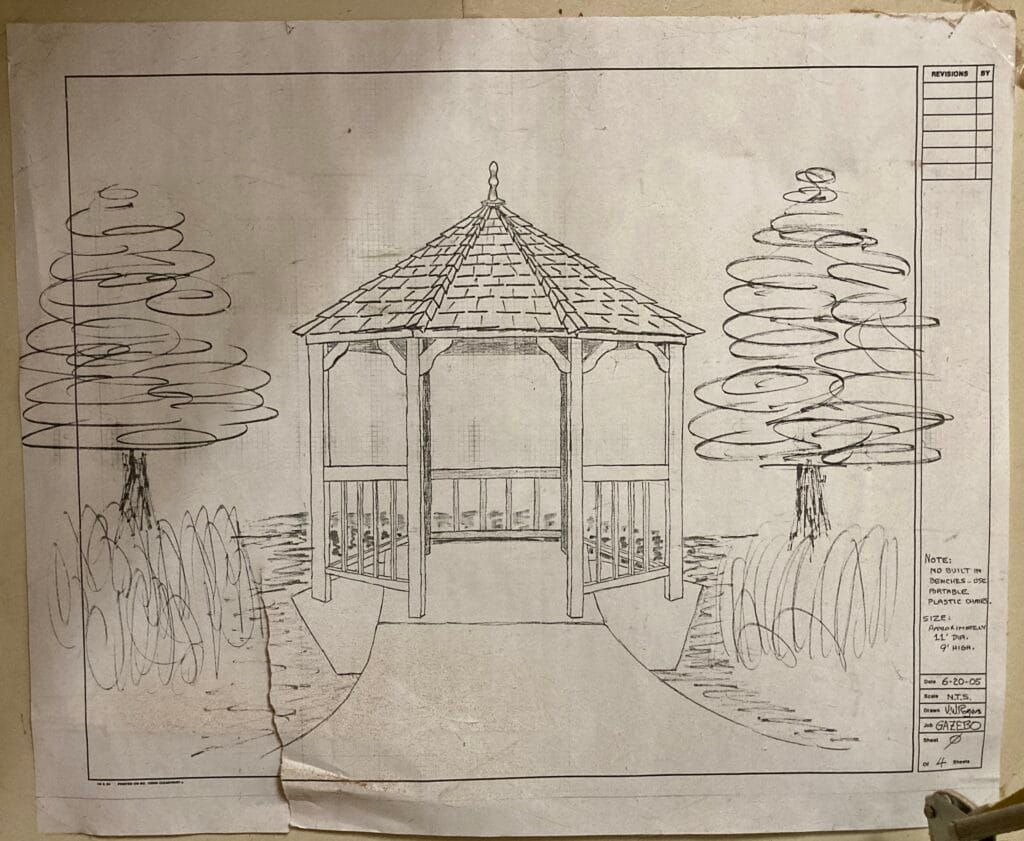
Volunteers in the Mountain Meadows woodworking shop made this lovely gazebo in the park.

A bocce ball court was constructed in 2001 at the east end of the park, near the community garden. It is currently the only formal outdoor “game area” of the community. I haven’t played bocce ball since I was a kid, but I know the game has been played at least since the days of the Roman Empire.


The landscaping company
Mountain Meadows community contracts with Bumgardners Landscape, a large local landscape contractor that takes care of natural spaces like Madeline Hill Park, pocket parks, park rows along streets, and front yards at most of the homes. It has been a close, mutually beneficial business relationship for several decades. In his committee role, Ogden Kellogg works closely with the landscape company. He had special praise for Bumgardners staff member Mya Gweke, HOA liaison and horticulture specialist at the company. For starters, she is very knowledgeable and very patient. Beyond that, Ogden appreciates her ability to find creative solutions to difficult landscape problems.
Largest Community Garden in town
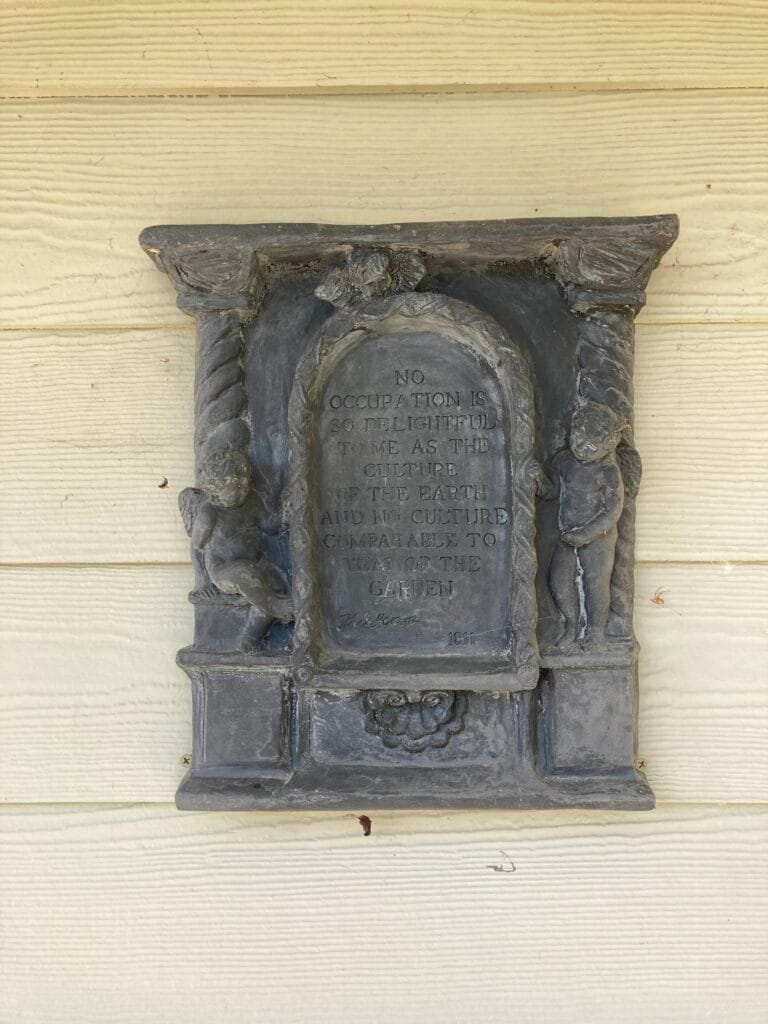
The garden artwork contains an 1811 quote by Thomas Jefferson.
“No occupation is so delightful to me as the culture of the earth and no culture comparable to that of the garden.”

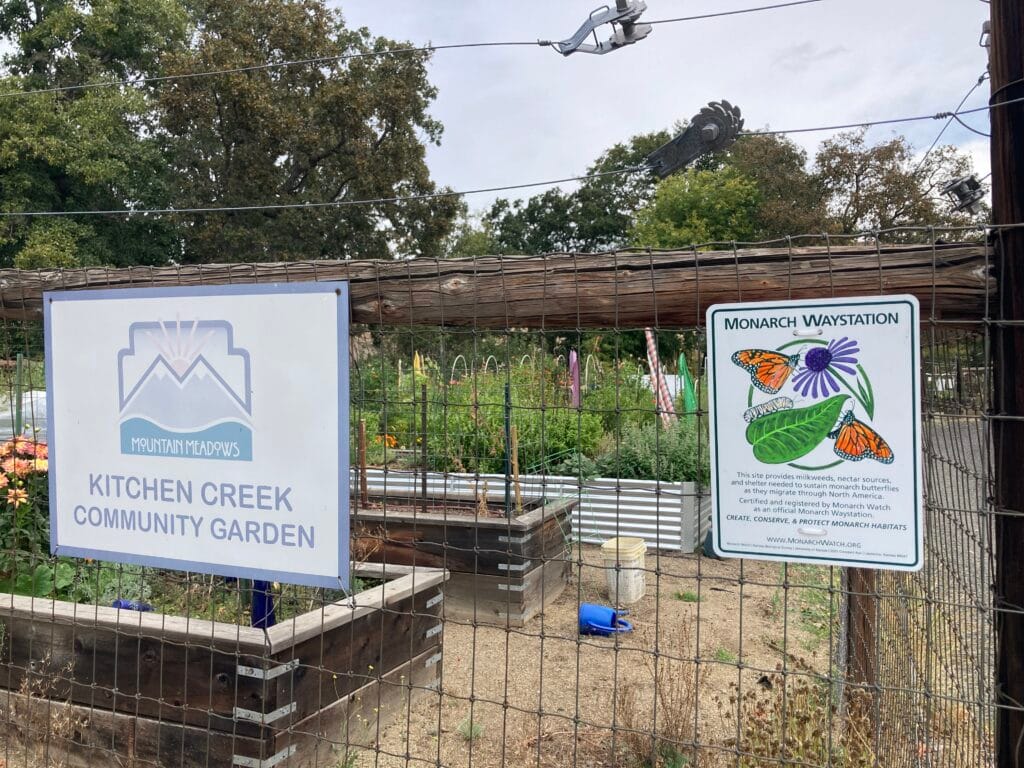
Mountain Meadows has the largest community garden in Ashland! Called the Kitchen Creek Community Garden, it offers 77 plots for Mountain Meadows residents to sign up for and tend. Kitchen Creek splits into two channels just east of Mountain Meadows, and the Community Garden is nestled between the two.
Ogden and I walked through the entire garden, which is quiet and somewhat bare in January. However, some residents tend a winter garden in their plots. Ogden is one, and he pointed with a smile to the still-thriving kale in his raised bed, which he picks all year for salads and stir fries. The entire community garden is lush most of the year, filled with both flowers and vegetables of all colors, shapes and sizes. I am impressed that all of the garden plots are set up with automatic drip irrigation lines.

Residents built the first half of the Kitchen Creek Community Garden in 1999, and added the second half a few years later. Here are some photos of the original raised beds being installed, and then replacements for worn out raised beds in 2014.


In additional to individual raised bed plots, larger plots are used to grow tomatoes and other vegetables. As we strolled through the garden, Ogden pointed with pride to espalier pear trees along the garden fence.
The garden includes a gathering place for gardeners to rest, talk and refresh with beverages as they tend their plots. It has also become a spot for small picnics.

As a side note, there are also community gardens in four city parks and at SOU. According to the city website, “The community garden at Ashland Creek Park is the largest of the four, with 45 plots available.” If this article inspires you, city residents can contact the Parks Department to get on a waiting list for a plot in one of the city’s community gardens.
Kitchen Creek


According to a topographical map of Jackson County, Kitchen Creek originates near Grizzly Peak at about 4,000 feet elevation. It flows most of the year, usually a narrow, gentle flow. At the east edge of Mountain Meadows, the creek splits into two channels. When the community was designed, Madeline Hill and the architects decided to maintain the two channels, using them as landscaping features. Both the community garden and central park area are located in the “island” between the two.
As a water source most likely hundreds of years old, Kitchen Creek is lined with trees and other vegetation. This has its advantages and disadvantages. Mountain Meadows residents watched with dread, as we all did, when the Almeda fire of September 2020 spread rapidly through the greenery and tree cover along Bear Creek from the west end of Ashland through Talent and into Phoenix. A major issue identified at that time was the profusion of blackberries along Bear Creek, often in thick and tall clumps.
This was a wake-up call for Mountain Meadows residents, because at that time blackberries also grew profusely along Kitchen Creek. In one area near the Community Garden, Ogden said the blackberry vines climbed 20 feet and higher into surrounding trees. In another area, he showed me dead remains of blackberry vines still lodged on branches 15 feet above the ground. The good news is that the blackberries in Mountain Meadows are almost entirely gone. It was a massive eradication effort for several years, and Ogden gave special recognition to the crews of Lomakatsi Restoration Project for their work.
After the two channels of Kitchen Creek flow through Mountain Meadows, they go under North Mountain Avenue and rejoin there as Kitchen Creek approaches its merge into Bear Creek.

Water reduction, Fire Wise and Fire Adapted
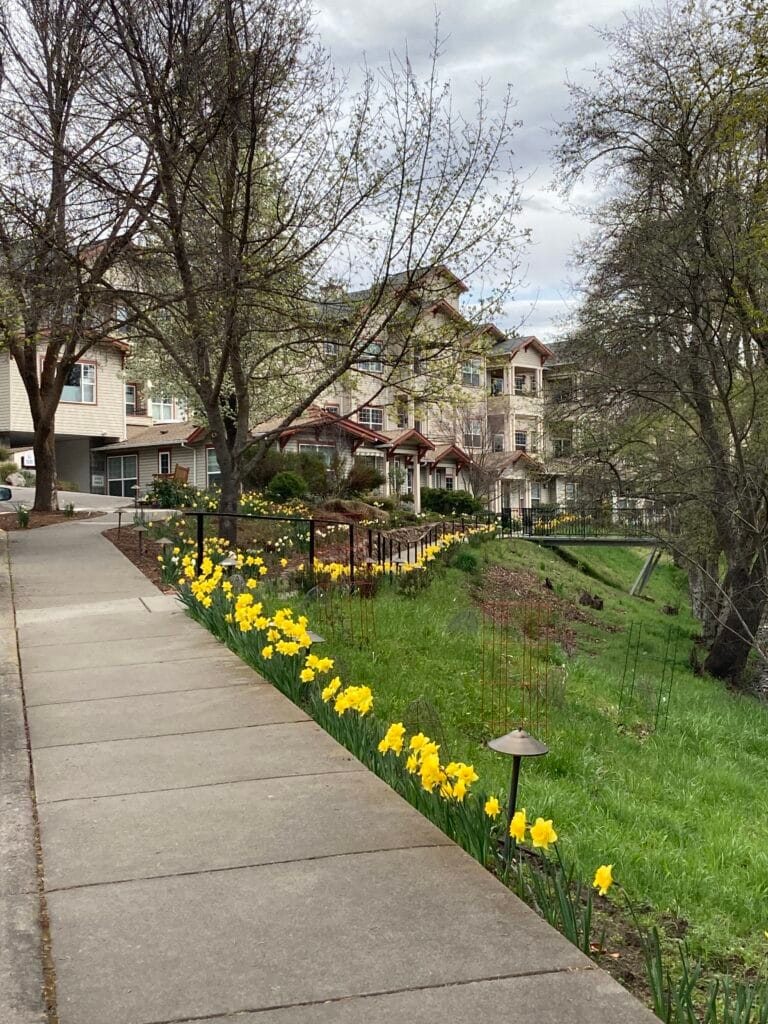
The ecologically aware residents of Mountain Meadows started a “water reduction task force” in 2013-2014. The park rows were all grass at that point, and copious water was needed to keep the grass green. Plus, half of the water intended for park row grass ended up in the street. Collaborating with Bumgardners Landscape, park row grass was gradually removed, and park row watering suspended. The upside was room for thousands of daffodils to be planted. Grass has also been removed from most front yards and pocket parks, leaving just a few lawn areas in all of Mountain Meadows. As a result of all these changes, the community has reduced water use by 60 percent (as of 2025). Not only does this save water, it also saves a lot of money for community residents.
With wildfires increasing across the West in the past couple decades, and then the devastating Almeda fire locally in 2020, another aspect of ecological awareness is reducing fire risk. This is challenging, because the lowest fire risk would be a neighborhood of houses that are surrounded by just sand or pebbles. Not very appealing! So we have to find a balance.
Ashland has been a “Tree City USA” for 40 years now. We have a thriving and continually growing tree canopy in most of the town, including in Mountain Meadows. And … trees next to houses, towering over houses, even between houses, are a fire concern. What to do? There are no easy answers.
The City of Ashland has a multi-faceted wildfire prevention plan. Here are five key recommendations from the “Fire Adapted Ashland” page of the city website.
- “Remove debris from critical areas: Remove leaves, pine needles, and other debris from the roof, rain gutters, from the base of walls, and on and under the deck.”
- “Trim tall plants and bushes growing directly under your eaves.” Preferably “at least a 6-foot vertical clearance between the top of vegetation and the bottom of eaves.”
- “Create proper spacing.” This refers to spacing between tree canopies and between trees and the walls and roof of the house.
- “Remove combustible materials.” Remove dead plants, fallen leaves and bark mulch from within five feet of the home. Replace bark mulch with decorative rock or leave as bare dirt.
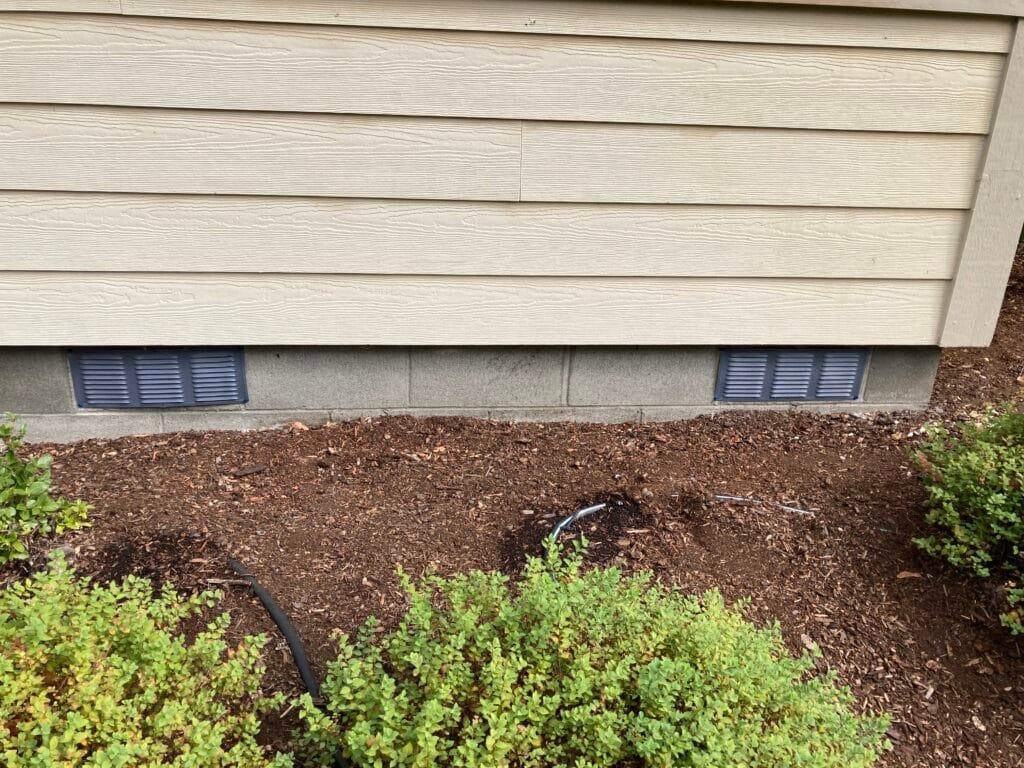
- “Install protective mesh: Cover exterior attic vents, soffit vents, and areas below decks and patios with 1/8″ metal wire mesh to block embers.”
The people of Mountain Meadows are working to improve in all of these areas. Basements and attics are being properly screened. When I walked the neighborhood with Ogden, he pointed out homes where 1/8″ wire mesh has been placed over larger openings.
One of the homeowner benefits at Mountain Meadows is that Bumgardners Landscape takes care of garden maintenance in most front yards and open areas, including removing leaves and dead plants.
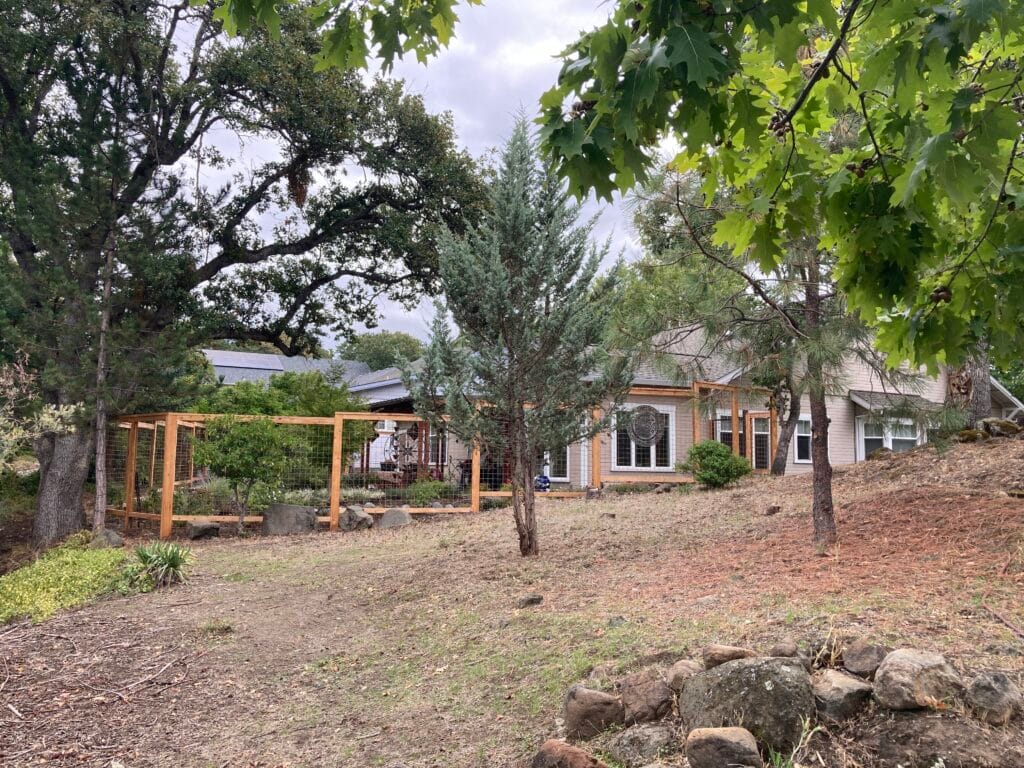
Some residents are replacing wood fences with metal fences to reduce fire risk. See photo below.
But when homes are close together, as in Mountain Meadows, eliminating greenery close to the houses would eliminate greenery all together on many streets. So then you get to “reducing” greenery between houses. Again, no easy answers. Residents here do take fire risk seriously, as they try to balance fire safety with the uplifting natural beauty provided by plants and trees. The Grounds and Natural Areas committee continues to research and discuss options small and large, as are other groups in Mountain Meadows.
“One time I went to a memorial service for somebody who had lived here in Mountain Meadows. Their family referred to this place as ‘the activist resort,’ which I loved.”
Tamsin Taylor
If you own your Retirement Community, it takes Work
Unlike most retirement communities, Mountain Meadows is owned and governed by the residents and homeowners.
Dozens of residents (at least) serve on a variety of boards and committees that keep the community surviving and thriving. The brochure dated March 2025 describes it this way: “At Mountain Meadows we own our homes, and with ownership we have the opportunity and responsibility of governing ourselves. As a planned community under Oregon law, our 226 homes, both single-family houses and condominiums, are individually owned and linked together by the Mountain Meadows Owners Association (MMOA). We are a self-governed community guided by our governing documents and led by the MMOA Board of Directors, made up of seven owners elected by all owners.”
The Board of Directors hires a professional management company to handle the day-to-day operations and management of the community. The Board also hires a landscape company, which was briefly described in this photo essay. Finally, the Board contracts with a third company for the operation of Food Services and the Dining Room.
When it was still being built, Mountain Meadows was already recognized as one of the best and most innovative retirement communities in the nation. The community received three major awards, all in 1999 when it was still in development.
*Best Small Active Retirement Community in America 1999
by the National Council on Senior’s Housing.
*100 Best Communities 1999
by Where to Retire Magazine.
*Grand Award – Best Senior Housing in the West 1999
by the Western Building Show.
In March 2026, Mountain Meadows will celebrate its 30th anniversary. Founders Madeline and Hunter Hill, as well as everyone who has been involved in building and improving the community during the past 30 years, should be proud.
To learn more, here are links to the other five Mountain Meadows photo essays.
References for the six-part series of photo essays about Mountain Meadows:
Ashland Daily Tidings, articles in multiple issues.
Atwood, Kay. “Mountain Meadows 1853-1995,” The Mountain Meadowlark, Winter 1994.
Bowman, Lee. Interview and walk, April 2023 and October 2025. Lee also shared some of his photos with me.
Craig, Joseph. “Thank you, Madeline,” Mountain Meadows News, October 2003.
Hayden, Curtis. “A Tour of Mountain Meadows,” Sneak Preview, September 30, 1996.
Hill, Madeline. Speech to Ashland Planning Commission, 1995 I think, Mountain Meadows collection.
Hill, Madeline. Interviews and personal communications, February, March, April, June 2025. Madeline also shared many photos and documents with me.
Hill, Madeline. “Madeline Hill, She Looks Ahead,” Stories of Southern Oregon video, December 31, 2019.
Hill, Madeline. “In the Beginning…Mountain Meadows Community,” interview with Shields Bialasik, Locals Guide, January 29, 2018 (I think).
Kellogg, Ogden. Interview and walk, October 2025 and January 2026.
Kotowski, Michael. Interview and walk, October 2025.
Luck, Jeff et al. “2023 Nursing Facilities,” Oregon State University College of Health, July 2024.
Mountain Meadowlark newsletter, articles in multiple issues.
No Comments