


25 Oct Honoring the Fire Department with public art on 9/11
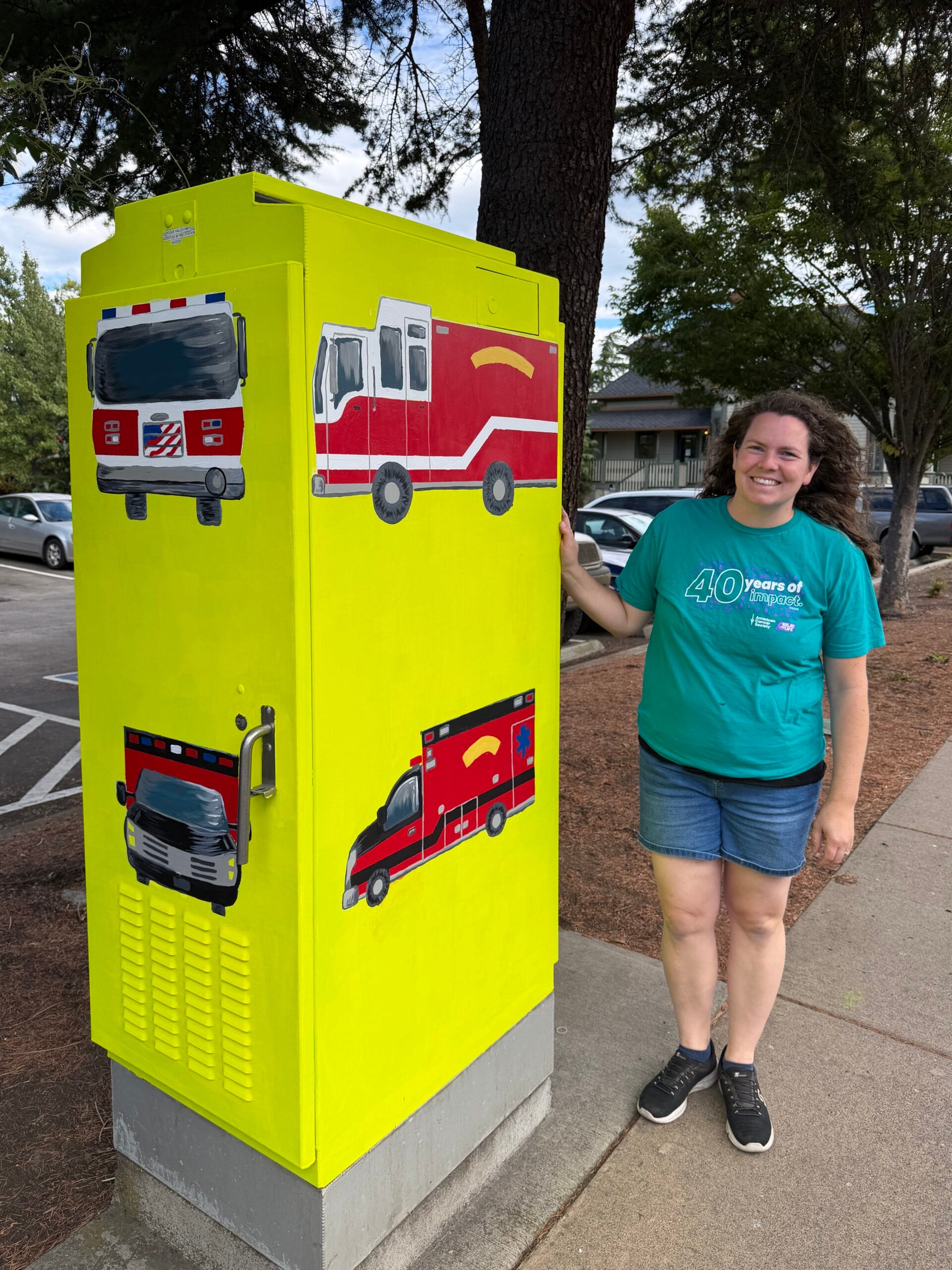
Traffic signal box art by Fire Station No. 1.
Painted September 11 and 12, 2026.
Artist Glory Nylander.
Includes 19 photos.
Published October 2026.
“September 11, 2026 started with an emotional tribute to the victims and fallen fire fighters from September 11, 2001. 25 years and the memory is still so clear. I can’t express what an honor it was to create a piece of public art with fire fighters, their families and community volunteers on this significant anniversary.”
Glory Nylander
Table of Contents
The “fire department” public art box
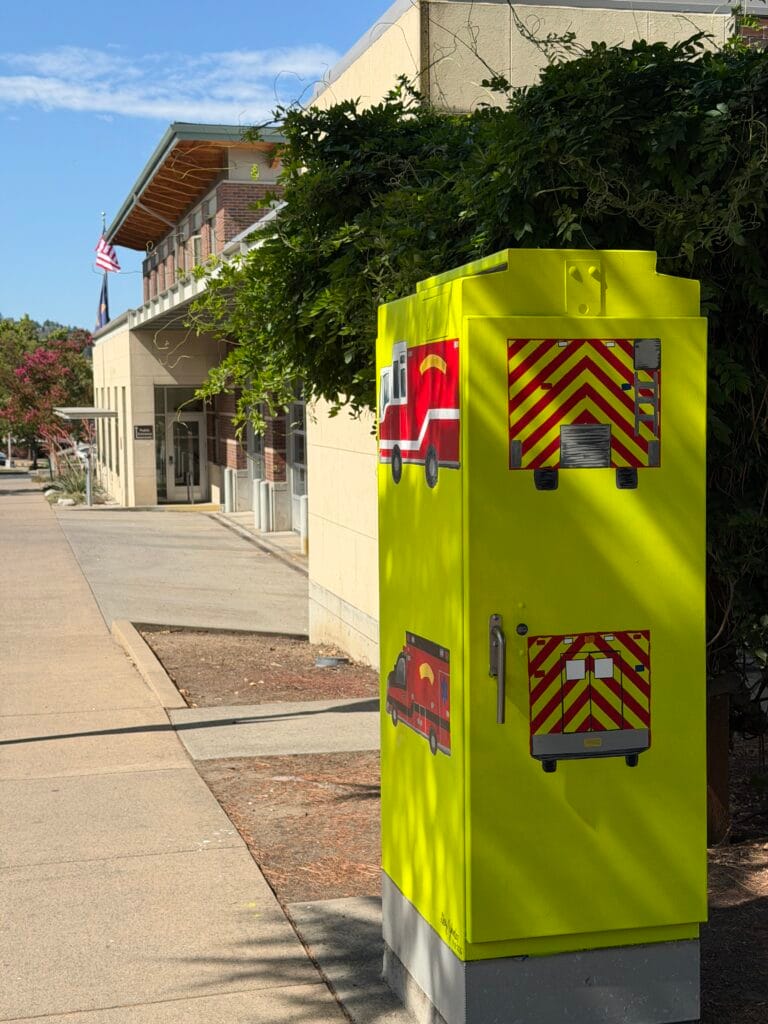
As artist Glory Nylander expressed in the quote above, this is a meaningful artwork for many reasons. The traffic signal box next to Fire Station No. 1 is one of about 20 of these boxes in Ashland. They are being painted with help from community members, to eventually involve several hundred adults and children in the creation of our local public artworks.
The “fire station box,” as I will call it, had an open call for artist designs in the summer of 2026. For this box, artists were asked to present a design that connected in some way with Ashland Fire and Rescue. A citizen Selection Panel chose Glory Nylander’s design, which she calls “Fire Engine & Ambulance.”
As Glory made preparations to paint the box, Gina Palmesano acted as a volunteer coordinator for families connected with fire department staff to assist with the painting. Gina is the wife of Ashland Fire and Rescue Battalion Chief Nick Palmesano.
9/11 ceremony at the fire station
Before I describe the fun process of painting the traffic signal box later that day, I would like to highlight two emotionally powerful 9/11 memorial events that were held at Fire Station No. 1 on the morning of 9/11/2026. The first took place on the small plaza and sidewalk area outside the station. Fire and Rescue staff were there, along with 30 to 40 community members.
Fire Chief Marshall Rasor spoke
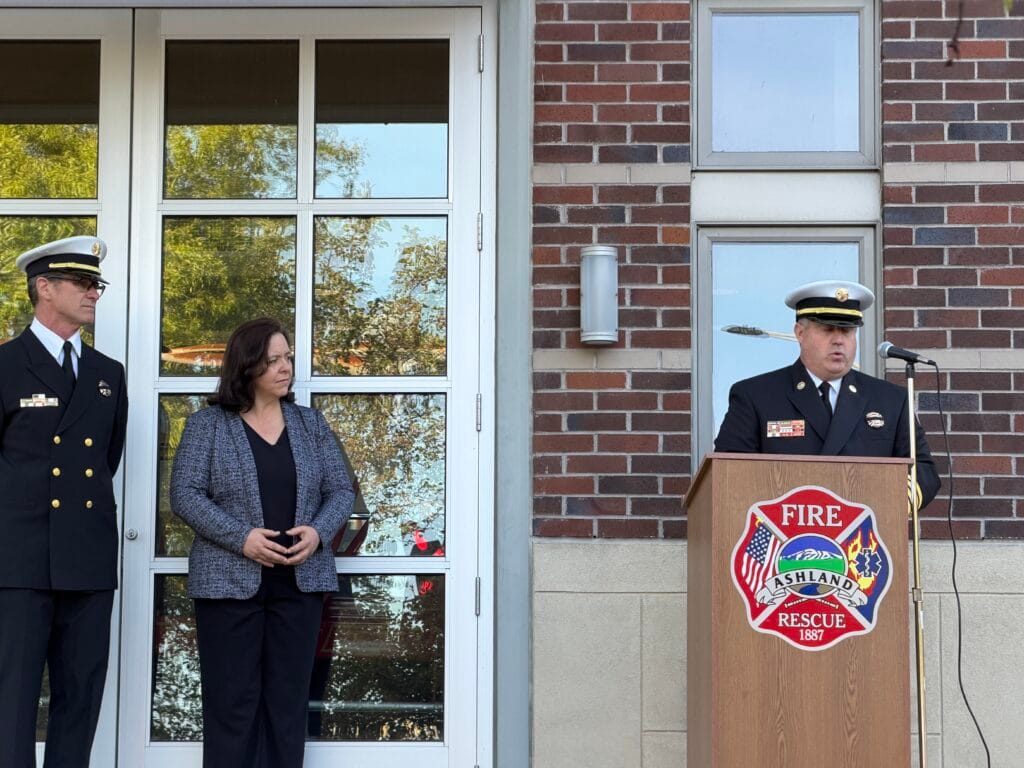
Fire Chief Marshall Rasor described what September 11 means to firefighters in Ashland today. “Nearly 3,000 people were killed that day. … Among those we lost were 343 members of the New York City Fire Department, 23 members of the New York City Police Department, and 37 members of the Port Authority Police Department. For those of us who are in the fire service, the actions of the firefighters who responded that morning hold a particularly significant meaning. As thousands of people were trying to find their way to safety, firefighters, police officers, paramedics, and other first responders were moving toward the danger. They climbed stairwells, carrying tools, hose, medical equipment. … They did not know what the outcome would be. They simply knew that people needed help.”
Towards the end of his talk, Chief Rasor brought the theme home to Ashland. “And perhaps one of the greatest ways we can honor them is by carrying that example forward. By continuing to serve our communities, by looking after one another, and never taking for granted their sacrifices on our behalf.”
Mayor Tonya Graham spoke
Chief Rasor introduced Mayor Tonya Graham. She told a story I have never heard, about the great boatlift of 9/11, when nearly 500,000 people were evacuated from the island of Manhattan in less than nine hours. She mentioned a 12-minute video, called “Boatlift,” that you can see on YouTube.
Like Chief Rasor, Mayor Graham also linked the memory of 9/11 with our lives in Ashland. “As we move through an era of ever larger disasters and increasing conflict between nations, we must also recognize that part of our commitment to this place we call home, is a commitment to do everything we can as individuals to be ready when disaster strikes. Not only to help ourselves and to reduce the strain on our first responders, but also to help our neighbors. To lean into community, to lean into resilience, to lean into love. I believe that’s the most important lesson we learned through the heartbreak of 9/11, to lean into love.”
9/11 artwork dedication
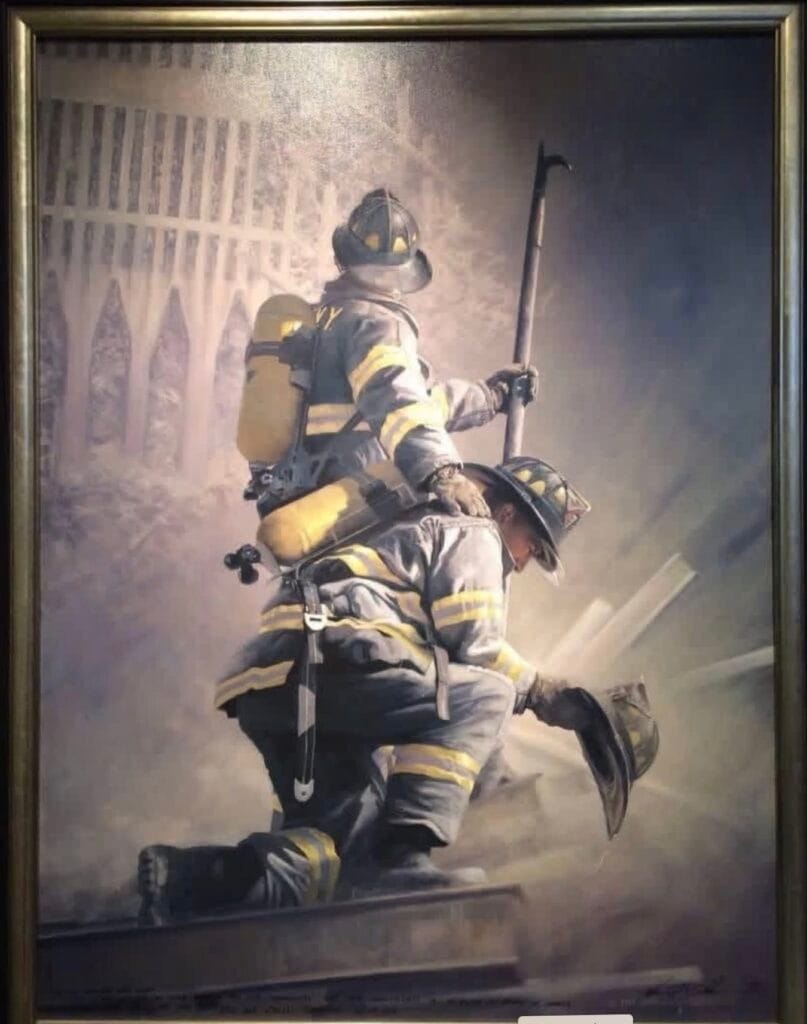
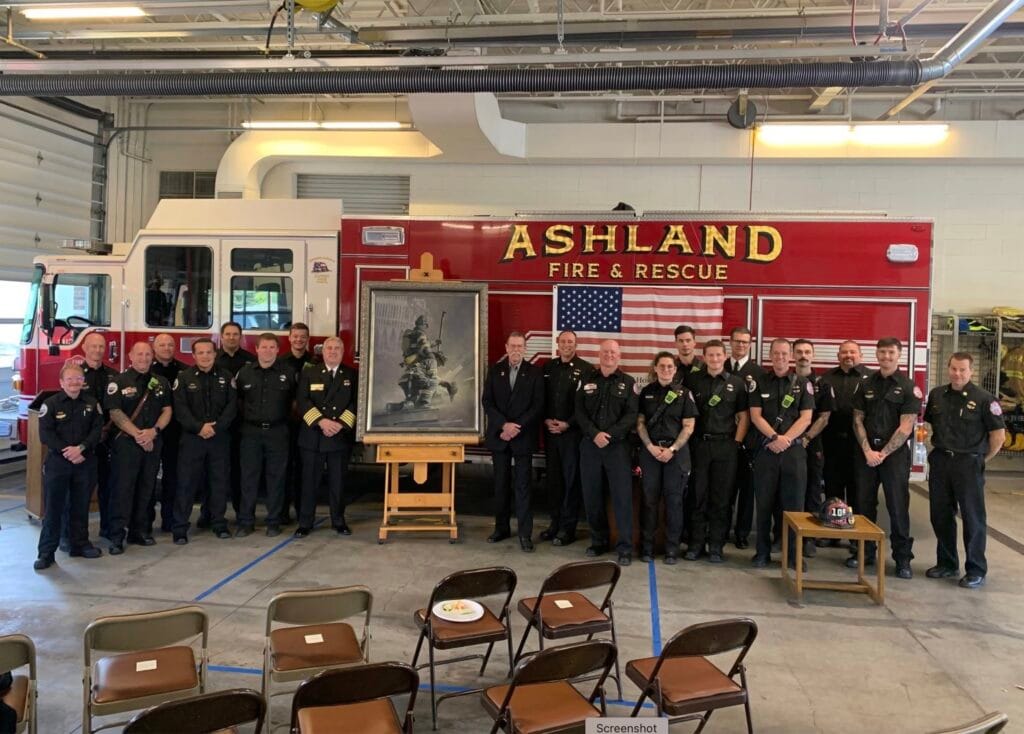
Following the outdoor ceremony, we moved indoors to the fire engine bay for a very special art dedication. Renowned local artist William S. Phillips is known worldwide for his aviation paintings. Channeling his grief after 9/11/2001 onto a canvas, Phillips painted “A Prayer for My Brother.” Copies of this powerful artwork hang in galleries and fire stations around the country. For the 25th anniversary of 9/11, Phillips gave the original painting to Ashland Fire & Rescue, saying, “I figured it would come home to where I started.”
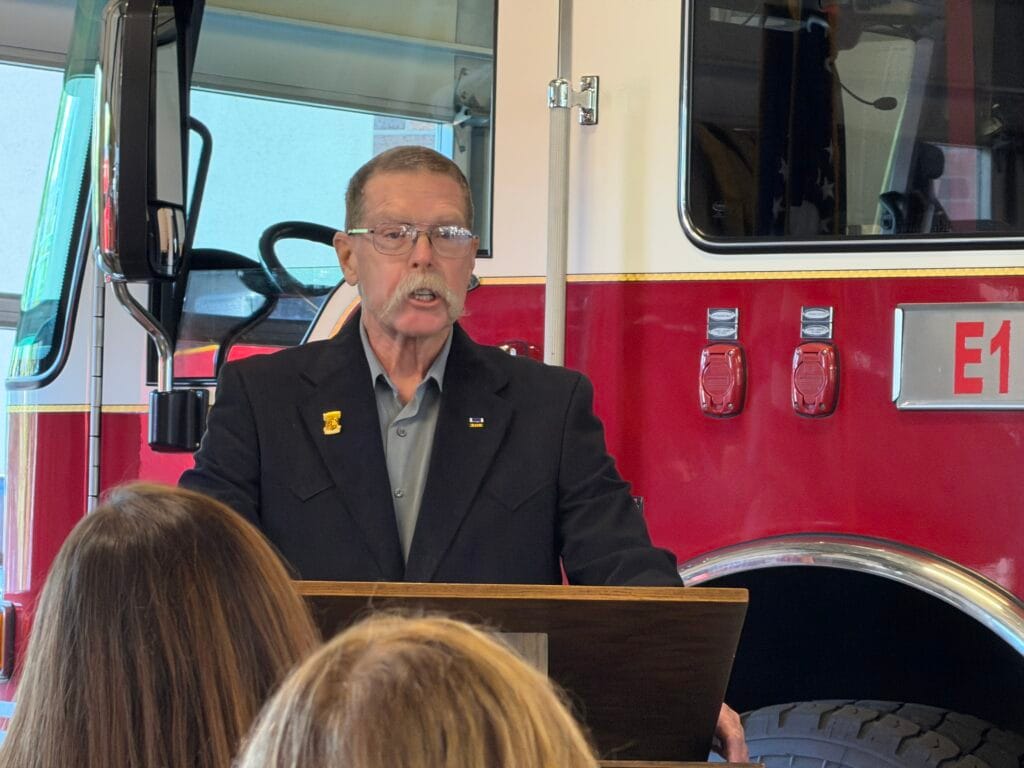
Phillips began sketching airplanes at age 12. As a young man, he served in the Air Force as a security police officer, continuing his art when off duty. After discharge, he came to Ashland and enrolled at Southern Oregon University (then called SOC – Southern Oregon College). He worked as a firefighter right here in Ashland for 12 years after graduation, and Ashland has been home base for him and his wife ever since.
A life-changing epiphany struck one day in 1971. He was allowed to hang four of his aviation paintings at the Red Baron Restaurant in the Medford Airport. As Phillips explained in a 1990 interview: “To my sheer delight, before I’d hung the third painting a gentleman sitting in the restaurant asked me if they were for sale, and bought all four for the grand sum of one hundred dollars.” He began to think of himself as a professional artist. The Ashland fire station job, working 24 hours straight, followed by 48 hours off, gave him the flexibility to hone his skills that would eventually take him all over the world as a painter.
The traffic signal box artist, Glory Nylander
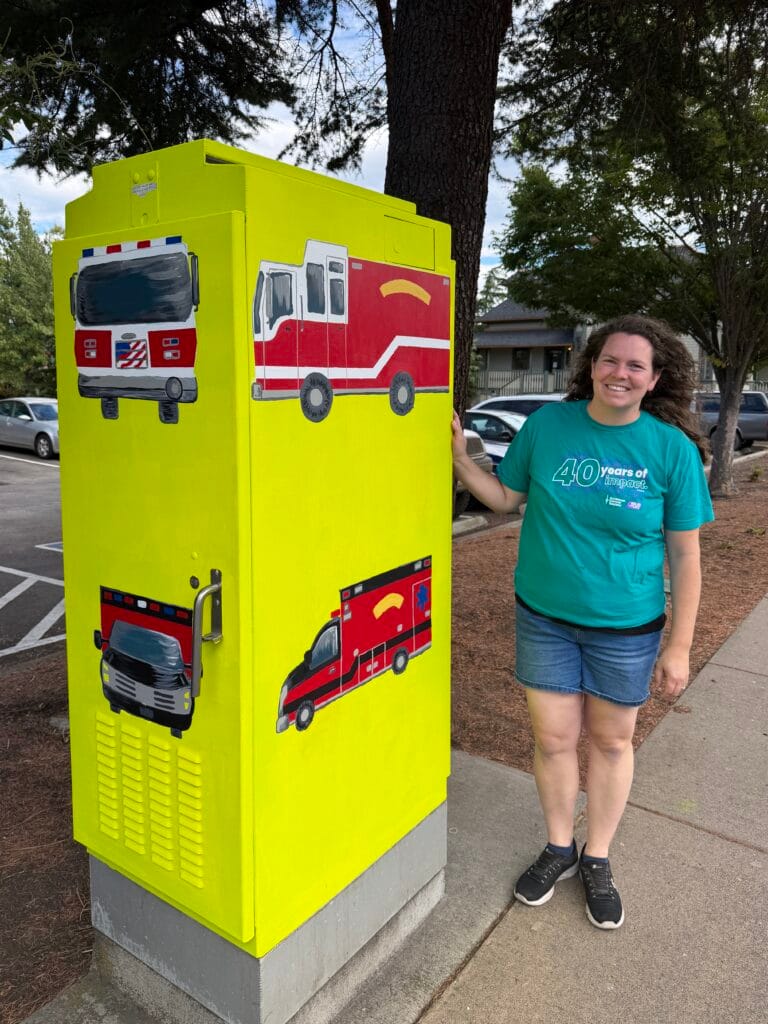
(photo by Peter Finkle)
“The design was inspired by my 3 year old son pushing his firetrucks around our living room. The caution tape yellow background draws the eyes of those passing by and matches the yellow stripes on the back of both vehicles.”
Glory Nylander
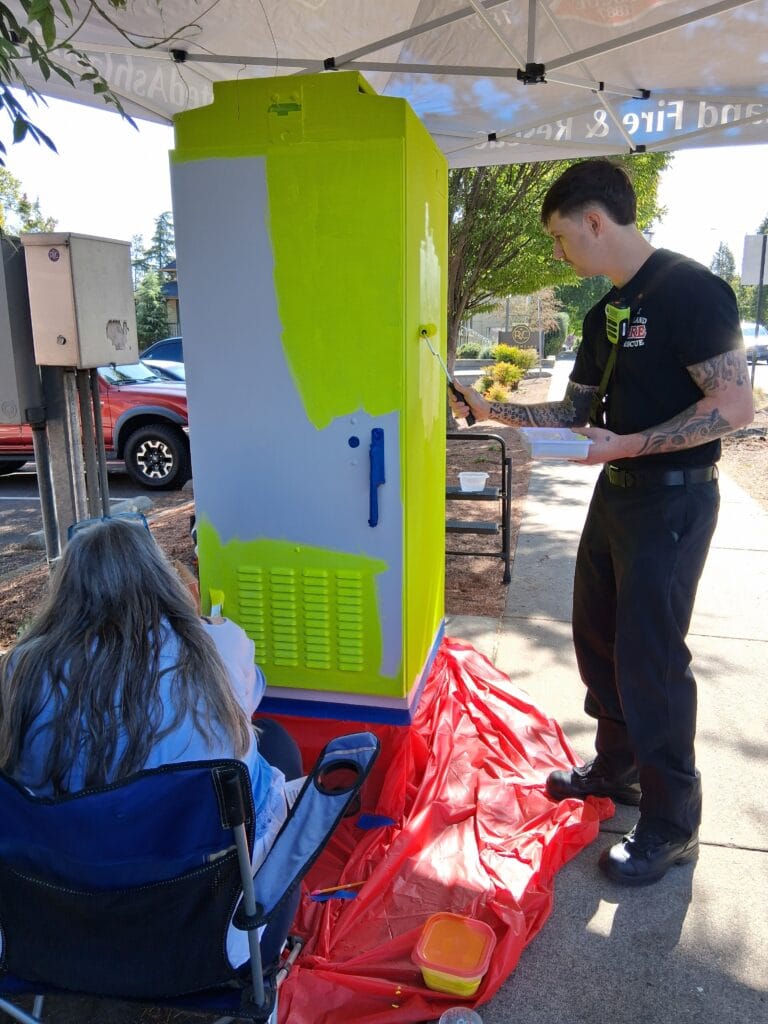
This brings us to the art being created September 11 and 12 at the traffic signal box right next to Fire Station No. 1. Glory Nylander describes herself as a “mural artist, singer/songwriter, graphic artist, writer and all around creative.” She is also a mom, wife and birth Doula. She and her husband Jordan have four young children and live in Longview, Washington, about an hour’s drive north of Portland.
“All around creative” is not an exaggeration. Here is a sweet story she told me. After her 5-year-old daughter fell in love with The Nutcracker ballet and started dancing to her own version of the Sugar Plum Fairy story when they got home, Glory boldly collaborated with her daughter to write a ballet together! It’s a sequel to The Nutcracker.
At her website, you can learn about Glory’s artistic side and her singer-songwriter side, including some of the worship music she writes for church. https://www.glorynylander.com
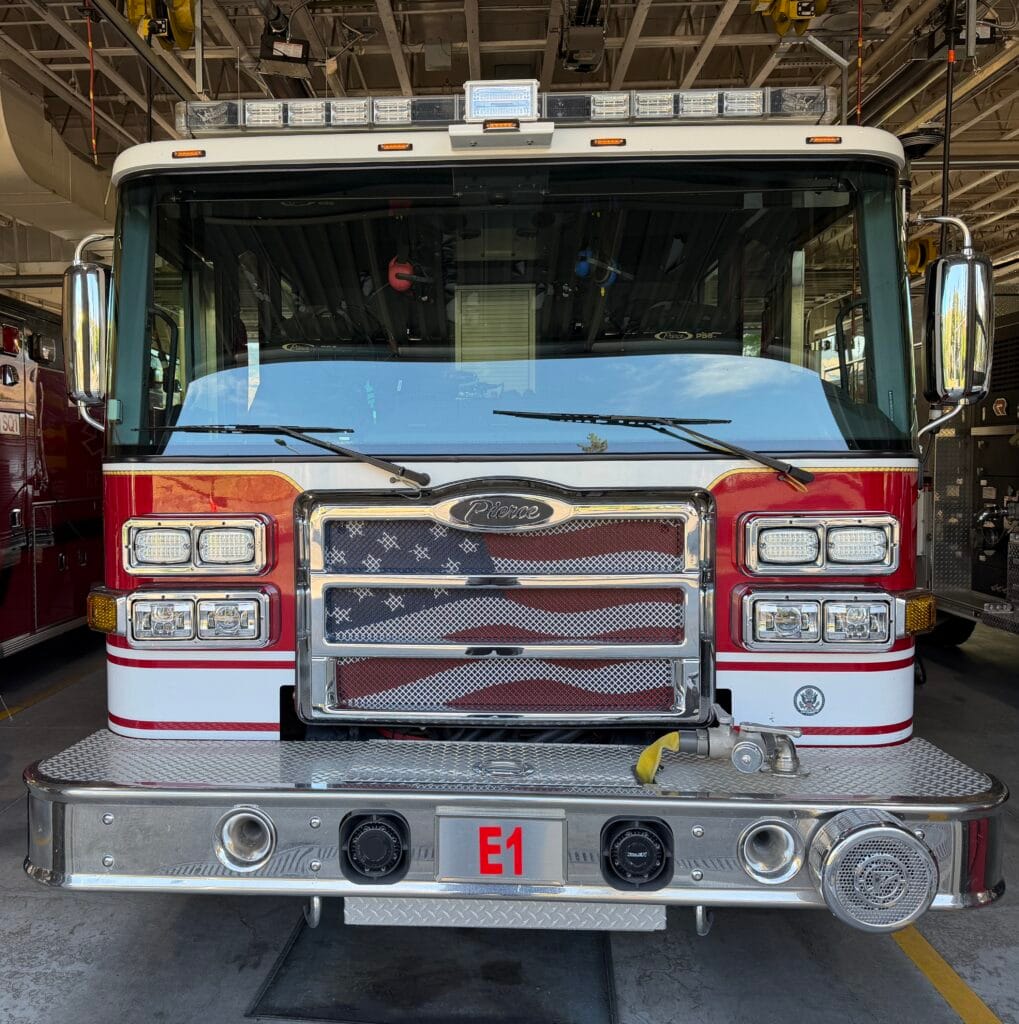
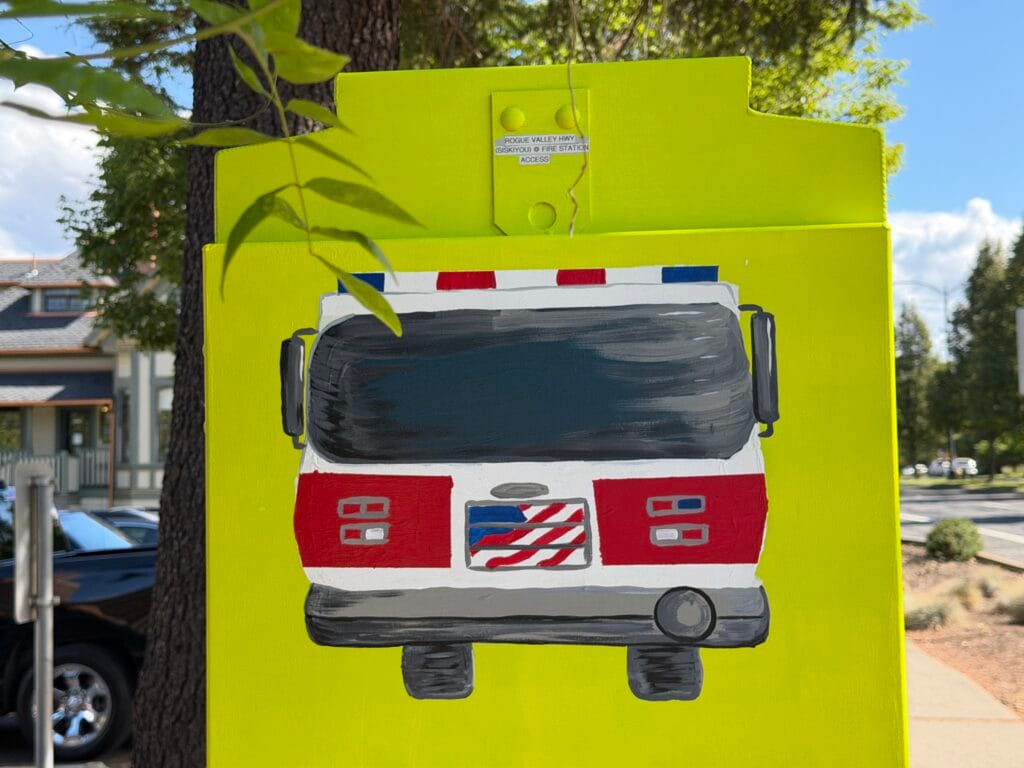
Glory Nylander and her family came to Ashland several weeks before the box was painted. She met Chief Rasor and several staff members. She did not want the fire engine and ambulance depicted on the traffic signal box to be generic. Her goal was to base her painting on a specific fire engine and ambulance. With cooperation from the fire department, she was able to do that. For one small example, see photos below of the front of a fire engine.
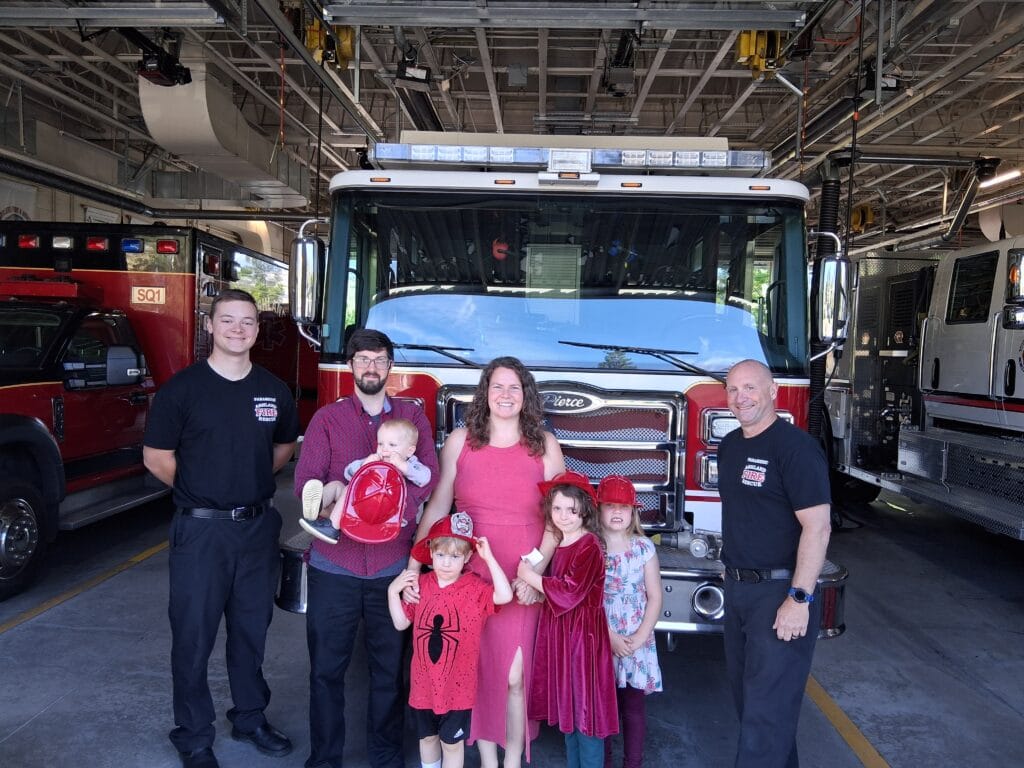
During that visit, the happy children and their parents posed for a photo with fire department staff.
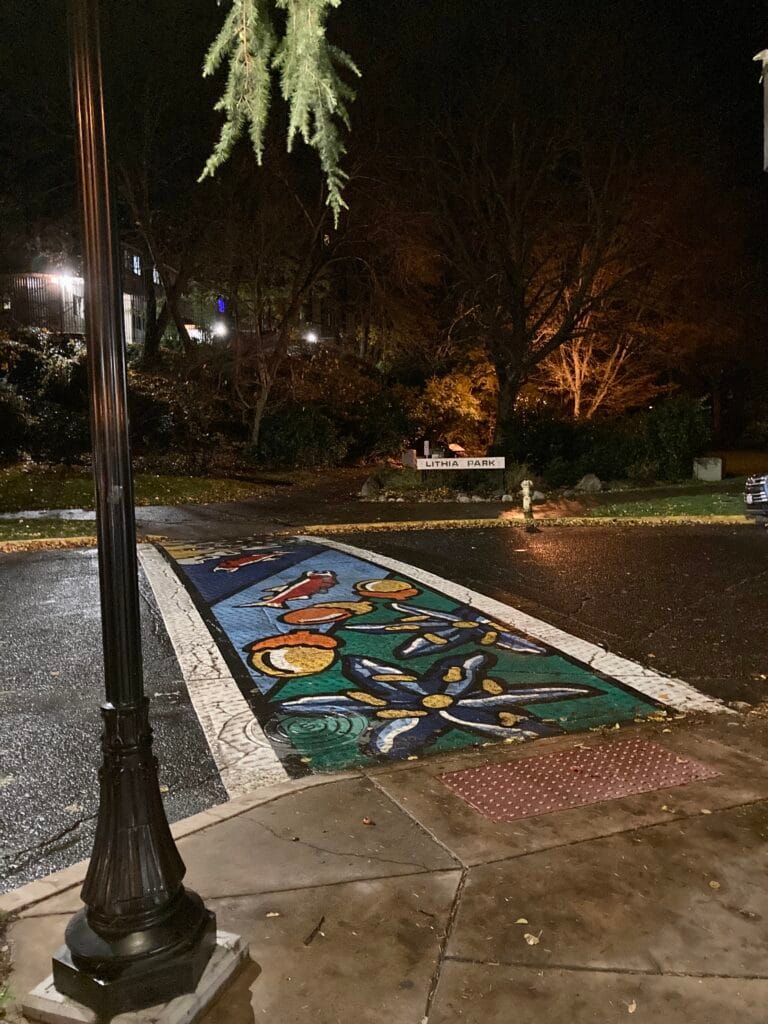
This traffic signal box is her second public artwork in Ashland. Glory designed the colorful crosswalk between the Plaza and the entrance to Lithia Park. Called “Walking Upstream,” the crosswalk art features foods of the Shasta people who lived here before the pioneers arrived.
See a photo essay on my website about the crosswalk artwork, plus more about Glory, here.
“The painted traffic box honors the local first responders. The fire engine and ambulance that are painted on the box are inspired by the unique vehicles at Ashland Fire & Rescue Station No. 1. I hope it is a bridge between the firefighters of Ashland, the community and the kids that love firetrucks and might someday become firefighters themselves.”
Glory Nylander
Who painted the public art box?
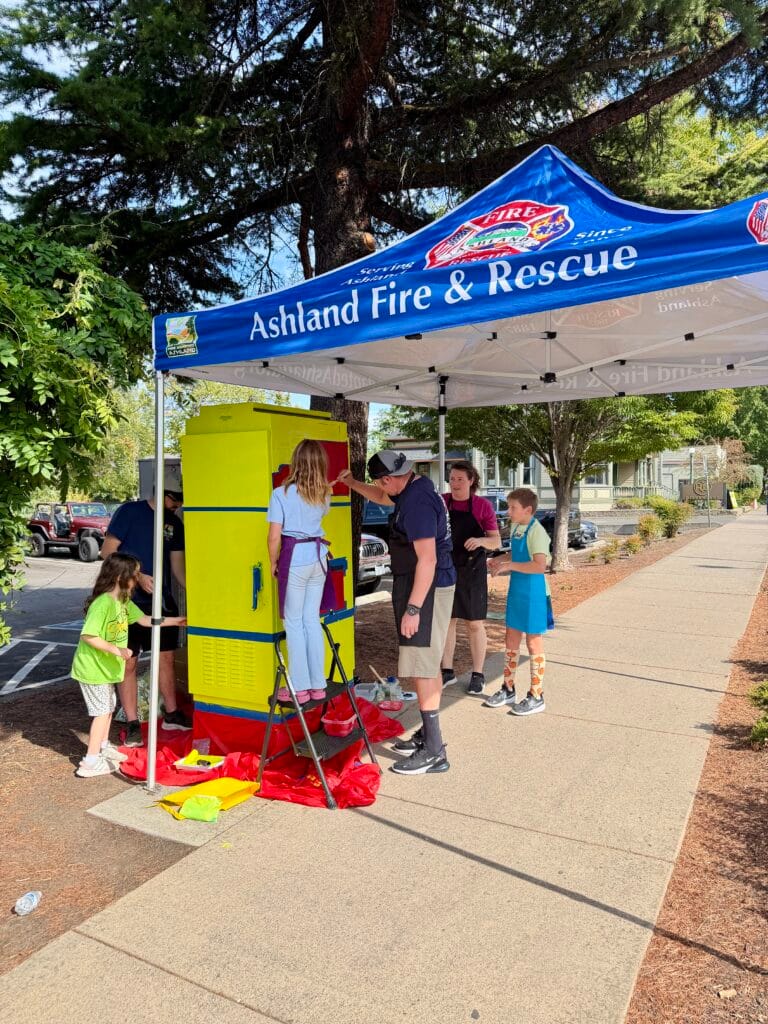
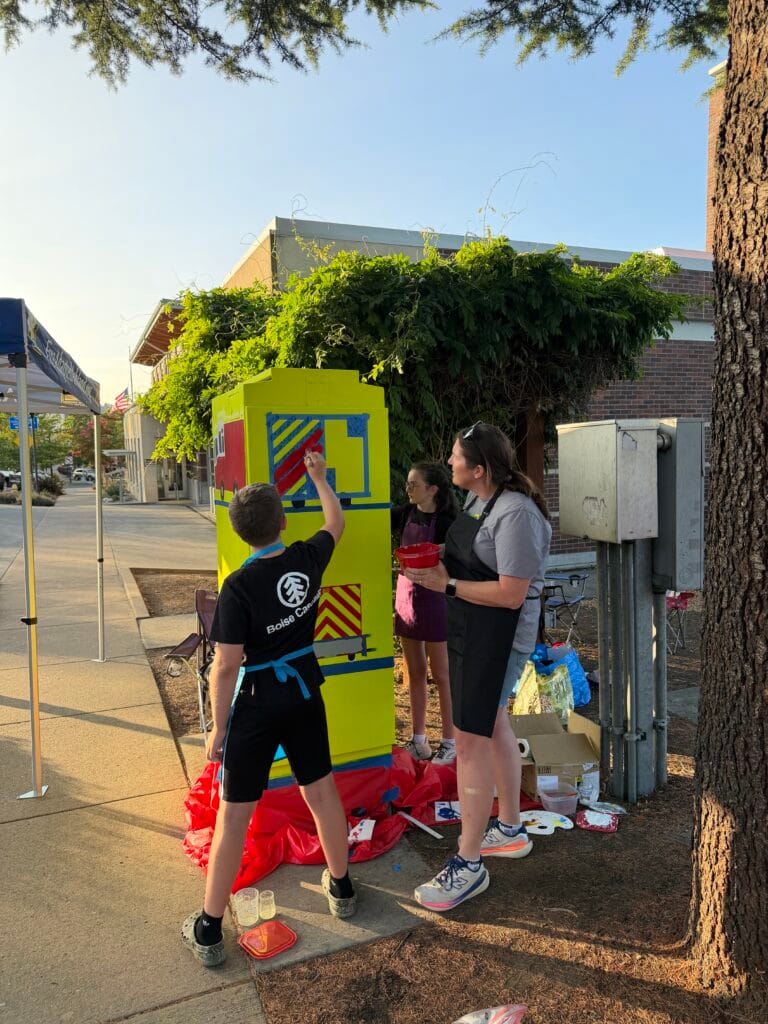
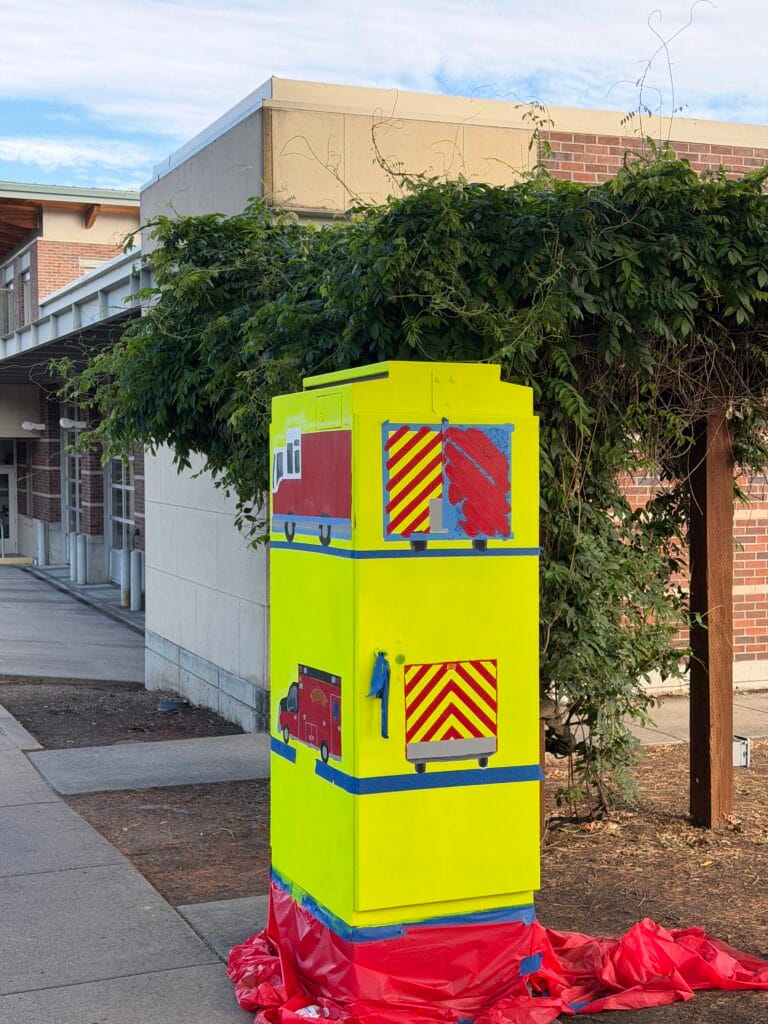
Painting this traffic signal box was both a community and family painting adventure. Two Ashland firefighters, Jacob Bergren and Nick Palmesano, helped on the first day. Nick’s wife Gina and their children Gus and Ellie added many brushstrokes. Gina’s sister Katie was part of the team, with her children Molly and Connor. Another family that painted was parents Justin and Molly, with their children Linnea and Gayle. When neighborhood resident Molly happened by with her husband Wu and their memorable Puli dog, she offered to help paint. I was there for about 10 of the 15 hours it took to paint the box, so I also picked up a brush multiple times and I feel the joy of contributing to the artwork.
The family part of the painting adventure was multi-generational. Glory’s family was here in Ashland with her. Her husband Jordan and three of their four children helped out. That’s two generations, but there’s one more. Glory’s mom Lorrie and her step-dad David contributed both child care and brush strokes.
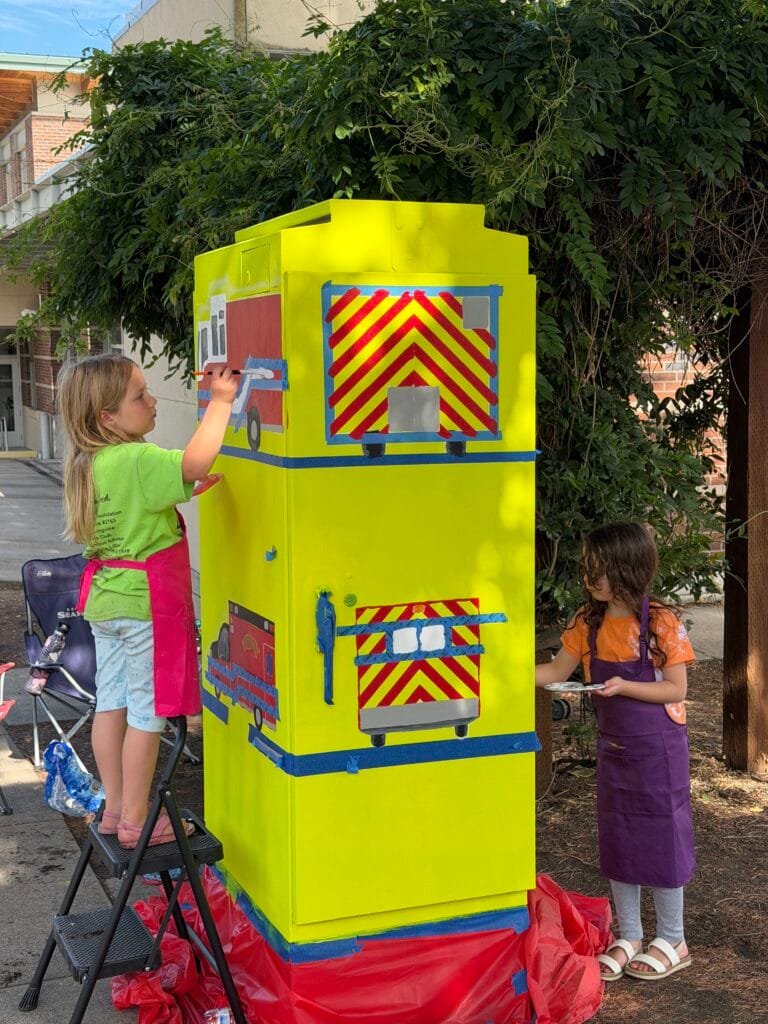
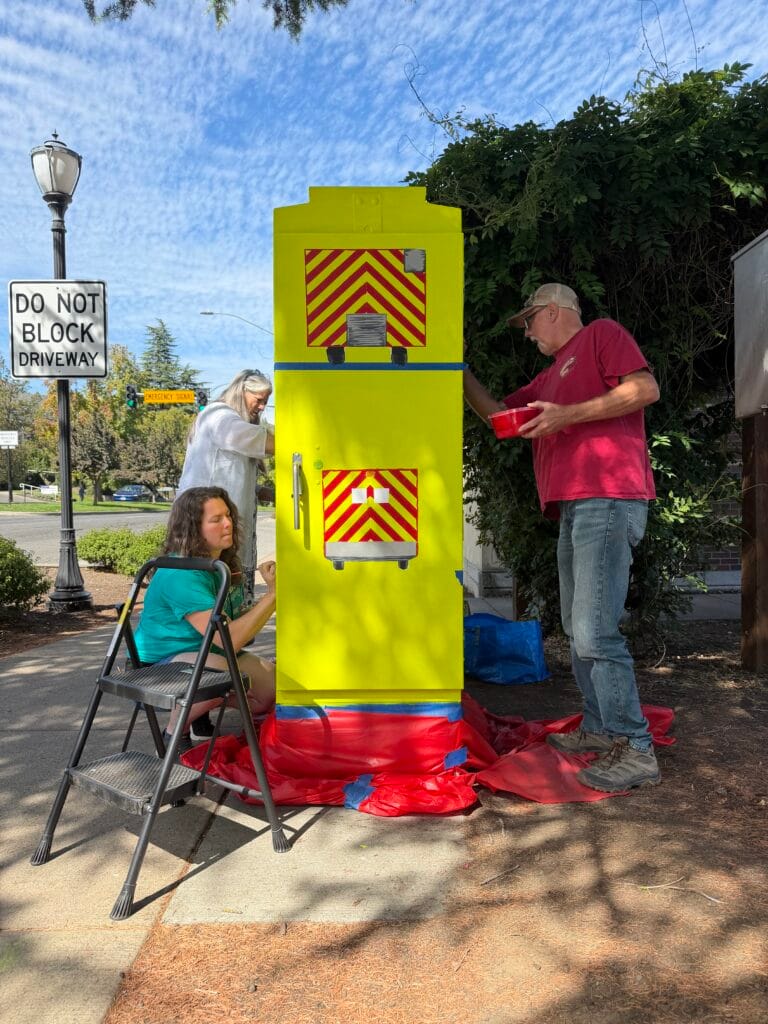
Creating art with community involvement is very different for an artist than working alone in the studio, or even painting alone in public. Having many participants is both a blessing and a challenge. Here’s how Glory put it. “The community involvement in this project drastically changed my role as a public artist. I went from “mural artist” to ‘art teacher’ and ‘project manager.’ I spent more time instructing others on art techniques such as painting on an upright surface, taping out straight lines and the different brushes and how to use them than painting. It was an interesting paradox of being the leader in the project while simultaneously ‘taking a back seat’ as others actually painted a good portion of the box.”
How can we increase appreciation for public art?
“I hope the box is a blessing to the entire community of Ashland. This signal box will be sealed and set to accompany the firehouse for years to come. Each person who worked on it will be able to see their work and remember the part they played in painting this box.”
Glory Nylander
Most public art, by its nature, is visible in our daily lives. We drive by and walk by public artworks day after day, year after year. I bet most of us take for granted the hundreds of artworks in the city, SOU, public schools, Parks Department and Ashland Library collections.
How often do we really notice each individual artwork, let alone appreciate it or feel an emotional connection with it?
I like what Glory said in her quote above: “Each person who worked on it [painting the box] will be able to see their work and remember the part they played in painting this box.” She tuned in to one of the goals of Ashland’s Public Arts committee. For years, the committee has discussed ways to make public art more meaningful for both residents and visitors – beyond a superficial response like “Oh, that’s nice” or “I don’t really like that one.” One approach being tried is community participation in painting the 20 or so traffic signal boxes in town.
Having a mix of children and adults paint this box made it extra special. Also meaningful was a mix of fire department staff and their extended families, along with other community members and the family of the artist.
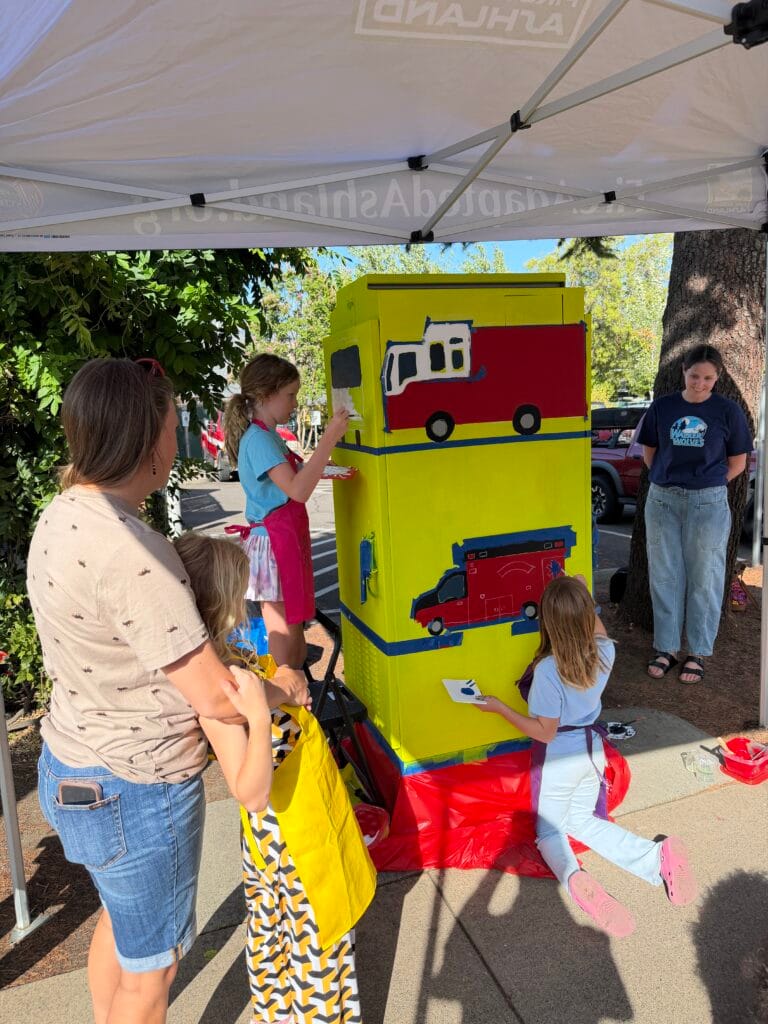
There is something special about dipping a brush into thick red or white or black paint, then carefully applying that paint to a mural – in this case the fire engine and ambulance designs on a metal box right next to busy Siskiyou Boulevard. If you look at the design, there are many small and large blocks of color. With 20 helping to paint, everyone had several places to “make their mark,” so to speak. With proper maintenance, the artwork could still brighten Siskiyou Boulevard 50 years from now.
Here’s an example I witnessed: A middle school age boy who had painted Friday afternoon came back in the evening with a friend. He brought his friend over to the box and proudly pointed out, “I painted this section.” Perhaps he will bring other friends to see the box in coming years. Perhaps – and I base this hope on what I was told about art at Helman School – he will bring his children here in 15 or 20 years and show them where he painted.
Glory noticed another way the children who helped brought their emotions to the art project. I will give her the last word.
“A highlight is the children that painted, asking what else they could do — and when the day of painting came to a close, they stood by the busy street asking for cars passing the station to honk their horns. The joy of this project will be remembered for a long time!”
Glory Nylander
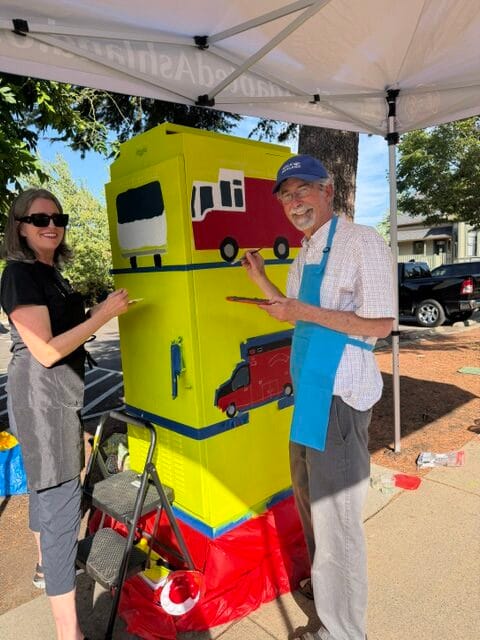
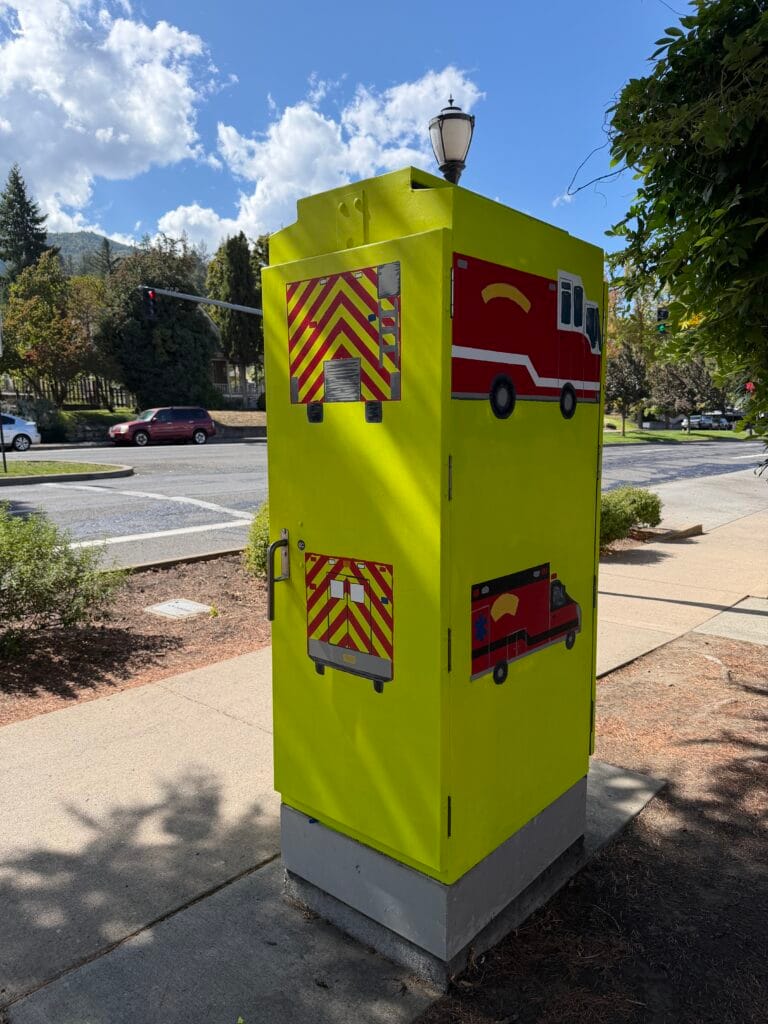
help painting from 9 children and 11 adults. (photo by Peter Finkle)
References:
Anon. Ashland Fire & Rescue, Facebook page.
Corbin, Luana (Loffer). ” As It Was: Artist Mixes Aviation and Art for Unusual Career,” As It Was, Jefferson Public Radio, April 3, 2019.
Nylander, Glory. Interviews and personal communications, 2024 and 2026.
Tillman, Barrett. “In Profile—William S. Phillips, ” Naval History, August 1990, Volume 4 Number 3.
https://www.usni.org/magazines/naval-history-magazine/1990/august/profile-william-s-phillips
No Comments