


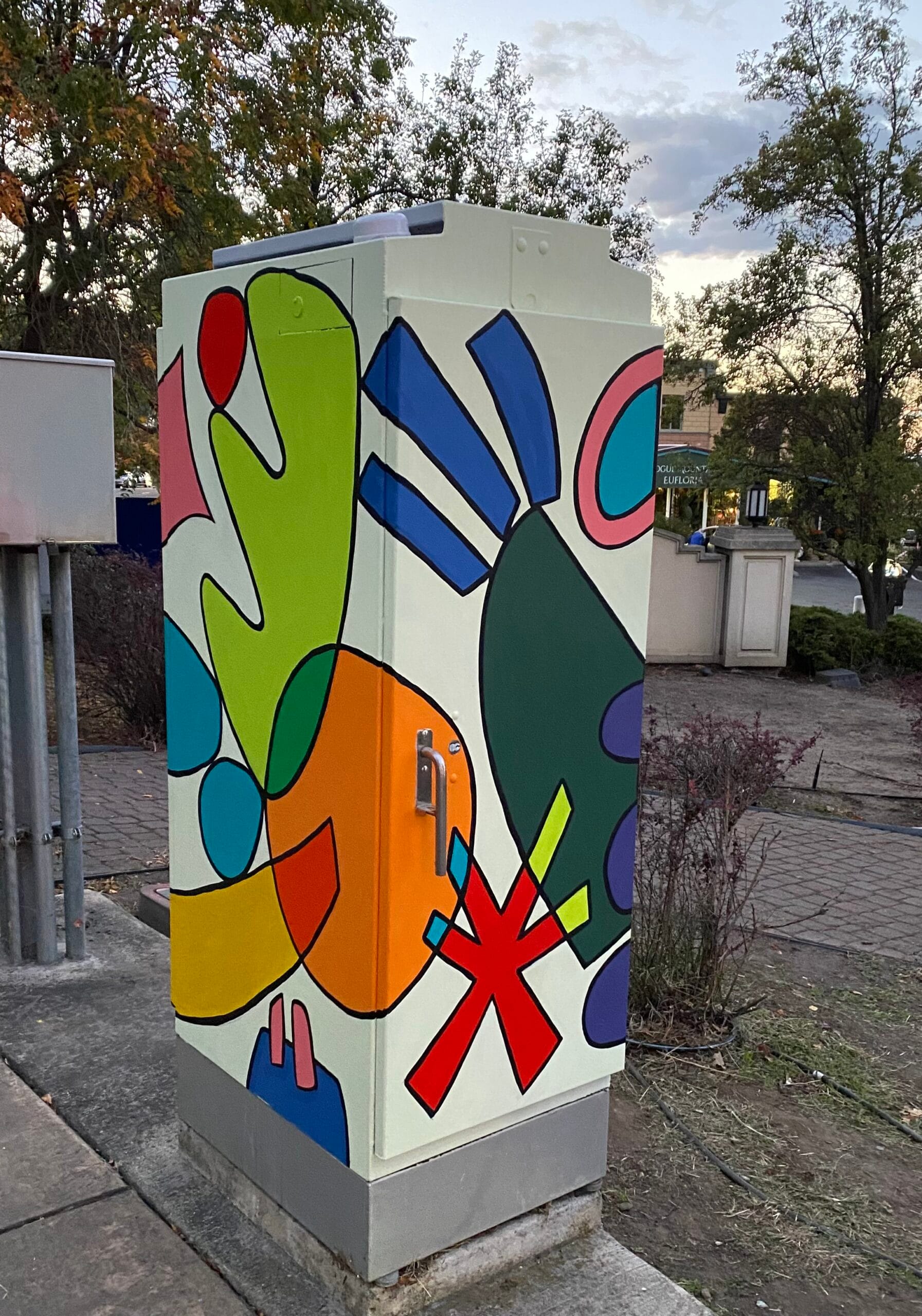
09 Nov “Happy Making:” bold community-assisted Ashland public art
Traffic signal box art between
Ashland Library and Fire Station.
Artist Jennifer Alexander.
19 photos.
Published November 2026.
Table of Contents
“We had really amazing community response. People really enjoyed watching the live painting happen. People driving by kept shouting out, ‘Thank you for making Ashland beautiful.’ Some parked their cars and came to see what we were doing.”
Heather Warden
We drive by traffic signal boxes so often that they become nearly invisible when painted light gray, as most have been in Ashland. On the flip side, when painted with bold colors and designs, they become some of the most widely noticed and appreciated public art in town.
What a great place for an uplifting public artwork!
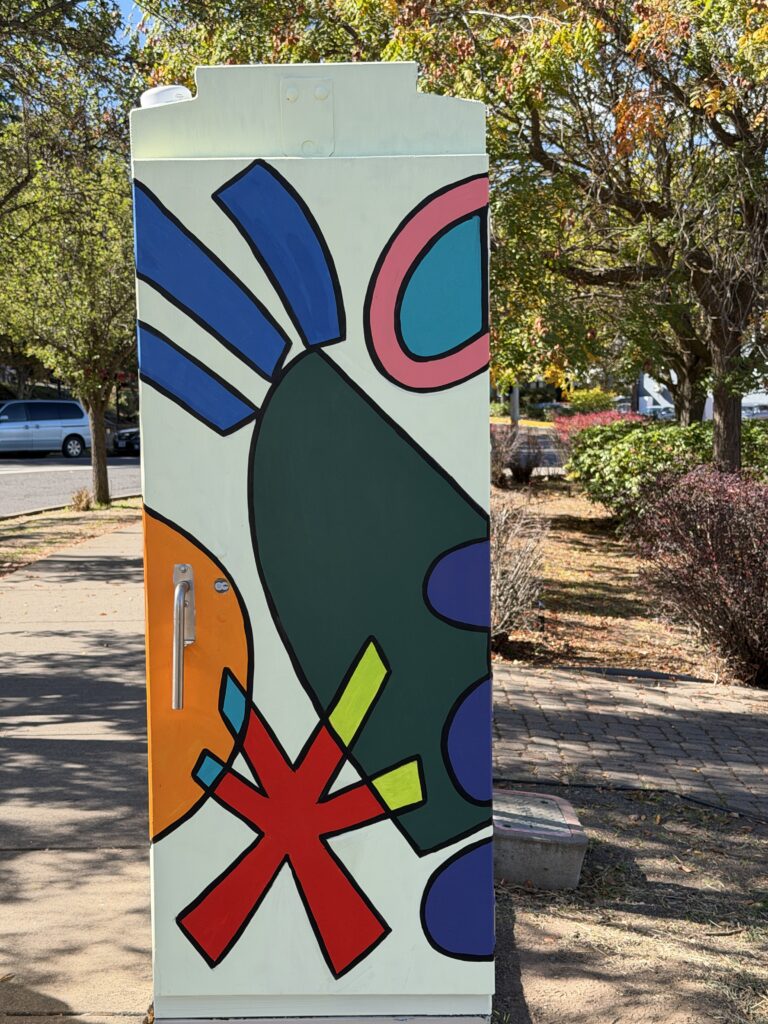
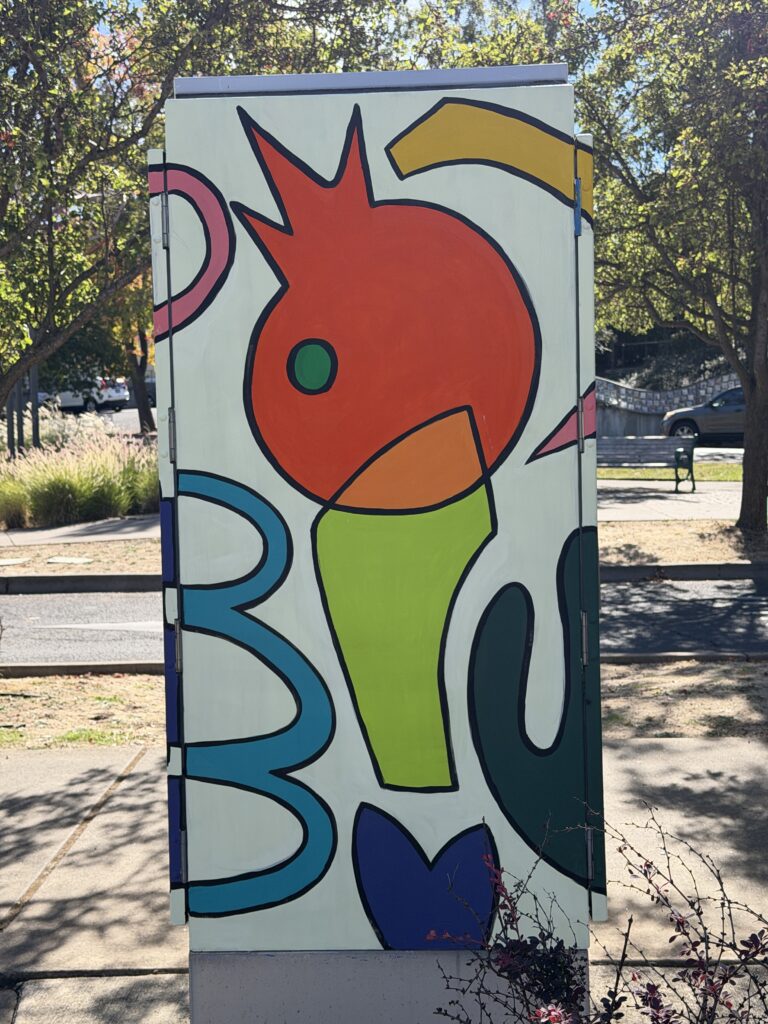
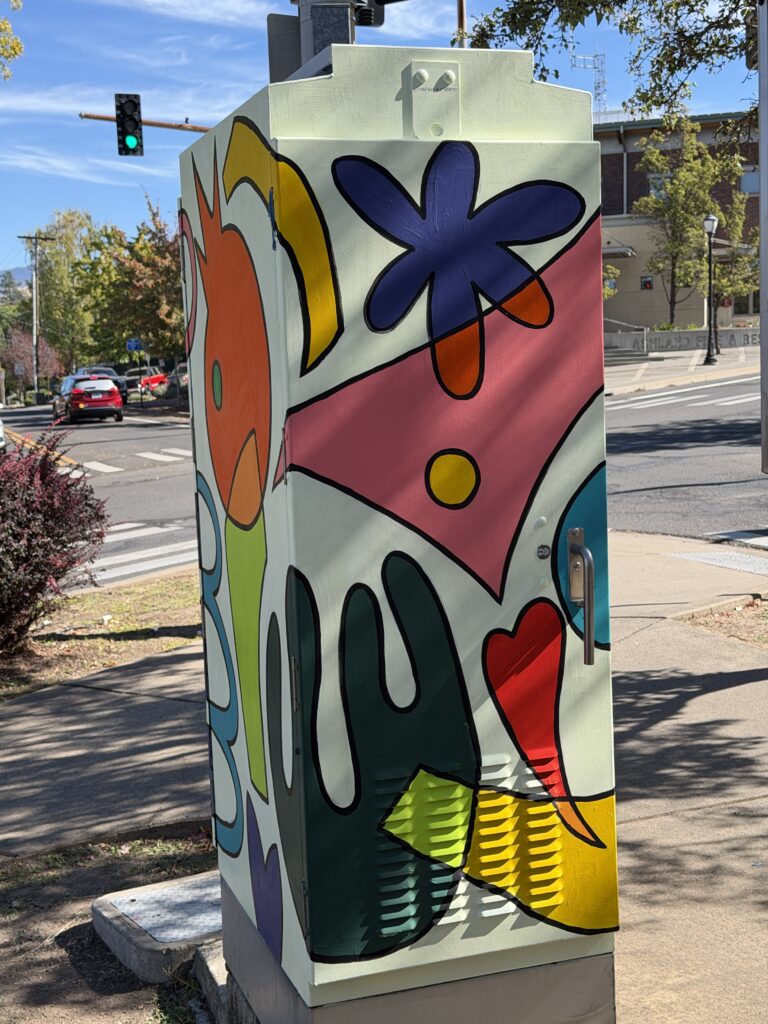
You will find this artwork by Jennifer Alexander, called “Happy Making,” where East Main Street, Lithia Way and Siskiyou Boulevard all meet. It is near the Ashland Library, Fire Station No. 1 and the Astro gas station. This is surely one of the most widely traveled intersections in town.
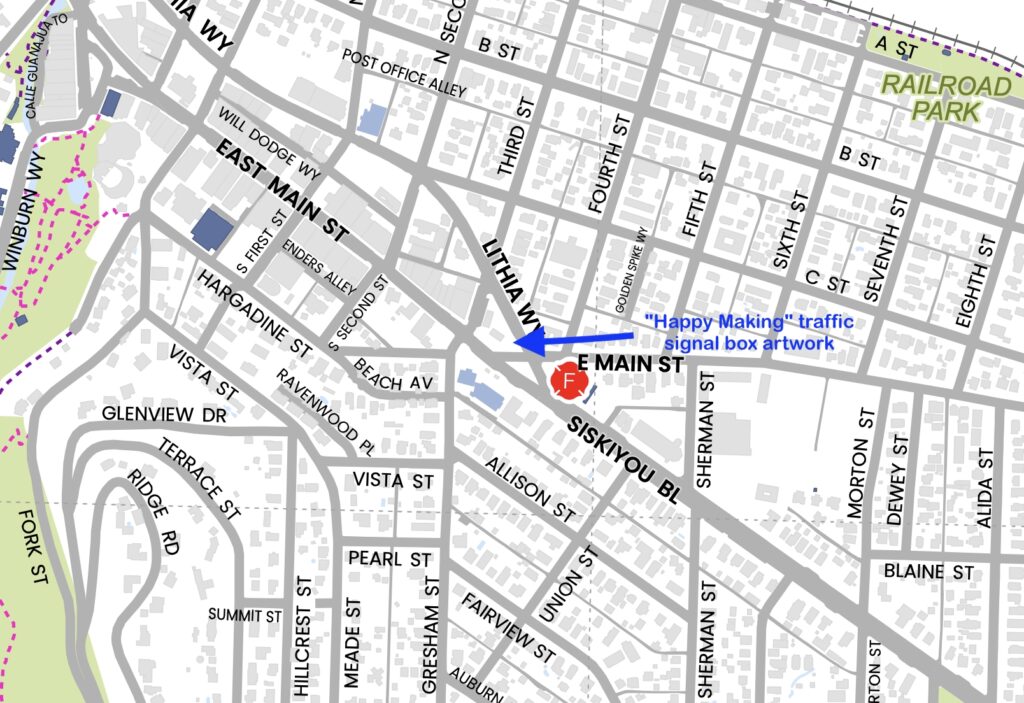
“Happy Making” is one of about 20 traffic signal boxes in town that are being painted as part of a multi-year public art project. One goal is adding to the beauty of Ashland. In Heather Warden’s quote above, she describes her first-hand experience hearing from people who thanked the painters for doing just that. Another goal is to increase our local residents’ appreciation for public art on a personal, emotional level. Ashland’s Public Arts committee has a goal for community youth and adults to assist artists in painting these now-visible boxes. For everyone who participates, and perhaps for some of their family members and friends as well, public art can become more personal – as in, “I helped create that.”
As Heather put it to me: “I think it’s worth the effort to get people involved. I feel the more that people are involved in things, the more they will feel some pride. Then they will look after the community, and look after artworks; you might say, be more likely to make sure things are taken care of.”
Artist Jennifer Alexander: “You converted my thinking.”
“I want to emphasize that it really makes a difference, actually painting the boxes instead of wrapping the boxes as many cities do. With your goal of community involvement and community appreciation, so many people in their cars stopped at that light, thanking me, making positive comments. Others driving by were honking, waving out the car window, yelling thank you. Lots of people walking by talked to me. I was told, ‘I’ve never seen anyone paint one of these. That’s so great.'”
Jennifer Alexander
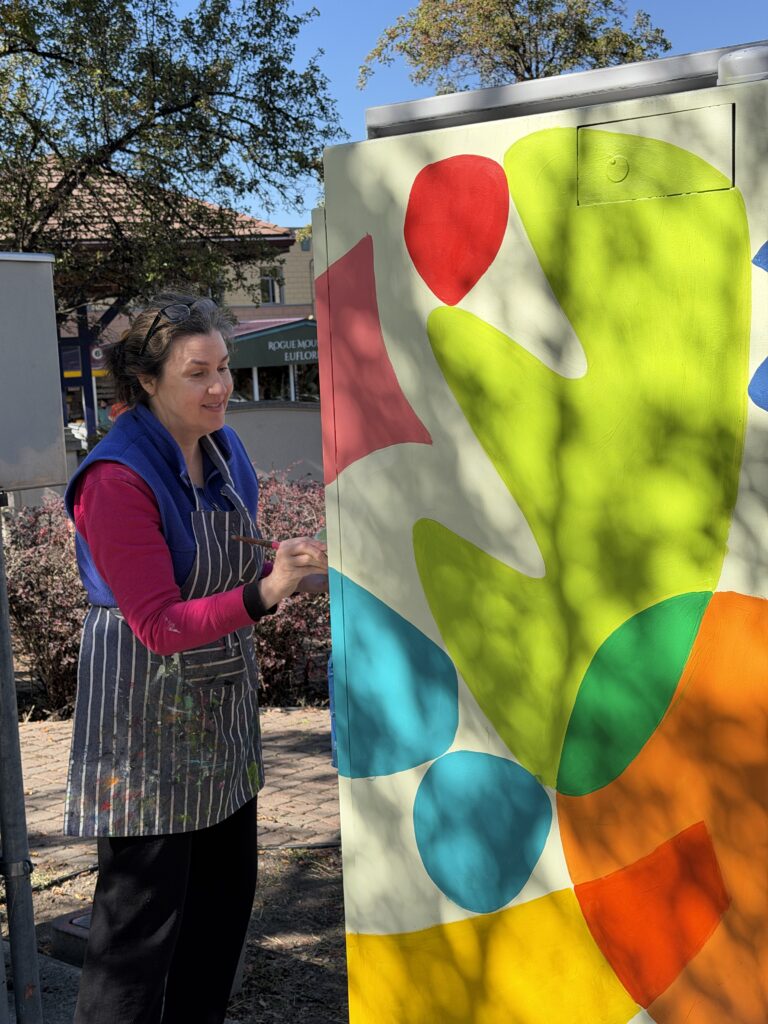
I interviewed Jennifer a few days after the box was painted. That gave her a chance to reflect on the experience of painting her artwork with helpers from ages 7 to 76. As I mentioned above, one of the goals of the Public Arts committee is for artists (including Jennifer) to involve youth and adult community members in painting these boxes.
I was surprised when Jennifer told me: “I have to say, at first when I thought about one of the requirements to have kids involved, I was, like, ‘Oh, no.’ Because you have to be careful of what design you do. It can’t be something that’s not achievable or you can’t have kids involved. So I actually found that quite a limitation. And I was kind of grumbling in my head.”
By the time box painting was completed, her attitude shifted. She said with a smile, “You guys (Public Arts committee members) are right. You converted my thinking.” In short: the painting went smoothly, and the community response was gratifying.
In the section below called “The artist’s creative process,” I will tell you how Jennifer uses what she calls “problems” or “limitations” in an art project as powerful allies to help her design a new artwork – including “Happy Making.”
The artist’s background
When I interview artists, I like to ask them, “When did you first think of yourself as an artist.” Jennifer had an interesting answer. “Well, that’s a great question. All children are artists, but I did not think of myself as an artist, as a child. I thought of myself as an artist when I committed to going to art school for graphic design.”
After graduating, she worked as a graphic designer for about ten years in Silicon Valley, during the boom years of the 1990s. Doing graphic design, she thought of herself as a “problem solver/artist,” and that has carried through to her artwork today.
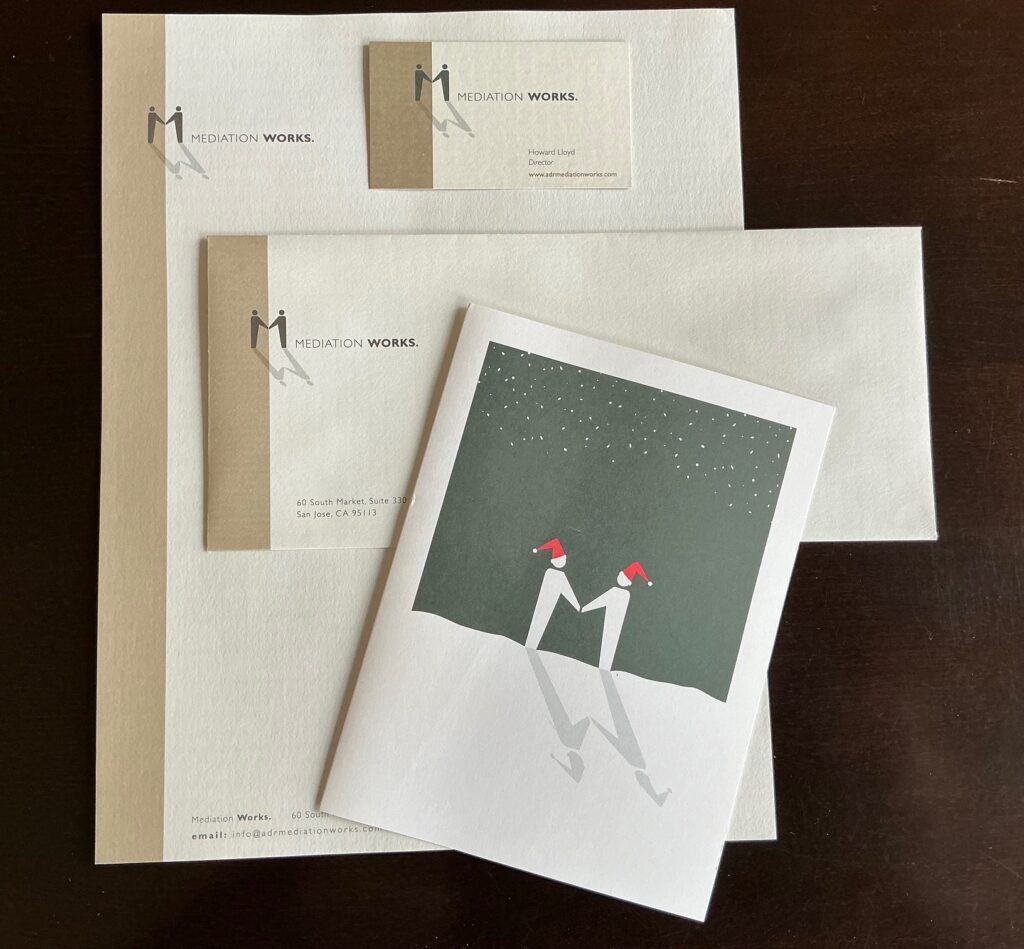
Here’s how she explained “problem solver/artist” in practical terms. First, she described what it is not. “I am not an artist who gets a blank piece of paper or a canvas, and needs to express myself through that. I don’t have that urge.”
For what it is, here’s a simple example she gave me of one type of job graphic designers take on. Let’s say a client comes to you and wants a package design for a new product. Right away, you are given limitations. A particular size. A particular shape. The company logo has to be featured. It might be an attractive logo, or an ugly logo, but it has to be there. There is a budget and due date for the design. Where does it sit on the store shelf? What other products will sit next to it?
Jennifer summed it up: “You have to think of all these things. I mean, the problem for the business is to sell their products to keep their business going. I want to help solve that problem for them. A lot goes into graphic design.”
After moving to Ashland
After moving to Ashland, Jennifer enjoyed two years as the “Artist in Residence” for all grades of Walker School students until COVID interrupted that kind of in-person learning. She told me,
“I was able to go into each classroom a few times a year and bring in a level-appropriate project for that class. The children were very enthusiastic and it was incredibly rewarding to see ALL students feel successful.”
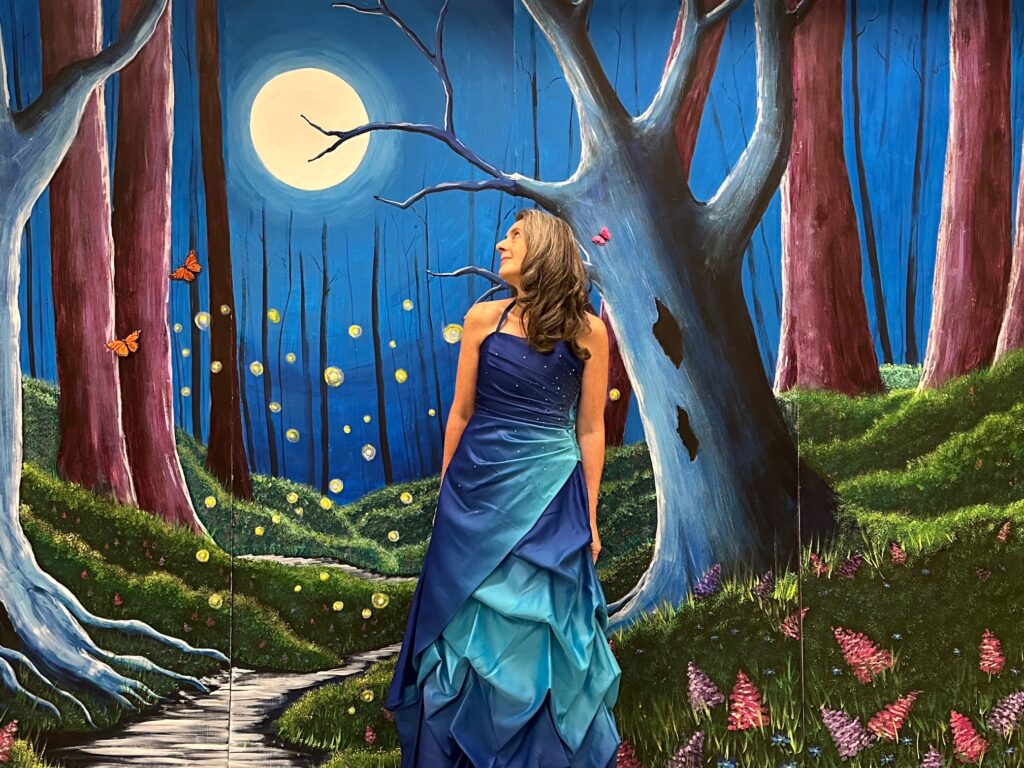
Since 2021, Jennifer has painted sets for Ashland Children’s Theatre, which is co-directed by Kate Sullivan and Eve Smyth. She painted the vibrant backdrop above for a production of Midsummer Night’s Dream. She took on “costume wrangling and construction” about 2024.
The artist’s creative process
Jennifer applied her “problem solver/artist” creative skills to the design of this traffic signal box. I was excited as she went through it with me in detail, both limitations and big picture visions going through her mind, shaping the artwork along the way.
She began with something obvious, but crucial. “First, it’s not a flat surface. It’s a three dimensional surface. I need a design that works around it and crosses the four corners.”
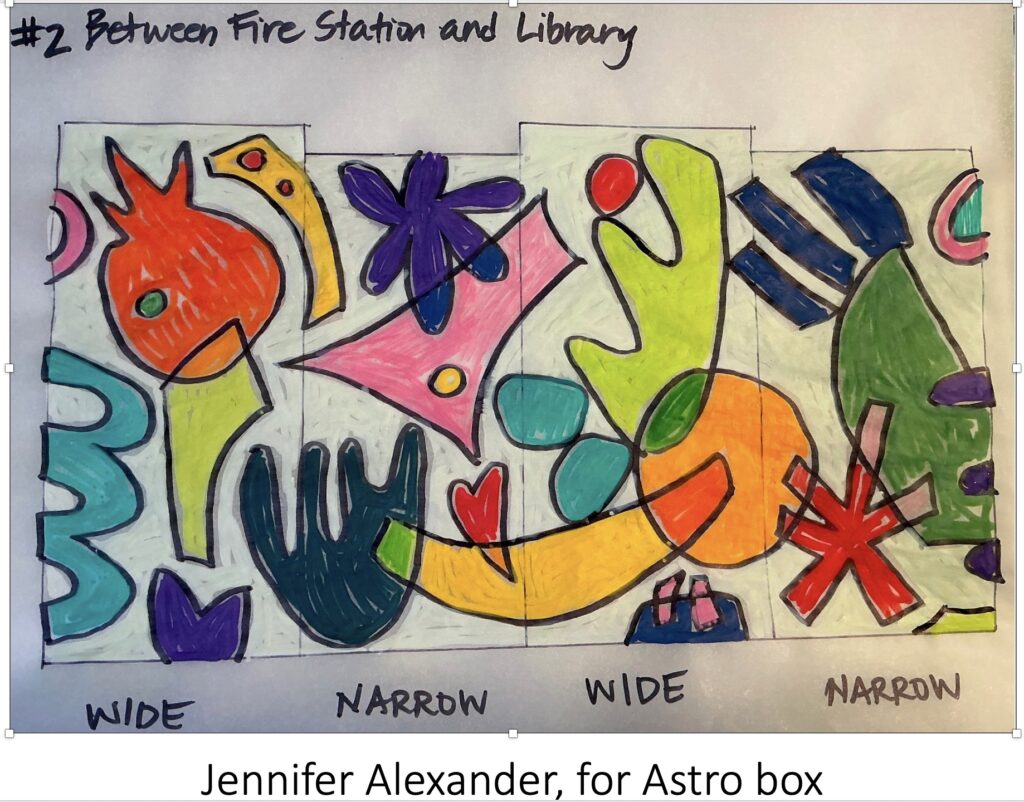
Second is the location. “There’s a lot of traffic going by. It needs to be bold and bright and clear to a passing car. Right? So I wouldn’t put in little minutia details that nobody’s going to see.” The location also has foot traffic, people walking from nearby neighborhoods and the Stratford Inn to downtown and back. It needs to look good for them, but realistically there are probably 100 cars for each pedestrian.
A third limitation is the community painting aspect, as discussed above. The design has to work for both youth and adults, painters and non-painters, to help paint it.
Beginning with those problems or limitations, her design process got going. For this box, the artist was not given a specific theme to incorporate. (In contrast, the nearby Fire Station traffic signal box was given a theme: a design related to the fire department.)
Here we get to Jennifer’s creative, bouncing thoughts. And my attempt to compress her days of searching for a final design on the box, starting from powerful but initially vague ideas. Let’s go. She saw that the box is placed near the center of Ashland, at one of the gateways to downtown. She wanted the box to visually express aspects of the heart of Ashland. But she didn’t want to paint literal images, like the theater or Lithia Park. She thought those designs, if used, would work best near the theater or park.
Now back to quoting Jennifer’s thought process. “So again, what is Ashland? It is a town that I love dearly. We’ve been here about 20 years. It’s an inclusive, happy community. Those are very vague general words, right? So how can I express that?”
“Now this is kind of where the answer lies. I mean, no matter what shape you are, no matter what color you are, no matter what you believe in, or what your sexuality is, or any of those things, we all live in harmony together, in a community. And that really is the catalyst for: what does that look like visually? There has to be some driving force behind your vision; that, to me, was it.”
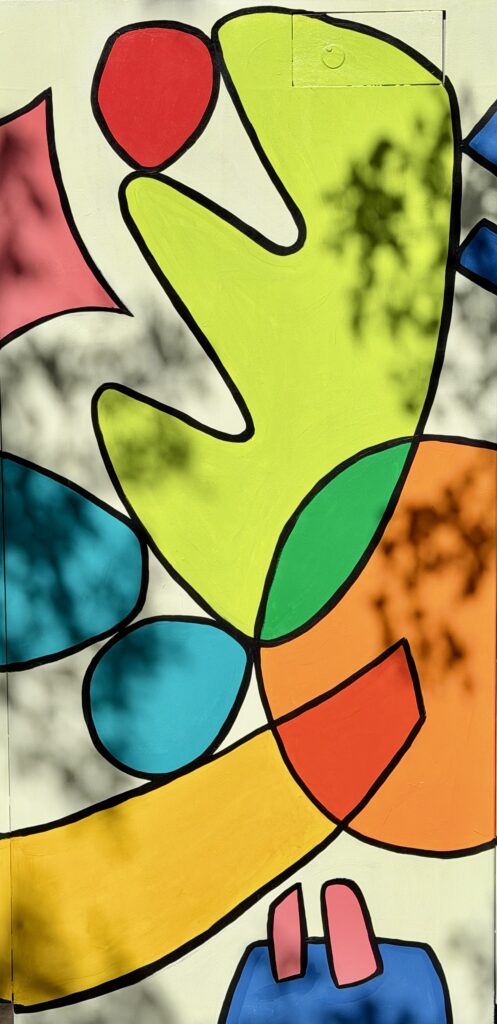
“Now, how do you express that? That’s where you get the shapes, bouncing around, interacting, touching, crossing, many bright colors.” At this point, Jennifer was narrowing down to the final design. She went back to the limitations or problems set by the Public Arts committee or by herself. She came up with a description of the theme in just a few words.
“Bold.”
“Has to work around the edges.”
“Easily seen by passing cars.”
“Fun.”
“Happy.”
“Joyful.”
When one of Jennifer’s friends looked at the box and suggested the name “Happy Making,” Jennifer immediately knew that would be the name.
The painting days
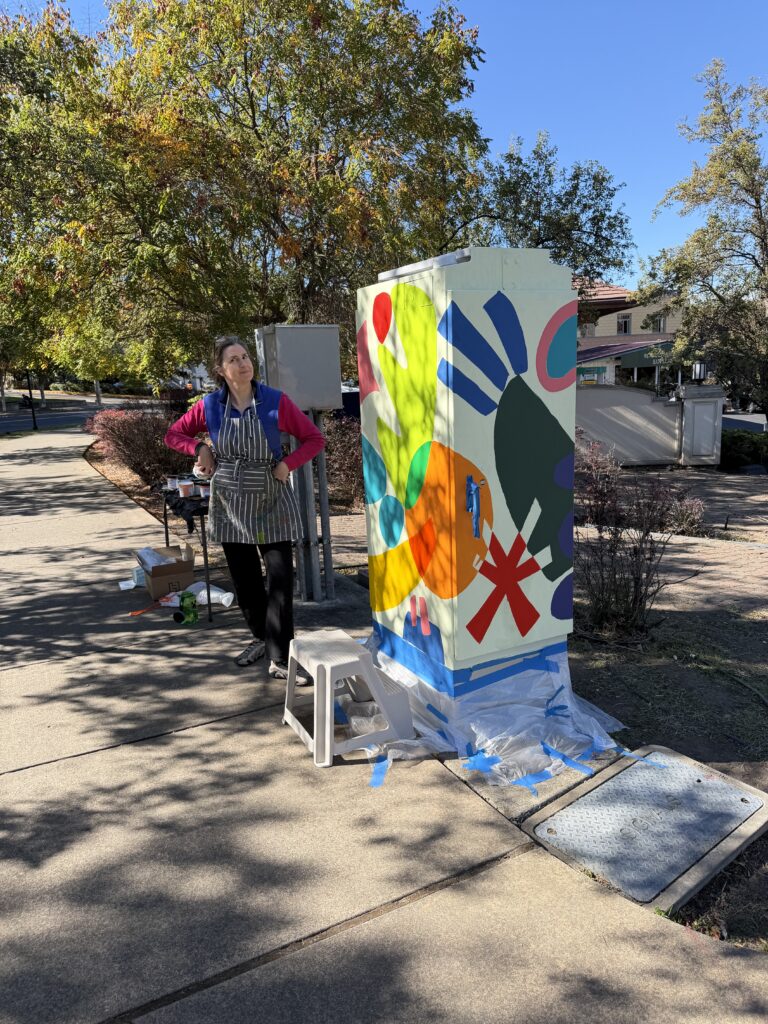
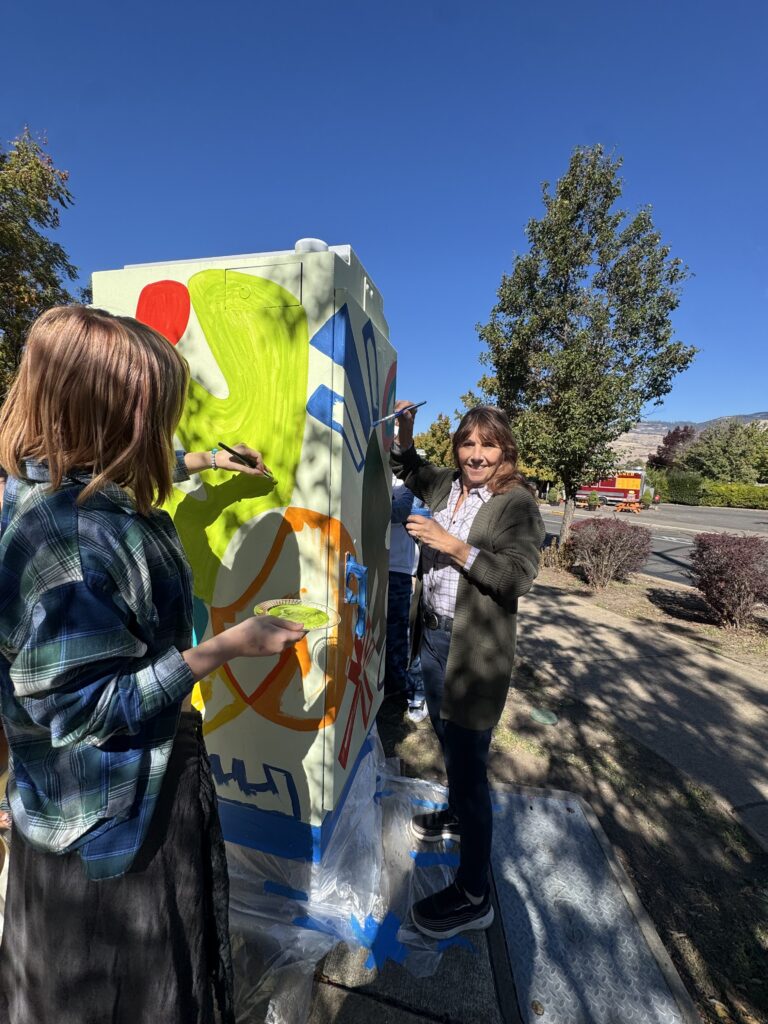
Based upon Jennifer’s experience teaching art to Walker School students, she knew that her small “community of painting helpers” would take her full attention when they came to paint. Therefore, she set herself up for success by doing preparatory work on her own.
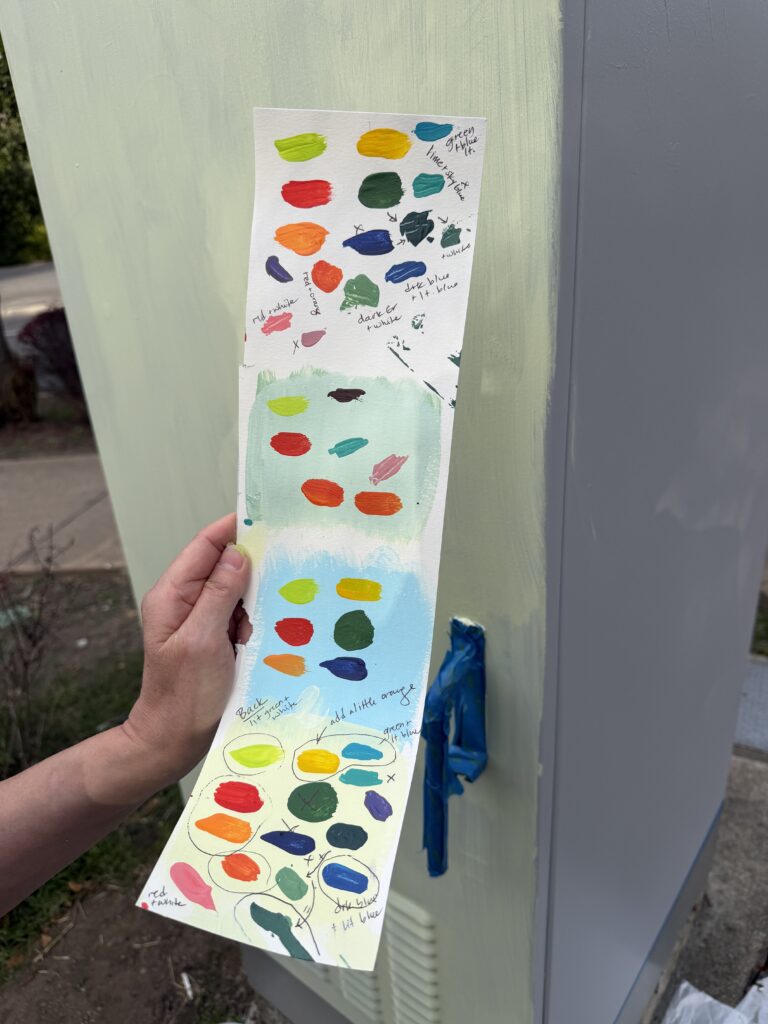
Her first step was painting the background color on the entire box. The high quality Golden Mural Paints from Central Art Supply in Medford dry quickly, so she was able to apply two coats of a light greenish-yellow color on the same day. After that, she drew the abstract shapes in pencil, wrapping them around the box corners so they were interesting.
Here is one of the secrets of Jennifer’s success with her youth and adult painting helpers. Following the pencil sketching on the box, she outlined each shape in the color it was going to be painted. Not just an outline – a thick outline. As I looked at the photos (see below), I realized that the thick outlines made it easy for both youngsters and oldsters to paint “within the lines.”
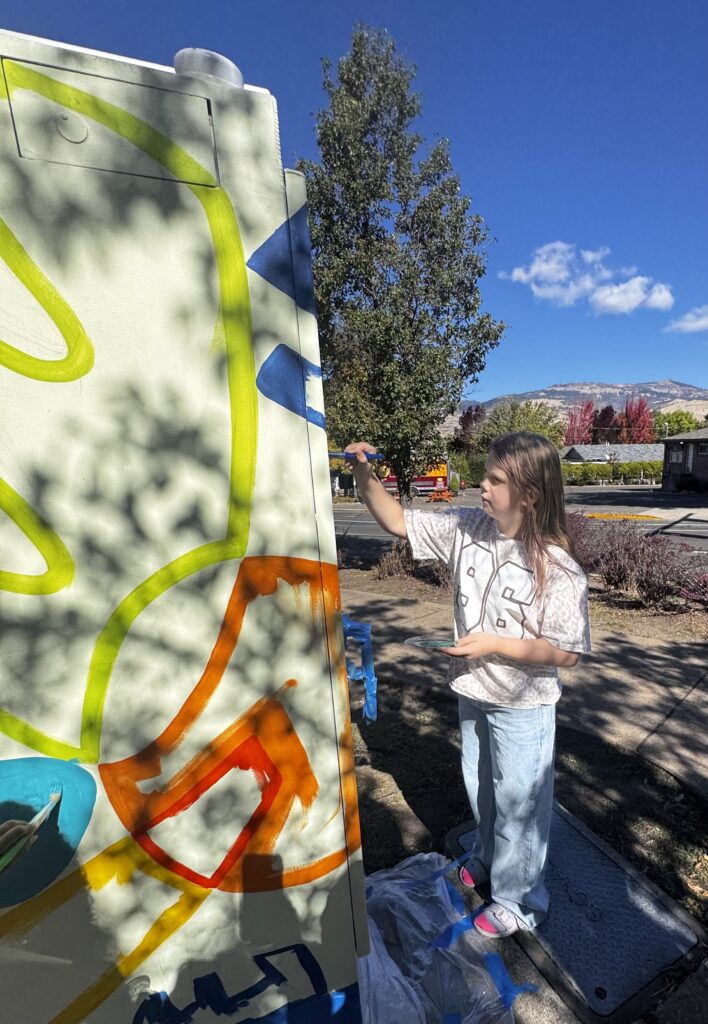
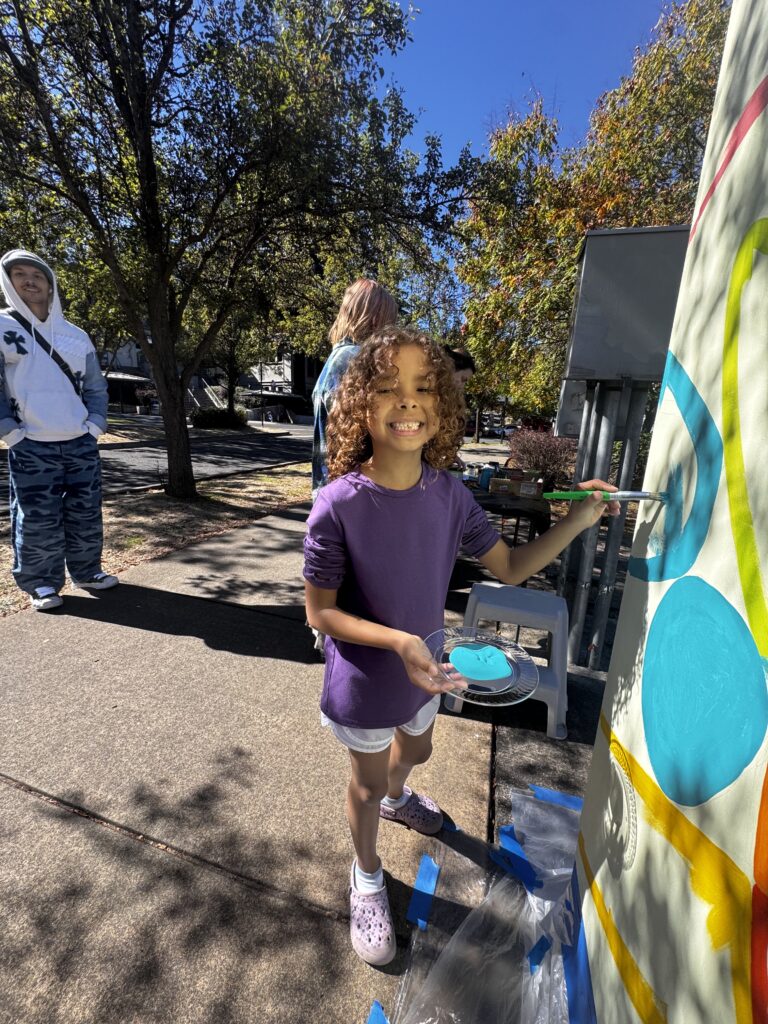
Jennifer explained to me that she was ready in advance with kid-sized paint brushes and small plastic plates. As she put it: “I had a bunch of the kid brushes, and a little plate for each color. I would give each kid a brush and a plate. The shapes were already outlined in the color that they were going to be painted. The kids were great about just painting their shape, and then checking in to see what’s next.”
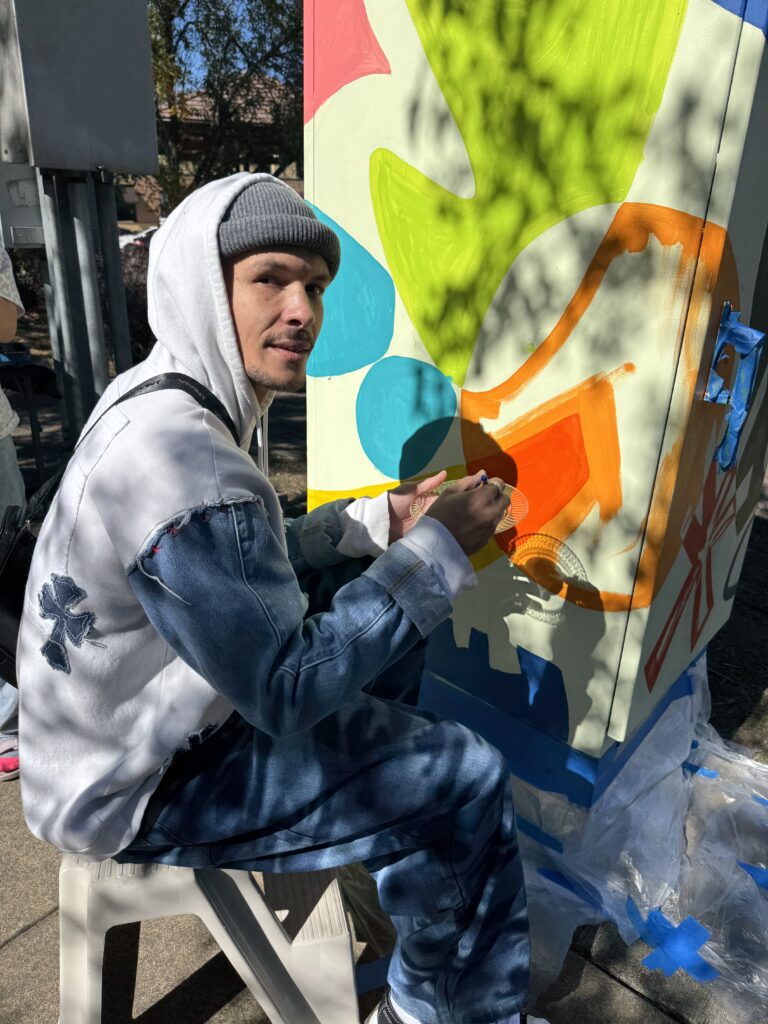
Four people were able to paint at one time, one on each side of the box. After the painting helpers filled in all of the color blocks, Jennifer outlined the “bold, fun, happy” shapes in black paint as the finishing touch.
Four generations – quite extraordinary!
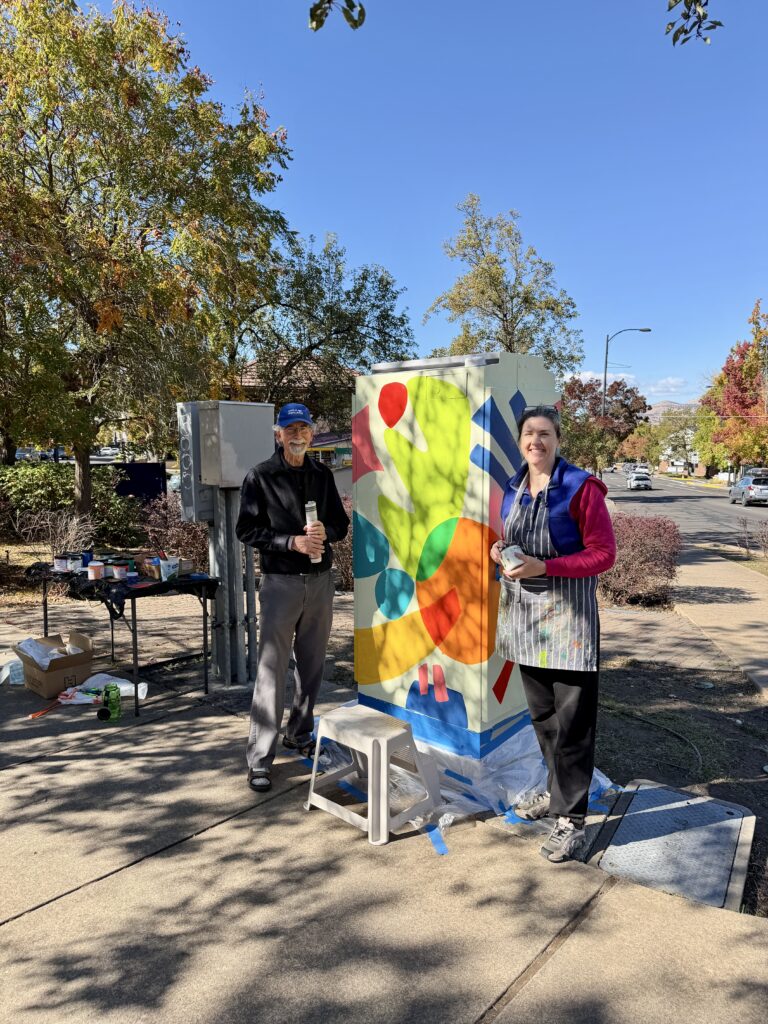
In all, three children and four adults helped Jennifer create her “Happy Making” artwork. Heather Warden, owner of the Gypsy Road Studio shop just half a block from the box, coordinated the painting helpers. Here’s the amazing part. The painting helpers included four generations of Heather’s family! Heather’s son and granddaughter live locally, so that makes three generations. The fourth generation was a surprise gift. Heather’s mother came to visit at just the right time to join the traffic signal box painting day. It may be a long time – if ever – before we again see four generations help create one of Ashland’s public artworks.
A months-long process, with many steps
If you enjoy learning “how things work,” here you go. If this “nuts and bolts list” bores you, feel free to skip this section. You can skip to the closing photos below.
Creating a public artwork is a months-long (or sometimes years-long) process that involves many people and many steps. The creation of this painted traffic signal box was a relatively simple example of the process, but I still came up with 14 steps.
Step 1: March 2026, the Public Arts Advisory Committee (PAAC) and city staff prepared a “Call for Artists” to submit designs for the painting of three traffic signal boxes later in 2026.
Step 2: In early May 2026, the “Call for Artists” was published and disseminated to artists in Ashland and throughout Southern Oregon. Some artists beyond Southern Oregon also received the Call for Artists. June 12 was the deadline for artists to submit their designs.
Step 3: A traffic signal boxes subcommittee of PAAC suggested names of community members to be on a Selection Panel that would review the designs submitted and recommend one design per traffic signal box. The goal was to have five members on the Selection Panel.
Step 4: PAAC discussed the suggested names and approved a list of Selection Panel members at their June meeting.
Step 5: Designs were received by email and a city staff member organized them.
Step 6: The subcommittee tried to find a meeting date that would work for all or most of the Selection Panel members. Most, but not all, were able to attend on the date chosen.
Step 7: The Selection Panel met in early July, 2026. The subject of this photo essay is one of three boxes that the Panel reviewed designs for. The Panel made a first choice for each of the three boxes.
Step 8: At the PAAC meeting on July 16, 2026, the committee formally approved the first choice of the Selection Panel for each of these three boxes.
Step 9: In order for an artwork to become part of the city’s public art collection, it needs to be approved by both the Public Arts committee and by Ashland City Council. So the next step took place at the August 4, 2026 City Council meeting, when the council approved the three designs submitted by PAAC.
Step 10: Artists were given the go-ahead to purchase paints and materials.
Step 11: The Traffic signal boxes subcommittee collaborated with each individual artist to choose a small “community of painting helpers” as preparations were made for the box to be painted.
Step 12: Box preparation: the box was cleaned, sanded, and a direct-to-metal primer coat was painted on the box.
Step 13: Specific to the box described in this photo essay, artist Jennifer Alexander began the process by applying two coats of the base color to the entire box. Next she drew and outlined the shapes on the box. The most exciting part was the “community painting day,” when adult and youth painting helpers filled in the colors on the box, guided by Jennifer. Her last step was to outline each color block in black paint.
Step 14: A protective coating was applied to the newly painted traffic signal box.
Closing photos, all four sides
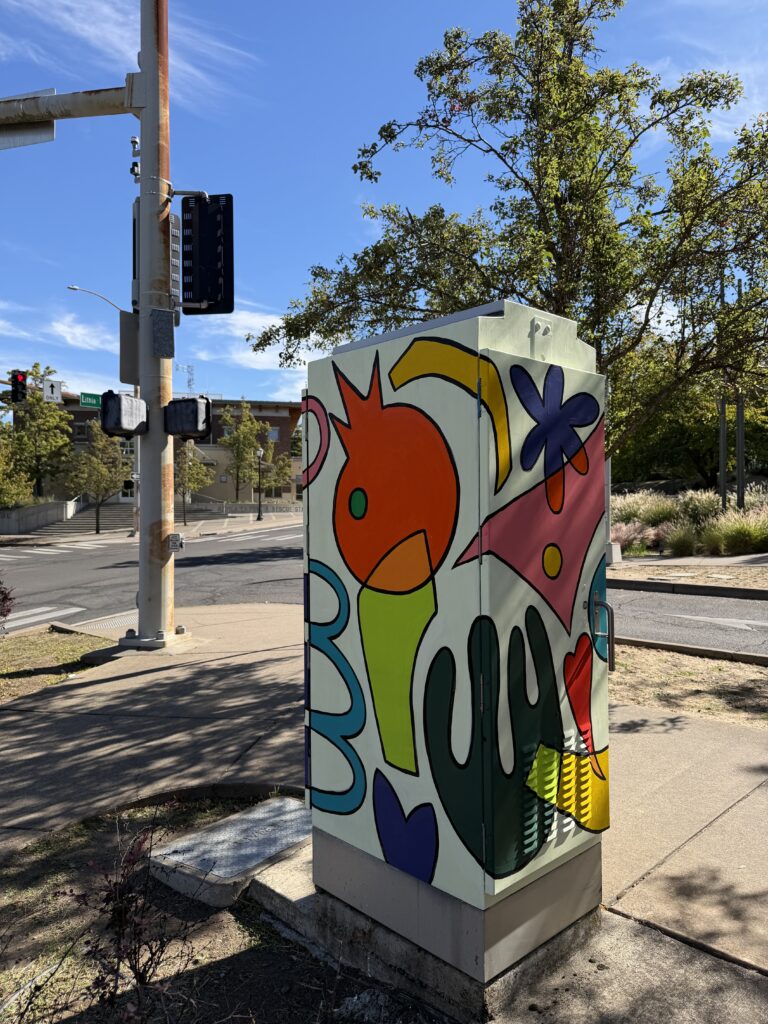
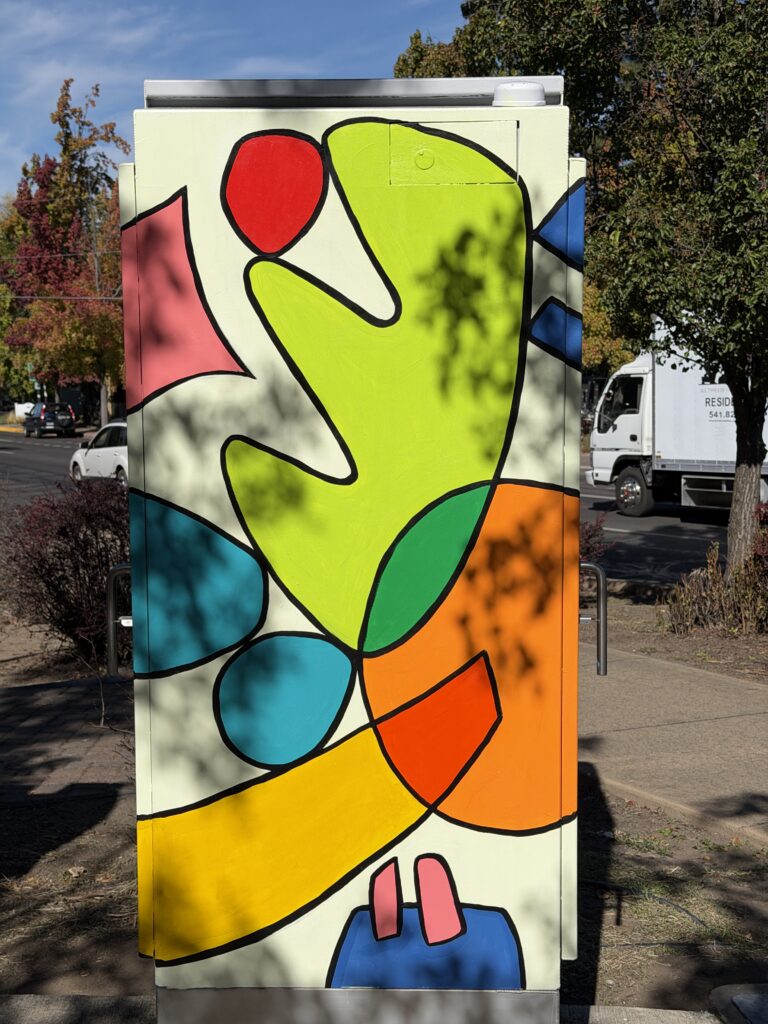
After I took photos of the four individual sides of “Happy Making,” I was struck anew by the liveliness, fun and joy added to this artwork by Jennifer’s wraparound design. That’s what really makes it special, especially as you drive or walk by and see it almost alive and moving with you. See the box for yourself up close, or take a look at the photos below, and see if you agree with me.
References:
Anon. Ashland Public Arts Advisory Committee minutes, at AshlandOregon.gov website.
Anon. Ashland City Council minutes, at AshlandOregon.gov website.
Alexander, Jennifer. Interview and personal communications, 2026.
Warden, Heather. Interview and personal communications, 2026.
No Comments