


17 Nov Painted Traffic Signal Boxes: A “community-assisted public artworks” project (first 5 of 20 boxes to be painted)
Featuring the first 5 of 20!
Two are by Ashland High School.
One is by First Presbyterian Church.
One is at Ashland and Walker streets.
One was by Southern Oregon University, but it is now gone.
Published December 2026.
Have you noticed …?
You may have noticed bold, brightly painted traffic signal boxes along Siskiyou Boulevard: at the intersection with Walker Avenue (near the Presbyterian Church), at the intersection with Mountain Avenue (by Ashland High School) and at the intersection with Beach Street (a block away near Ashland High School). These are ODOT (Oregon Dept of Transportation) traffic signal boxes, located at intersections with traffic signals. Read on to learn who painted them and how they came to be.
As you walk around Ashland, you will also see utility boxes painted many years ago, especially in the Railroad District and along Calle Guanajuato. Nineteen of these colorful, humble artworks that brighten busy streets and pedestrian walkways were painted between 2009 and 2015. Sponsored by the Public Arts Advisory Committee (PAAC or Public Arts committee), the painted utility boxes and traffic signal boxes are all part of our public art collection.
Why public art?
“Public art humanizes the built environment. It provides an intersection between past, present, and future… Public art matters because our communities gain cultural, social and economic value through public art.”
Americans for the Arts, a non-profit association
Public art is valuable, even crucial to a community, because it is not just for “art collectors” or people who go to art galleries – it is for everyone.
Public art can celebrate history of place and local identity. Sometimes it encourages our imagination or challenges our beliefs. It can be socially relevant. And often, we value public art for its ability to stimulate smiles, wonder and moments of joy.
See photos of the five boxes. Meet the artists.
This photo essay introduces you to the first five traffic signal boxes that were painted and the artists who designed and painted them. You will also learn about the challenges of trying to create “community-assisted public artworks” through a group painting process.
Painting the boxes began in 2024. After Ashland City Council approved the concept of painting all twenty traffic signal boxes with community involvement, the Public Arts committee identified three boxes to paint during the first year of the project – the year 2024. The committee planned for a “neighborhood” or “community” of people to assist in painting each box, with supervision by the artist whose design was chosen. Because this was such a new endeavor, and they knew there would be a steep learning curve, PAAC members identified a specific “community” of painters for each of the boxes.
- Ashland High School art students and faculty would be involved in painting the traffic signal box at the corner of Siskiyou Blvd and Beach Street, across the street from the high school.
- Members of First Presbyterian Church and the youngsters at Children’s World Montessori School that met at the church would help create the box at the corner of Siskiyou Blvd and Walker Avenue.
- Southern Oregon University art students and faculty would participate in painting the box near the corner of Siskiyou Blvd and Wightman Street.
- The fourth box, painted in March 2026, involved a fifth grade class at Walker School. The school was a block away from the box’s location at the corner of Ashland Street and Walker Avenue.
- The fifth box, at Siskiyou Blvd and Mountain Avenue, was also near Ashland High School. Unfortunately, the plan for Ashland High School art students to assist in painting this box did not come to pass.
Here’s what the first three traffic signal boxes looked like before painting began.
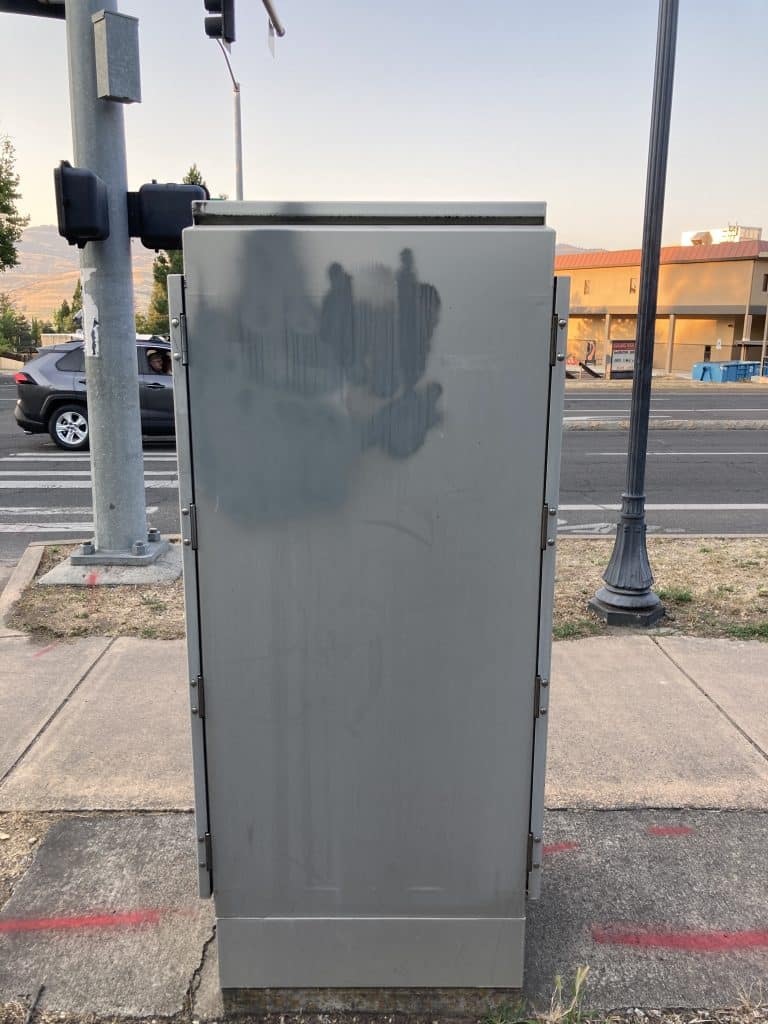
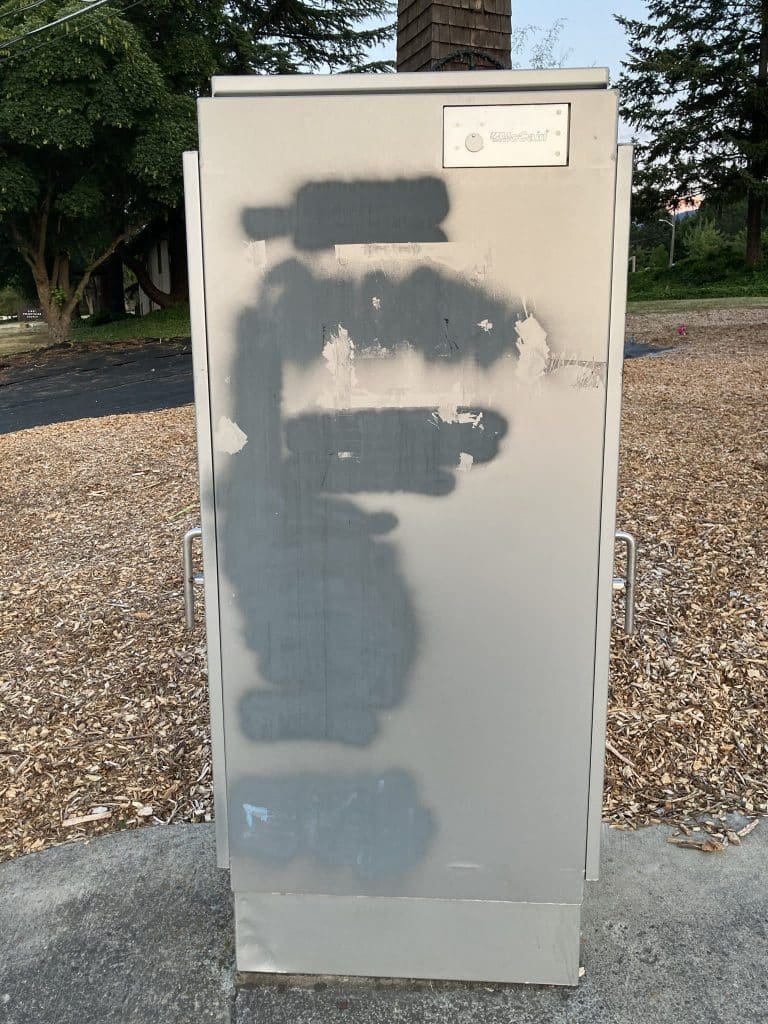
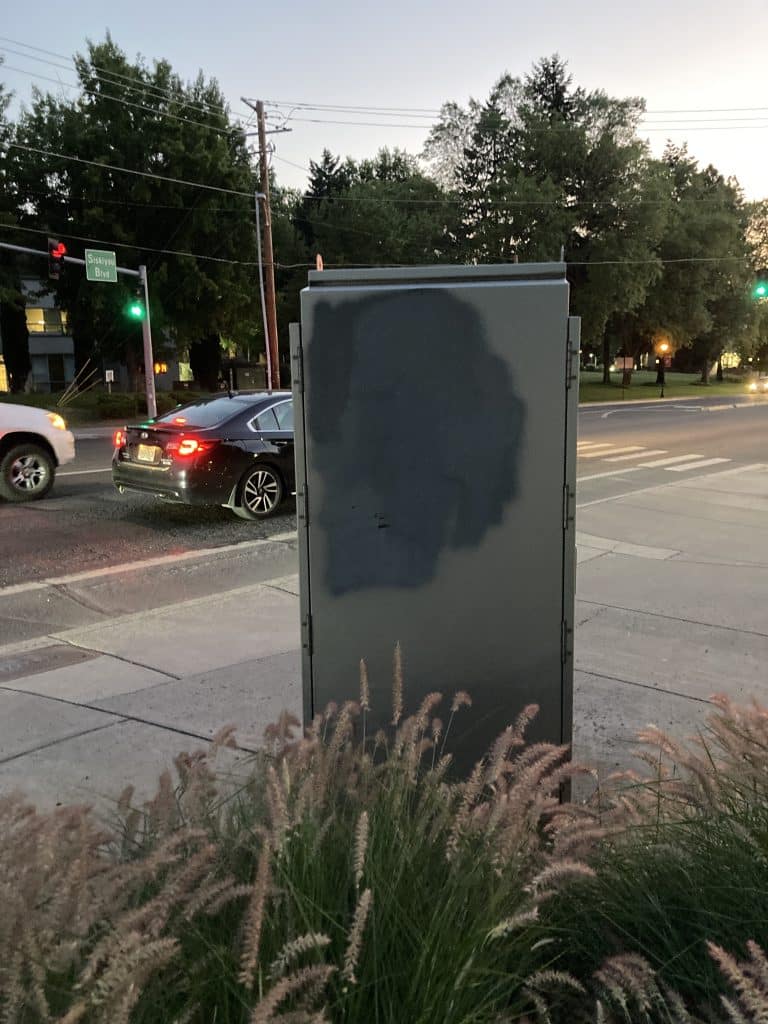
“Hello my name is” – Artist Junie Christopherson
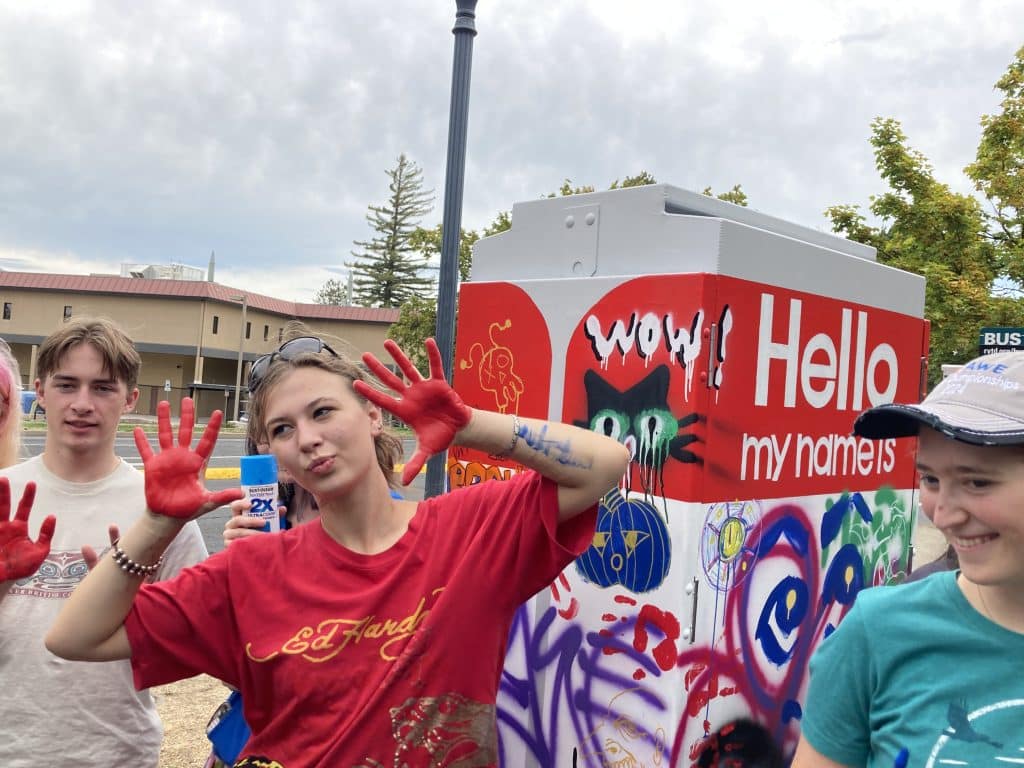
“I am super happy that I got it done. The community that formed while it was happening gave me a sense of pride as well.”
Artist Juniper “Junie” Christopherson
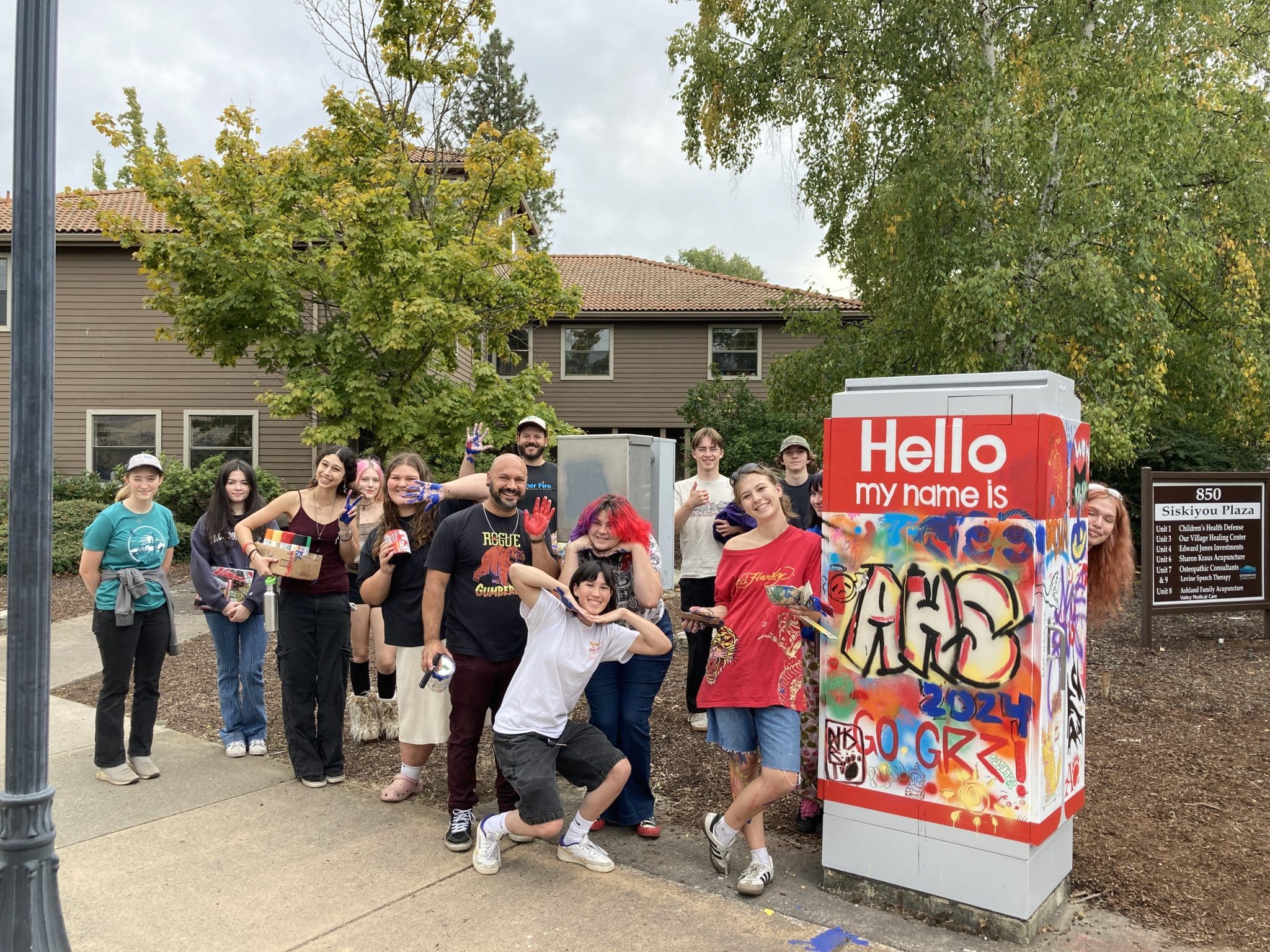
The first traffic signal box painted is across the street from Ashland High School, at the corner of Siskiyou Boulevard and Beach Street. The “community” helping paint this ODOT box was Ashland High art students and art teachers.
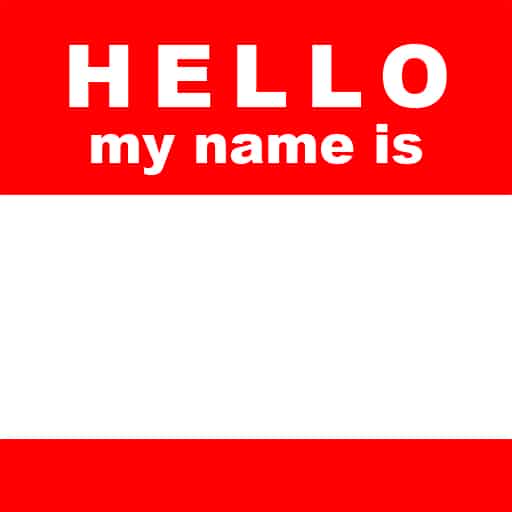
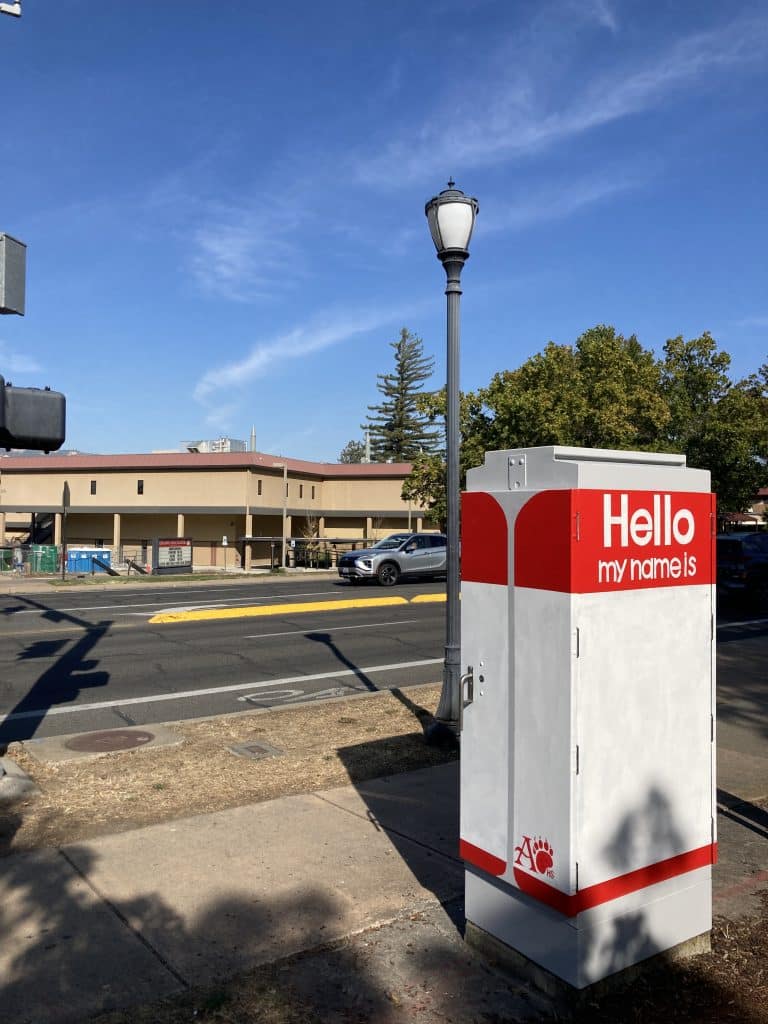
High school student Junie Christopherson presented a design in the form of the ubiquitous “Hello my name is” name tag, with its distinctive red color. Her vision was to have Ashland High art students and faculty fill in the white spaces of the name tags with their signatures and their art.
Painting the box took place between September 21 and 25, 2024. Junie began with the “Hello my name is” background on September 21, with assistance from her friend Otis Tracy. A few days later, two groups of art students walked across the street to fill the box with a wide variety of artistic styles. Junie thought that a lot of the students enjoyed participating and felt like it was a great way to express their artistic abilities.
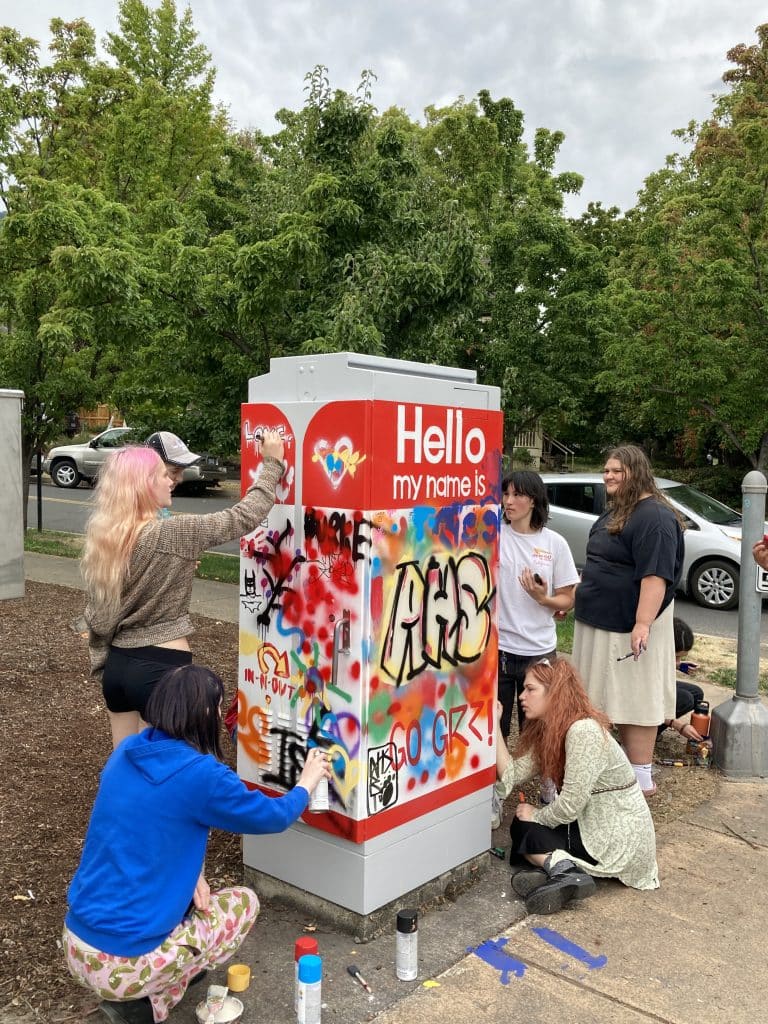
In response to my inquiry whether she likes the way the artwork turned out, Junie said: “I am happy. I think it looks great. I’m happy that we had a lot of different people with different styles of art paint on it. I think that contributes to the chaotic-in-a-good-way look of it.”
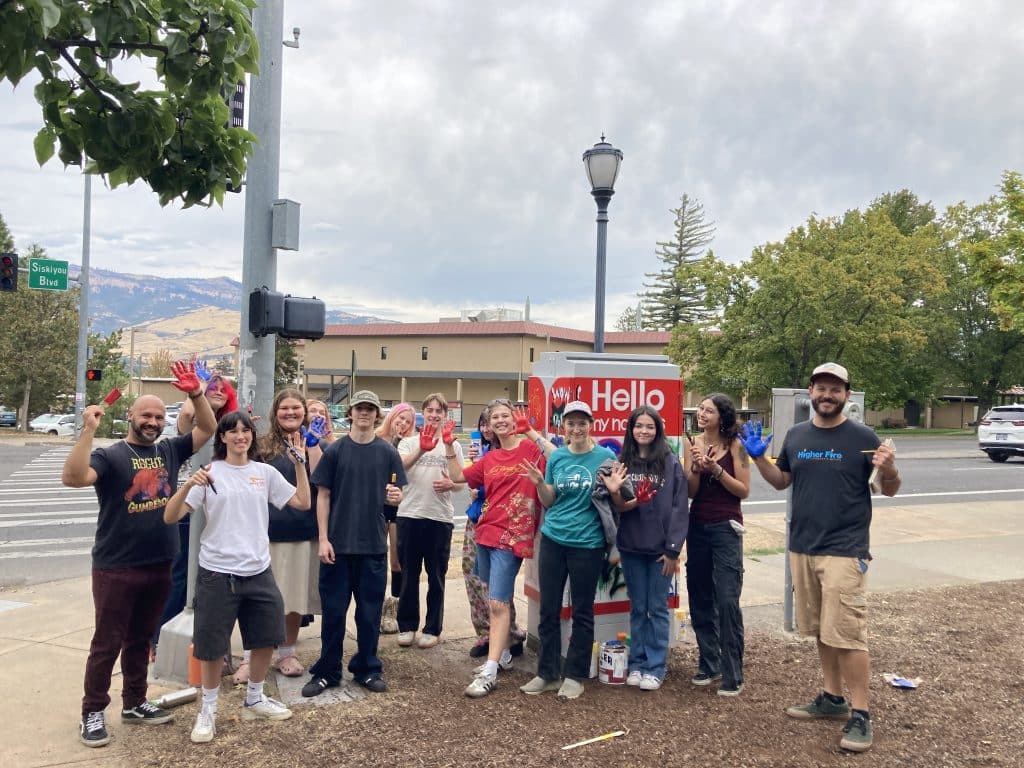
Community participation: eighteen people helped artist Junie Christopherson paint the box. Ashland High art teacher Max Malcomb brought an entire class across the street to paint, including a teaching assistant.
Local business support: Junie purchased paints and supplies at Ashland Hardware, which generously offered a gift certificate to the Public Arts committee for this project.
“chaotic-in-a-good-way”
Each of the student and teacher community painters added small images, often quirky, many in graffiti style. Here are photos of the four sides of the box in 2024, just after it was painted.
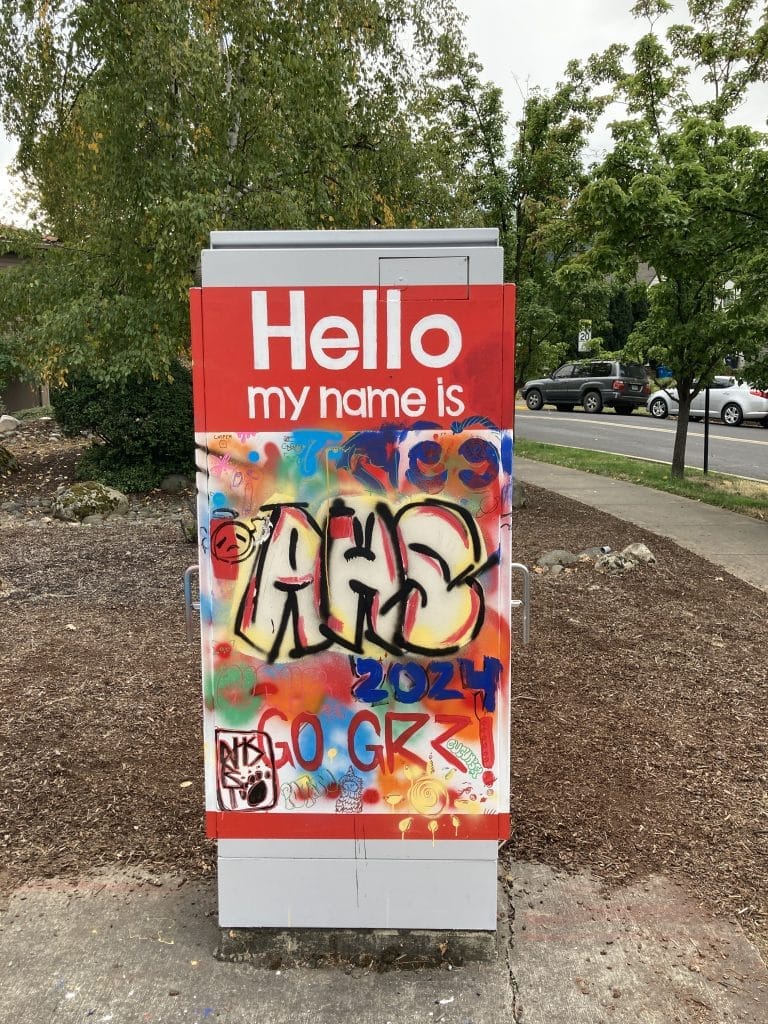
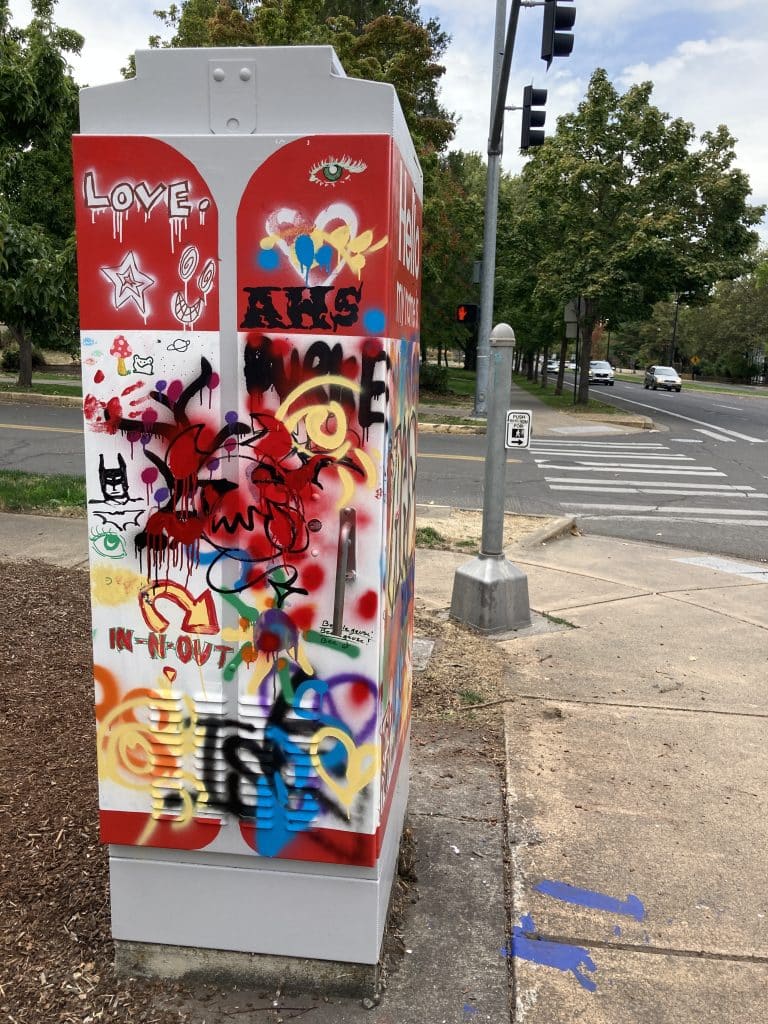
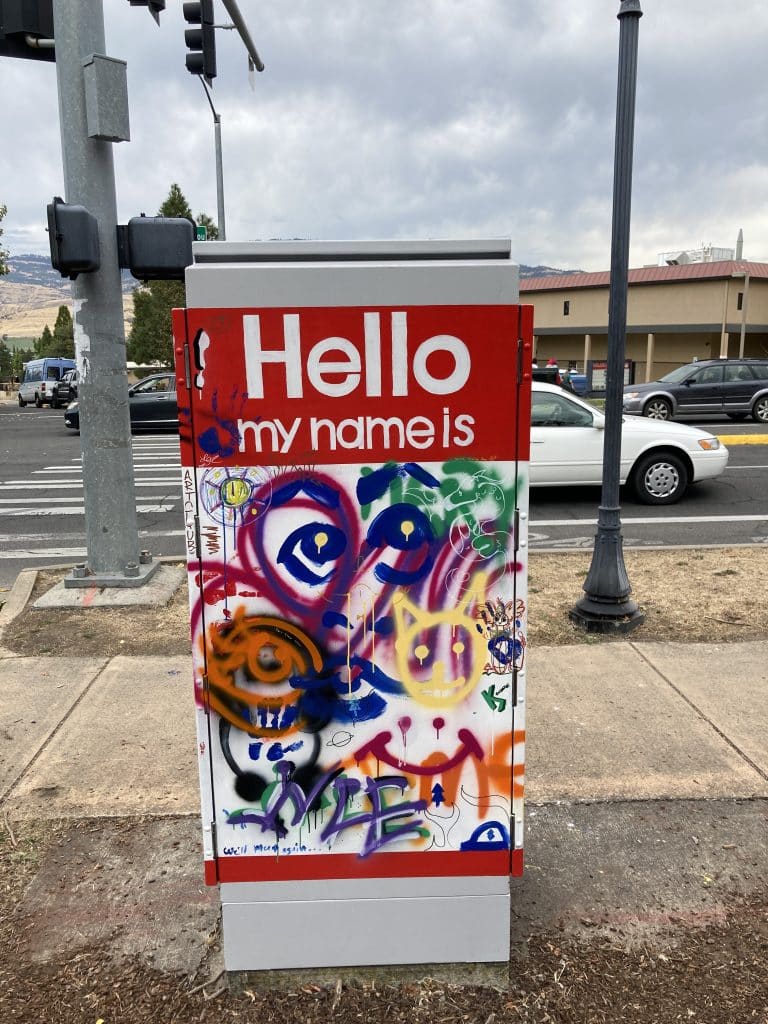
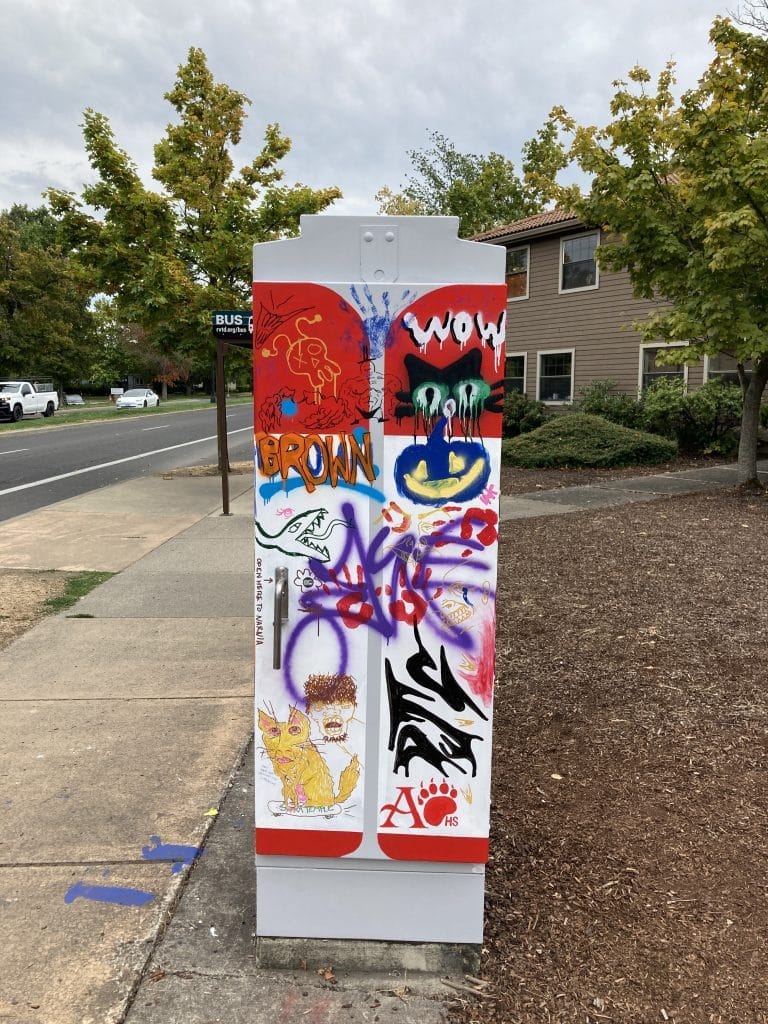
For some reason, perhaps because of the “graffiti style” art on the box, it did not take long before people started adding their own tags and images to all four sides of the box. Some of the original images are still visible, but many have been covered. That bothers me a lot. Here are photos of how the box looks in September 2026, two years after it was painted.
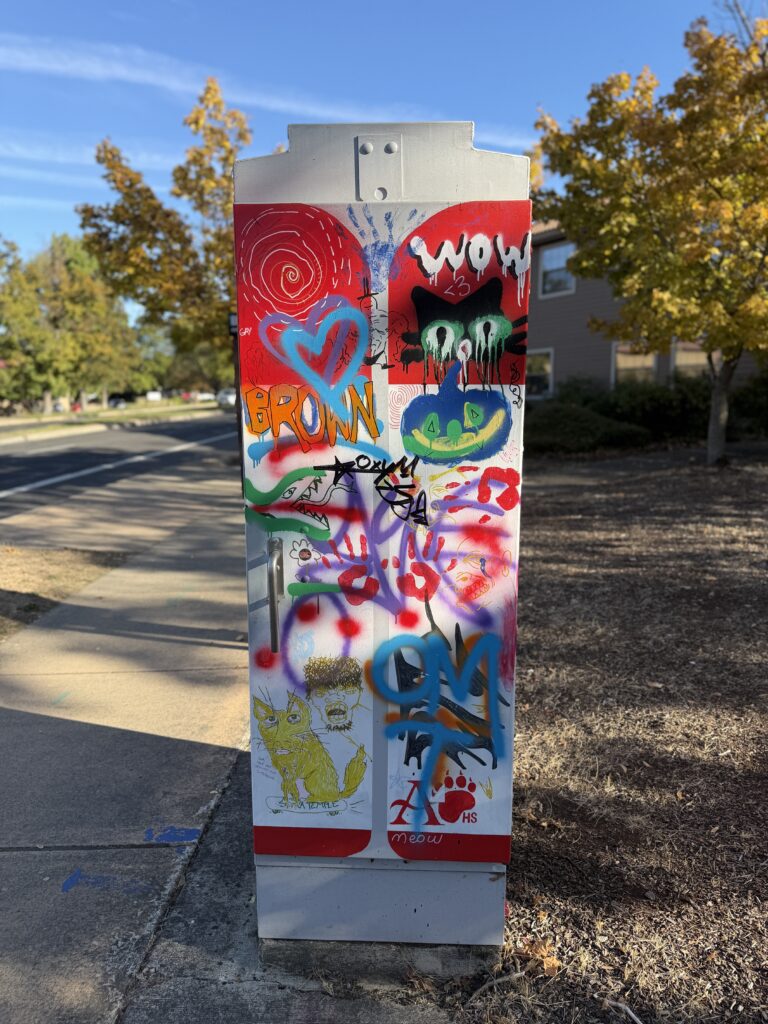
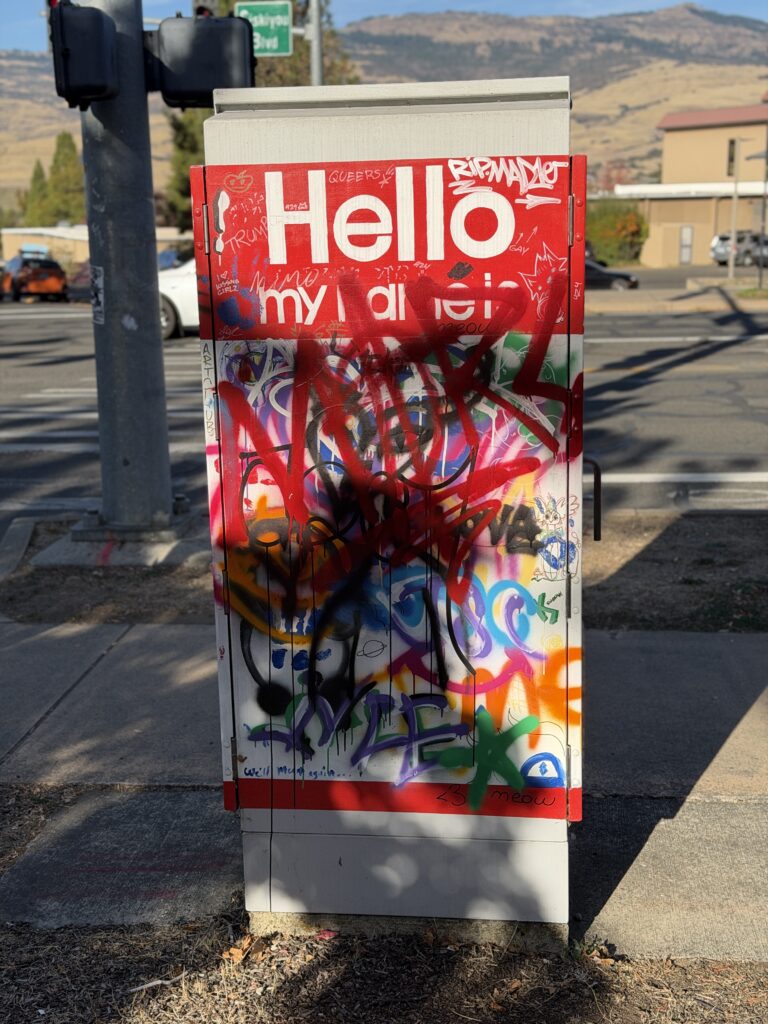
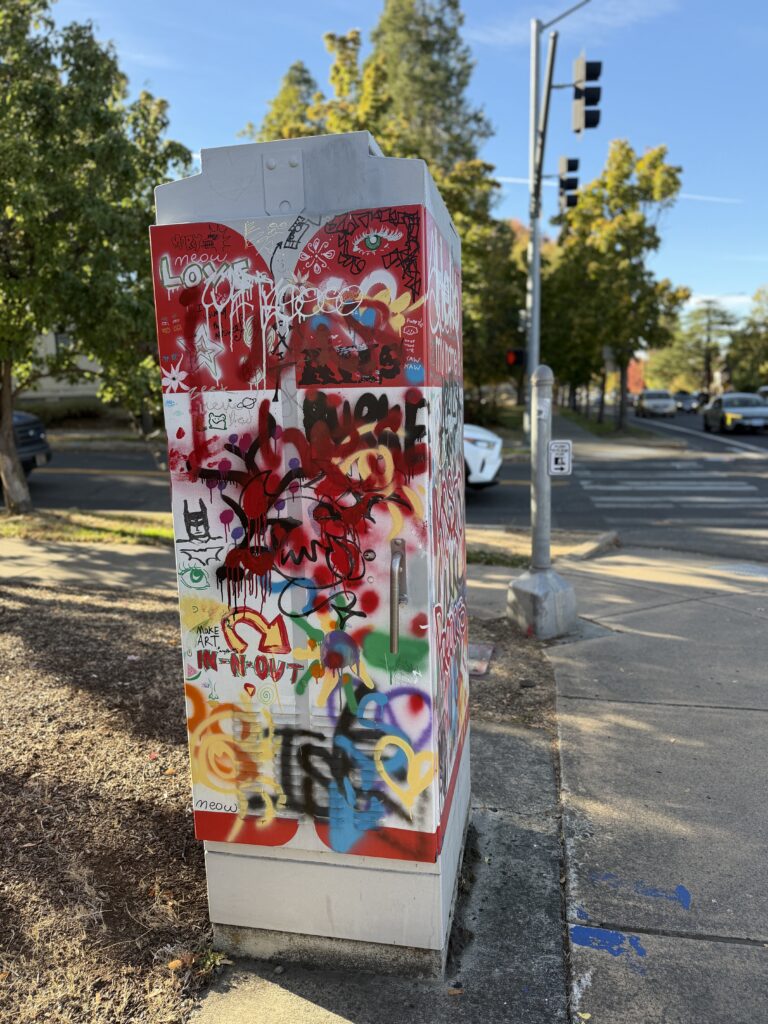
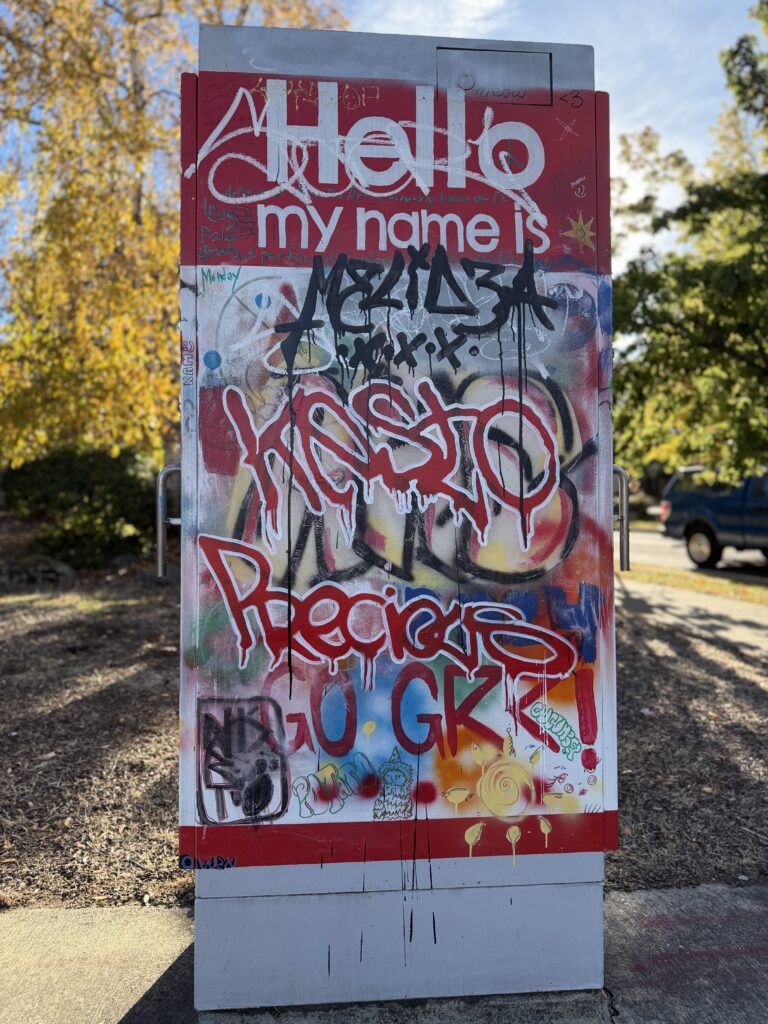
As I explore my own emotional reactions to these “additions,” I remember Junie’s description of the completed box mural. She described the look as “chaotic-in-a-good-way.” I think this particular box will be different than the other nineteen to be painted. With its genesis in the minds and hands of Ashland High School art students, I expect this will be a living, changing artwork, hopefully always “chaotic-in-a-good-way.”
“Hands on, Ribbons of Light” – Artist Adele Hiles
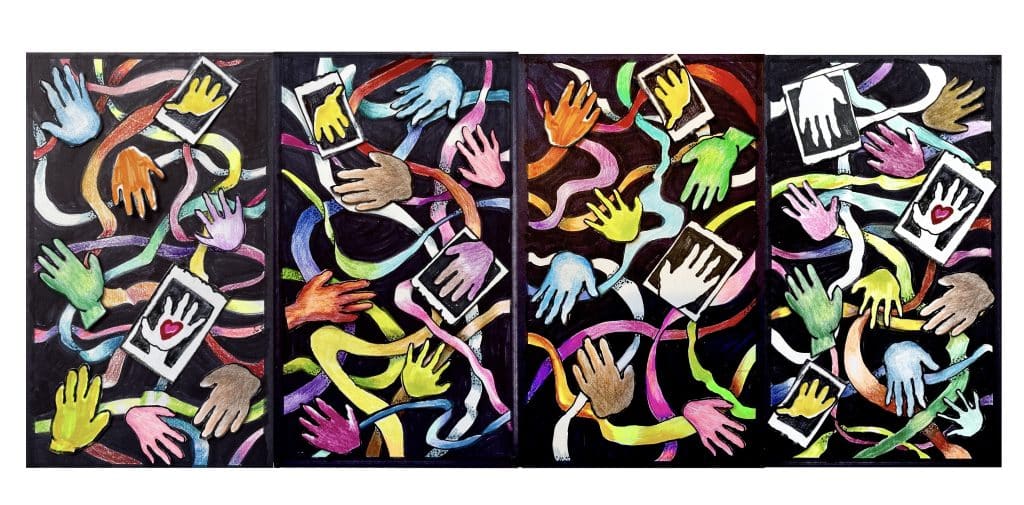
“All four sides of the box will feature unique colorful flowing ribbons, with individual handprints of Montessori school children and Presbyterian church members.”
Adele Hiles
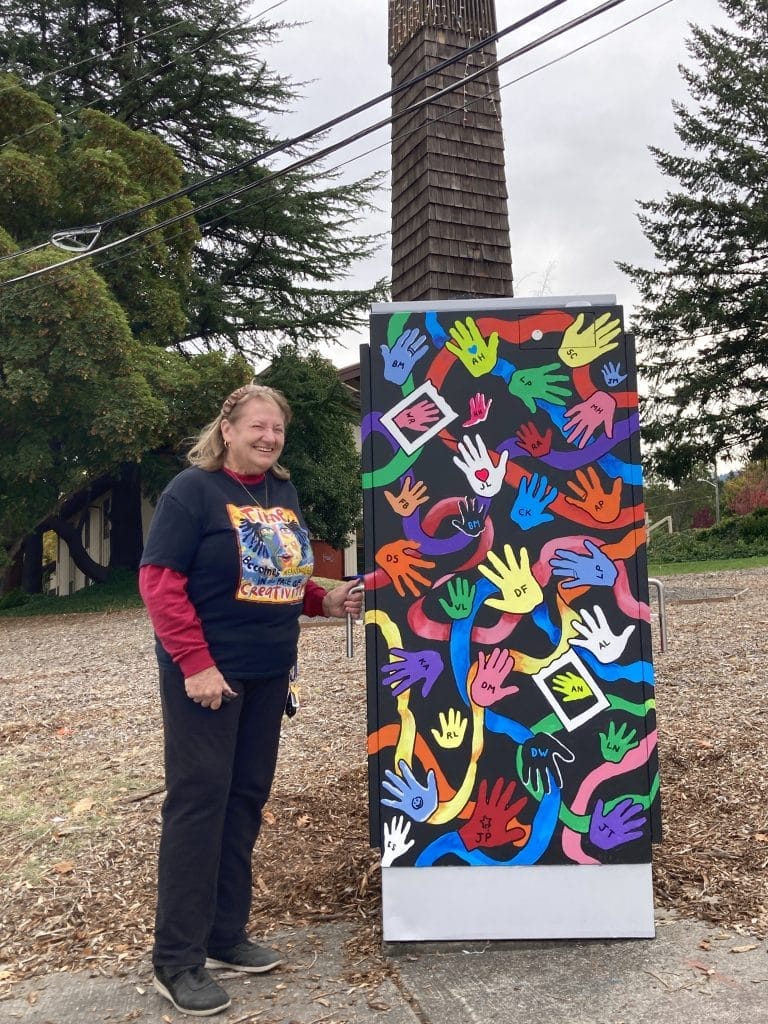
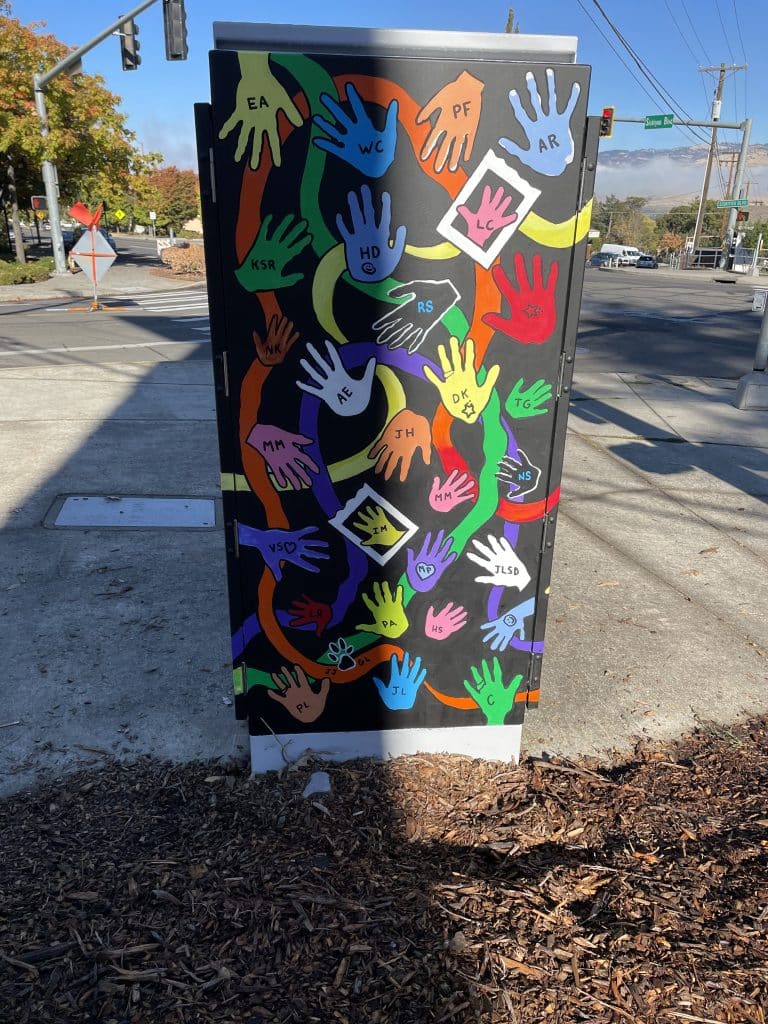
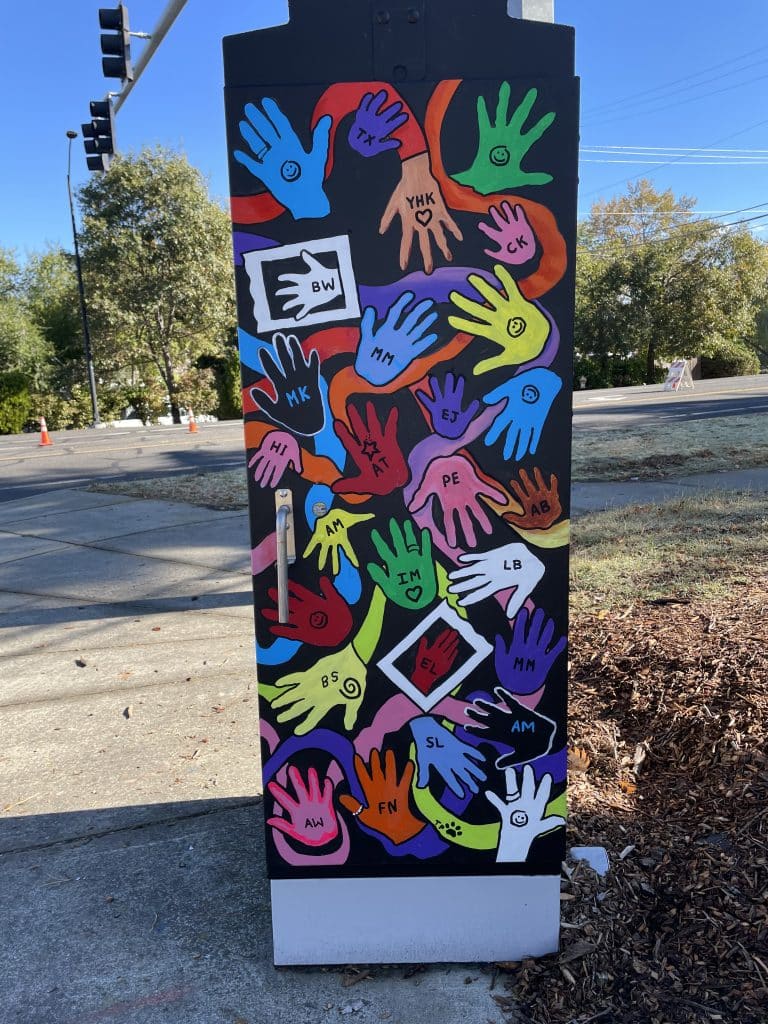
You’ll see this traffic signal box at the corner of Siskiyou Boulevard and Walker Avenue. It is next to the First Presbyterian Church. When the box was painted in 2024, Children’s World Montessori School met in the church facilities, though the school is no longer there as of 2026. The plan was for the “community” helping paint this box to be adults and children at the church and school.
Getting handprints
Adele began her community involvement by going to the Children’s World Montessori School to get handprints from about 35 of the children there, along with several teachers and parent volunteers. She was surprised how still the children were able to hold their hands as their fingers were being traced. She said, “They were serious looking and they knew they were contributing to the artwork. Then, as the mural was being painted, the classes came out twice and looked for their own handprints.” Her next step was getting handprints of members of the First Presbyterian Church, which went smoothly. Adele laughed as she told me there are even handprints from a two staff people from the nearby Market of Choice supermarket.
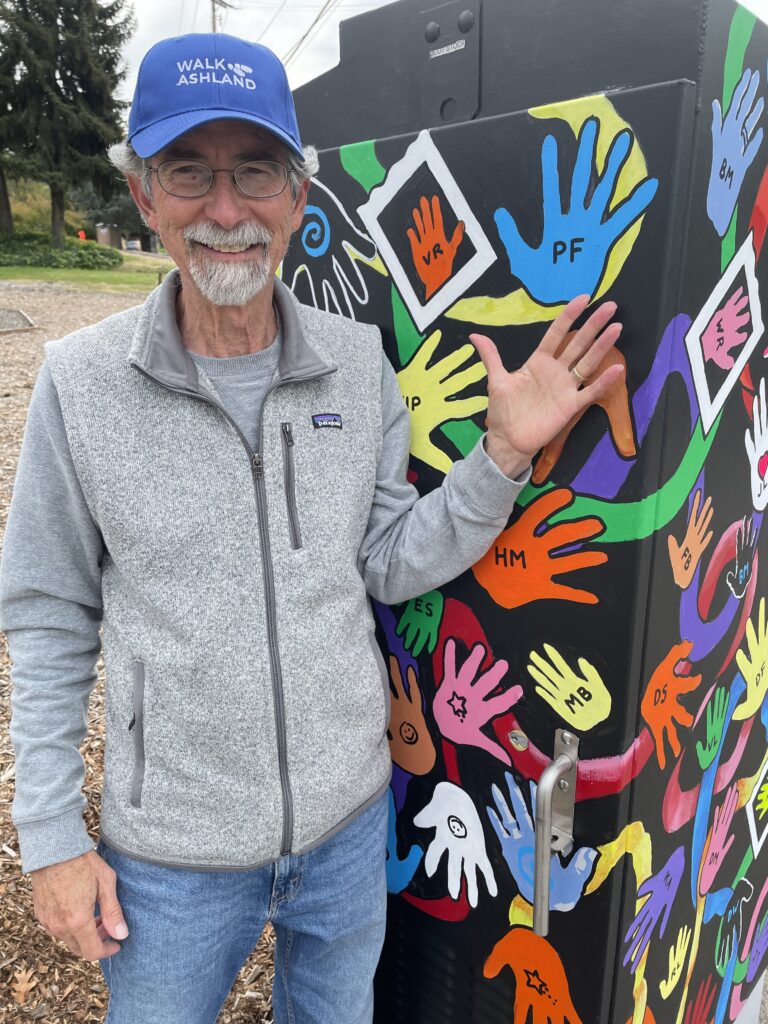
By the time painting was complete, the handprints of 107 community members (plus one dog and one cat) became part of the artwork! For most of the handprints, you will see initials of “the person attached to the hand.” My handprint is one of the 107.
My hopes
I hope that most of these 107 people will bring friends and family to see their handprints on the public artwork. Decades from now, children with handprints on the box may become parents. I can imagine them pointing out their own handprint to one of their children. If this does happen, it would be a wonderful example of a multi-generational emotional connection with public art.
The painting process
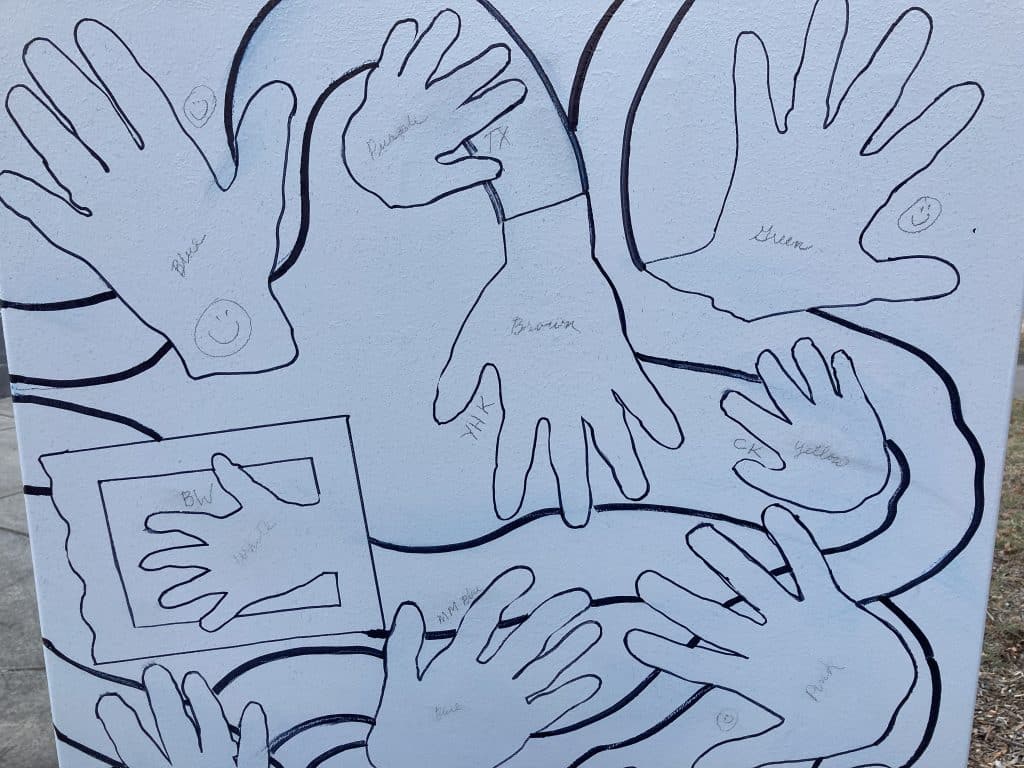
Painting the box mural took place between October 17 and 20, 2024. Adele began by drawing outlines of the complex, flowing design on all four sides of the box. When it was time to begin adding bright colors, Johanna Lear and Linda Purdom provided both assistance and companionship through the long hours. Adele said of Johanna, “I couldn’t have done it without her. She even gave me her feedback as I was designing it, which was really invaluable.”
People walking by who stopped to chat with Adele sometimes took up an offered paint brush and added blocks of color to the artwork (including me!). The dog print that found its way into the mural happened when a passerby asked Adele, “Can you include my dog JJ?”
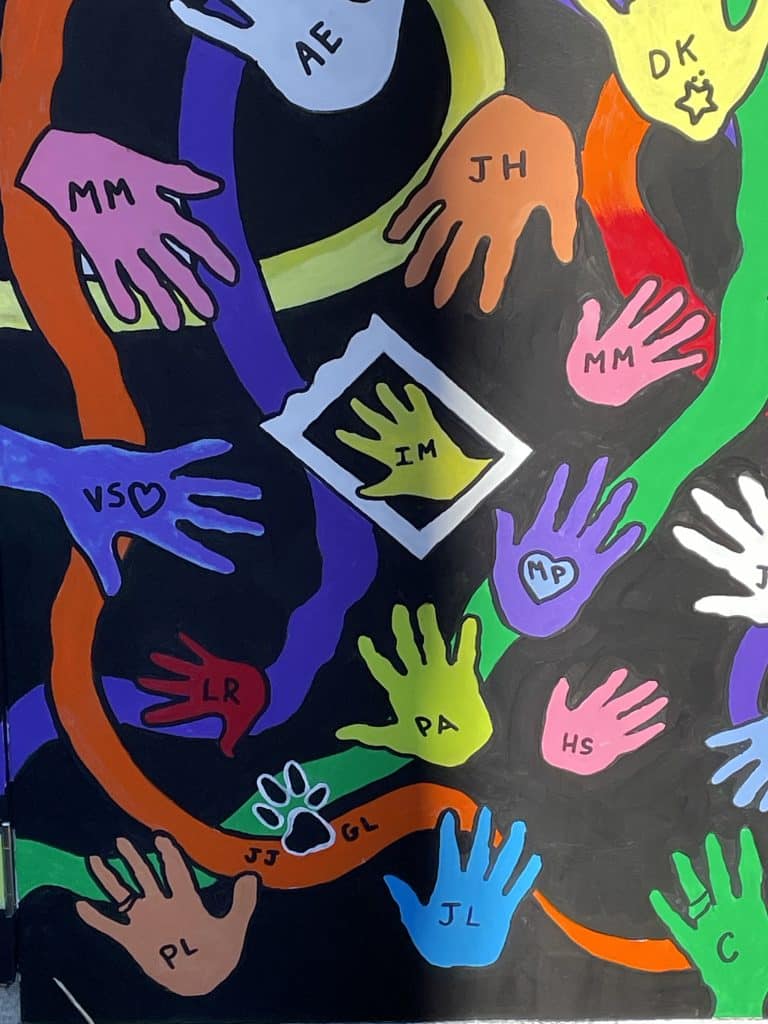
Community participation: About 115 people helped artist Adele Hiles create this artwork! For most, it was a handprint, while seven or eight assisted with painting.
Local business support: Thank you to Central Art Supply. Adele purchased paints and supplies at Central Art Supply in Medford, which generously offered a significant discount to the Public Arts committee for this project.
Adele’s evolution as an artist
Adele remembers a life-changing day when she was in third or fourth grade. “I did a drawing that my teacher thought was outstanding enough to display in a special location in the classroom, and I felt very proud of that. It made me feel something I hadn’t known about myself before then – that I was really good at something.”
She received support for creative pursuits from her mother, then studied art at high school and college. She received a Bachelor of Fine Arts degree at San Diego State University, eventually working with stained glass as a living.
Other art by Adele Hiles
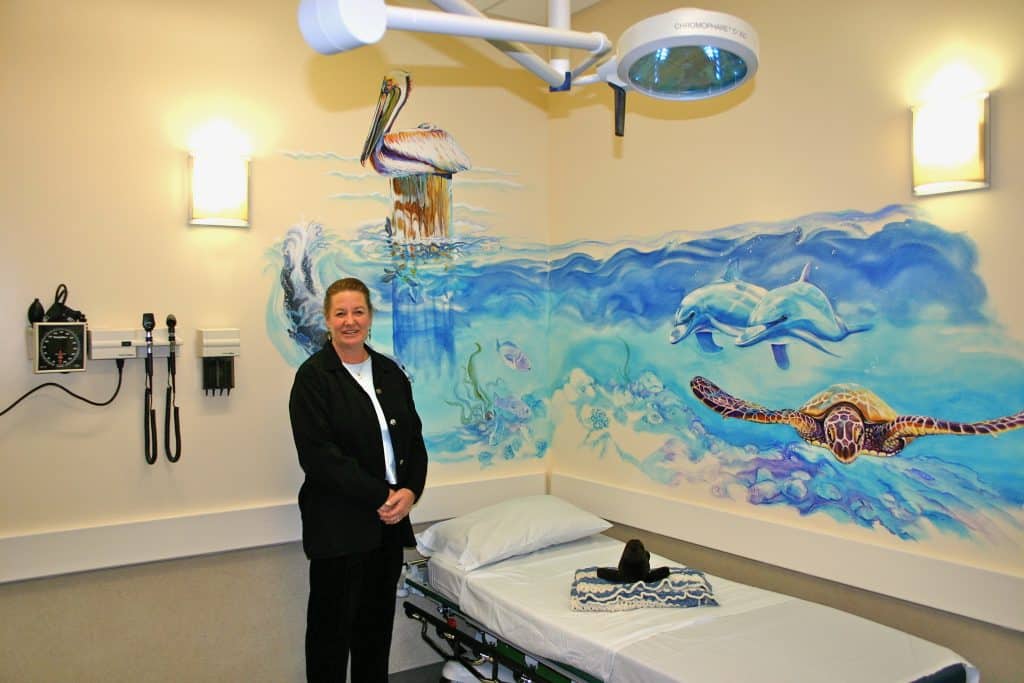
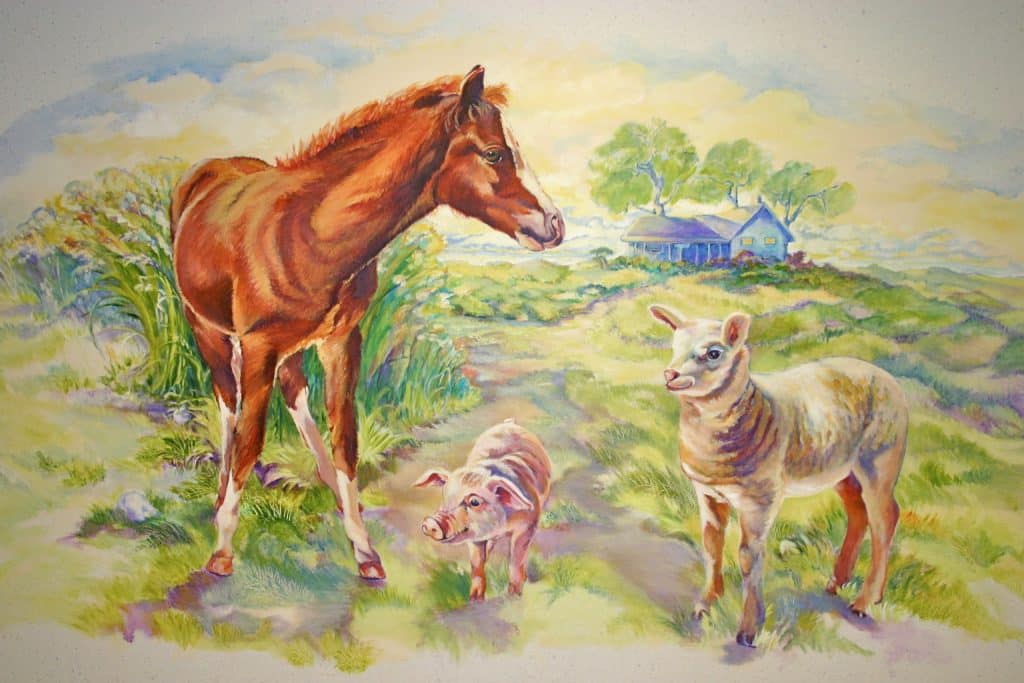
As you can see from these images, people who go to Asante Hospital in Medford will find uplifting artworks painted by Adele around the year 2000. These nature scenes were commissioned for four ER exam rooms used mostly by children.
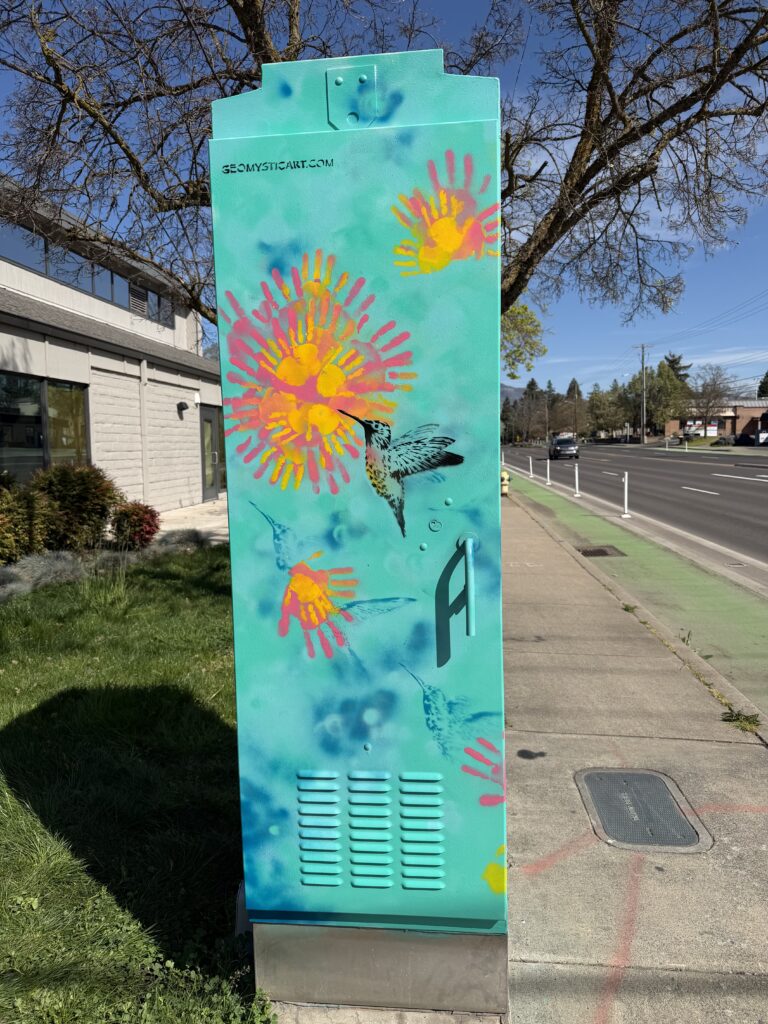
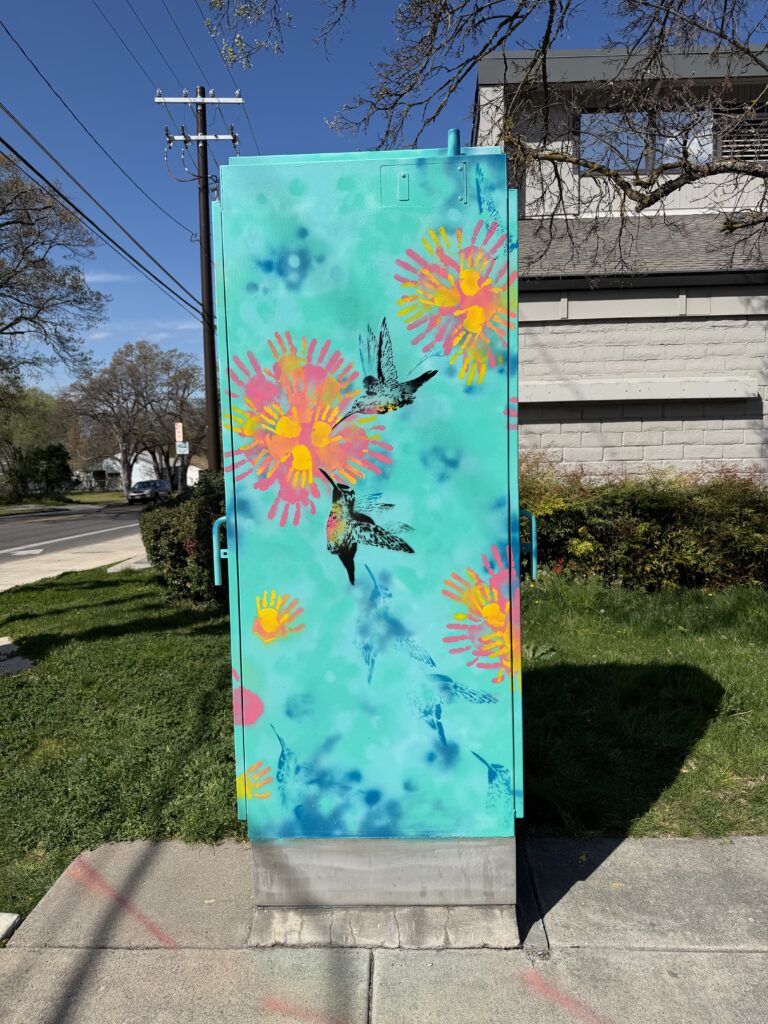
“Pollination Station” – Artist Dylan Fram
When did you become an artist?
I like to ask: “When did you first think of yourself as an artist?” Dylan responded, “I’ve been drawing since I was a young kid. I grew up on the Big Island of Hawaii. So nature was probably my first source of inspiration. Surf culture was very prevalent on the island. And there are a couple artists that were associated with the 80s and 90s skating and surf culture that I was really inspired by. One guy was named Jim Phillips, who did a lot of work for Santa Cruz skateboards. And then another artist named Steve Nazer, who did graphics and cartoons for a surf board company called T&C, which stood for Town and Country.”
Dylan told me he has lived in Oregon for many years, both in Portland and Ashland. He has “paid the bills” for the last 20+ years as a tattoo artist, most recently working at the tattoo shop called Ritual Evolution, next door to Brothers Restaurant on North Main Street. He also does a lot of graphic art and digital art, designing logos and album art for bands, as well as posters for concerts. He would also like to do more mural painting, if that is possible.
The painting process
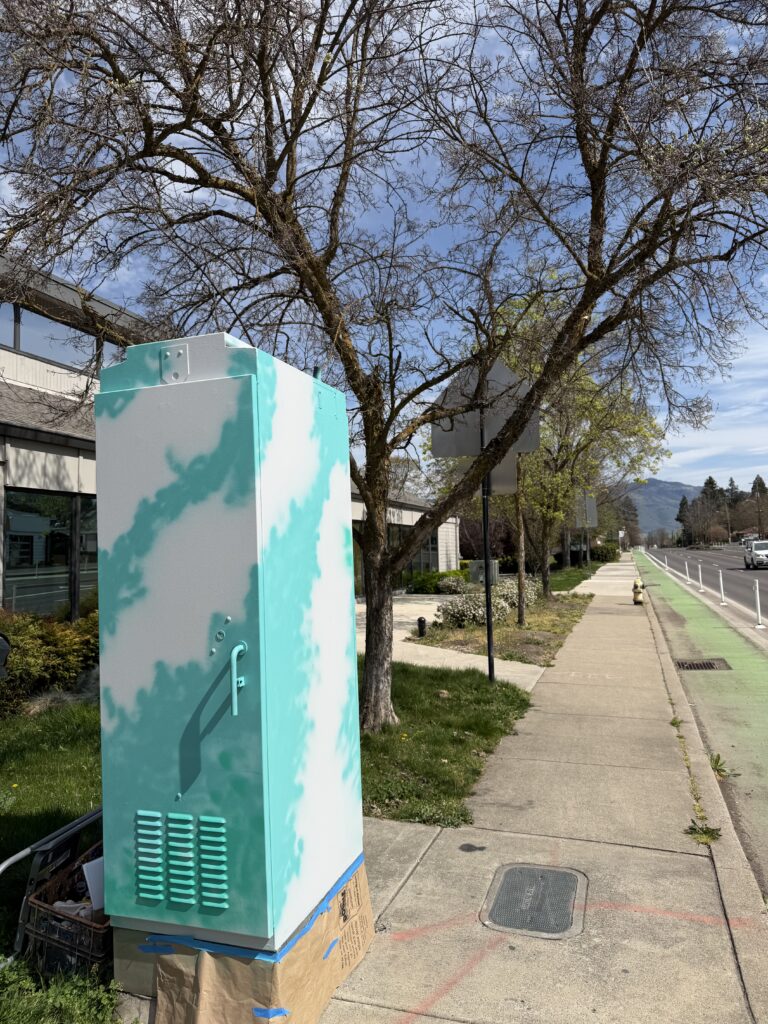
Unlike other traffic signal boxes that have been painted with brushes, Dylan’s was done with spray painting. He developed spray painting and multi-media art skills through decades. “I’ve been working with spray painting for a long time. since I was a teenager. That’s how I started painting walls was with spray paint. Then I got into painting canvases and wood panels that I would later go on to show in art galleries and even coffee shops.”
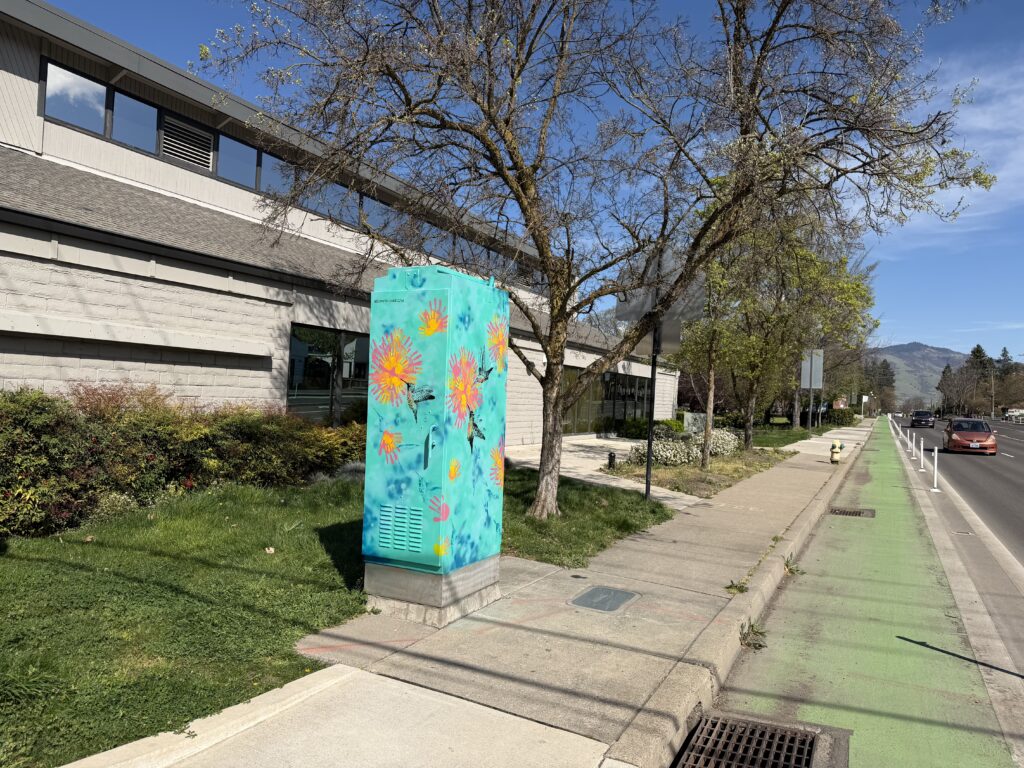
Dylan went to David Schirner’s fifth grade class at Walker School and got handprints from many of the students. If you look closely at the box artwork, you’ll see that the hummingbirds are looking for nectar in “flowers” created from student handprints.
He thought about screen printing or projecting the hummingbird designs onto the box, but both methods seemed more complex than necessary for this painting project. He concluded that “stenciling and spray paint was probably the most cost effective way to get it done. So that’s what led me to deciding to do it all in spraying. And it’s a very durable paint. It can stay vibrant for decades.”
Community participation: The students in David Schirner’s fifth grade class at Walker School became part of the artwork through giving their handprints to Dylan.
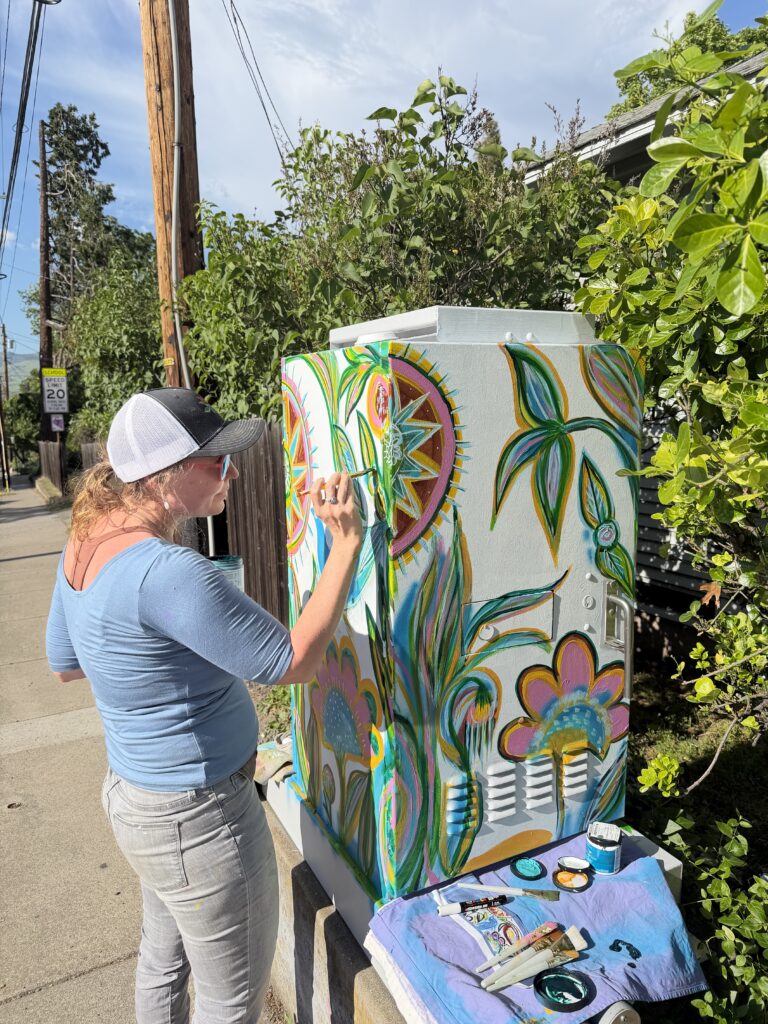
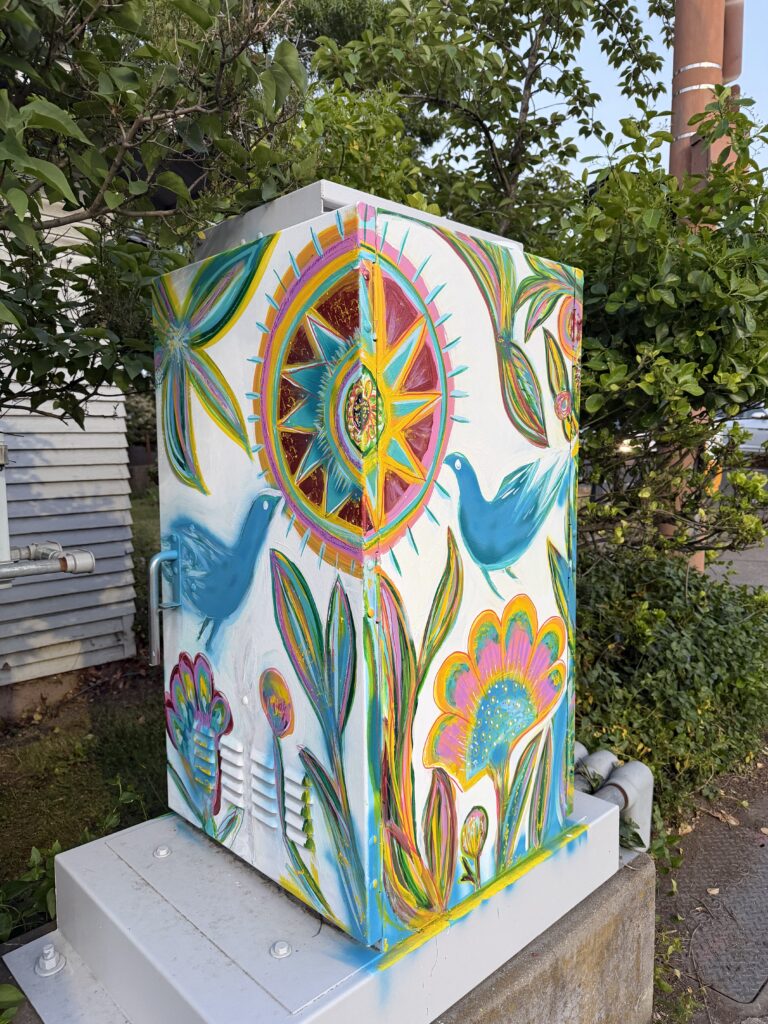
“ONE DAY” – Artist Jessica Lee Findleton
When did you become an artist?
Jessica told me: “I first thought of myself as an artist when I was 11 years old. I used to spend time underneath a willow tree beside the South Fork of the American River in Lotus, California. That was my little world. I remember the feeling of being there, surrounded by water, trees, light, and all the things that didn’t require words. I think that’s where my relationship with art and nature really began.”
Living into being an artist
As an adult, art has become a way for Jessica to explore and express, as she put it so powerfully, “the beautiful, messy business of being alive.” In her words: “My work has always been connected to the natural world, the human experience, motherhood, heartbreak, resilience, and the beautiful, messy business of being alive. I use color, texture, found materials, and organic forms to explore those relationships. I suppose I’ve always been an artist. It just took me a while to understand that making art wasn’t simply something I enjoyed doing. It was something I needed.”
The painting process
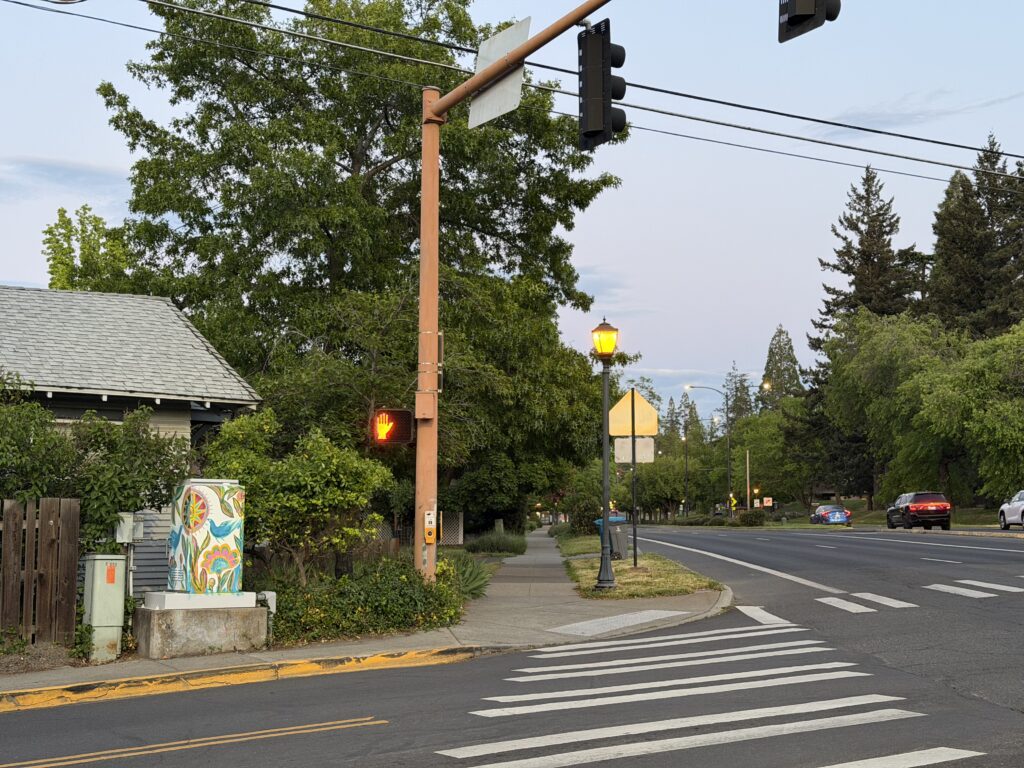
Here’s how Jessica described her inspiration for this design: “Springtime. The turn of the sun and flowers. And joy — bringing color to this corner.” I think she succeeded in bringing her vision to the physical world.
Community participation: The plan was for Ashland High School art students to assist Jessica with painting this box. However, she was not able to work out the timing with them, so she ended up painting it herself.
Local business support: Thank you to Central Art Supply. Jessica purchased paints and supplies at Central Art Supply in Medford, which generously offered a significant discount to the Public Arts committee for this project.
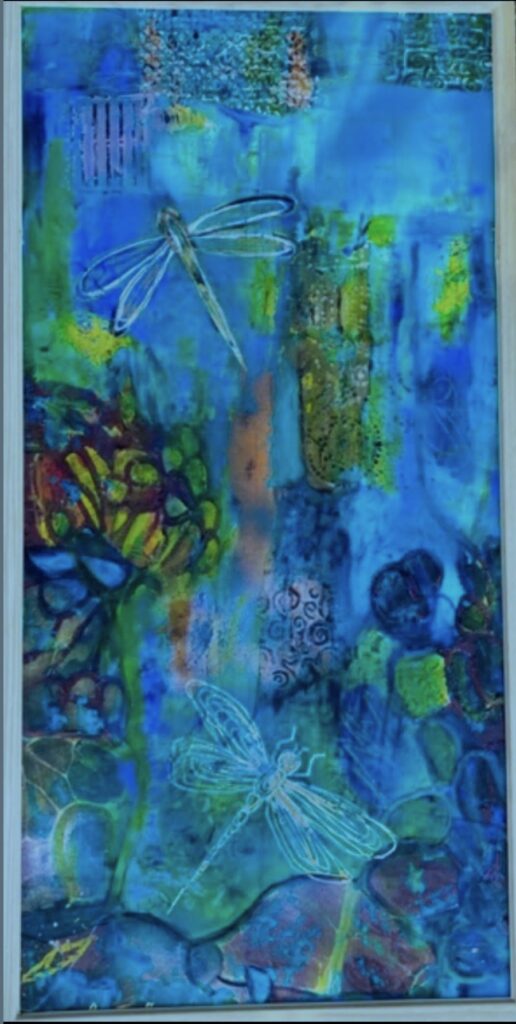
A poem, and other art, by Jessica
Studio Morning
A cozy, soft day at the studio
Sunlight spills through open windows,
petals lean toward the breeze.
Fresh flowers hum beside the brushes,
vinyl spins its slow golden circle,
and time forgets itself
just peace,
just color,
just me,
creating
Jessica Lee Findleton
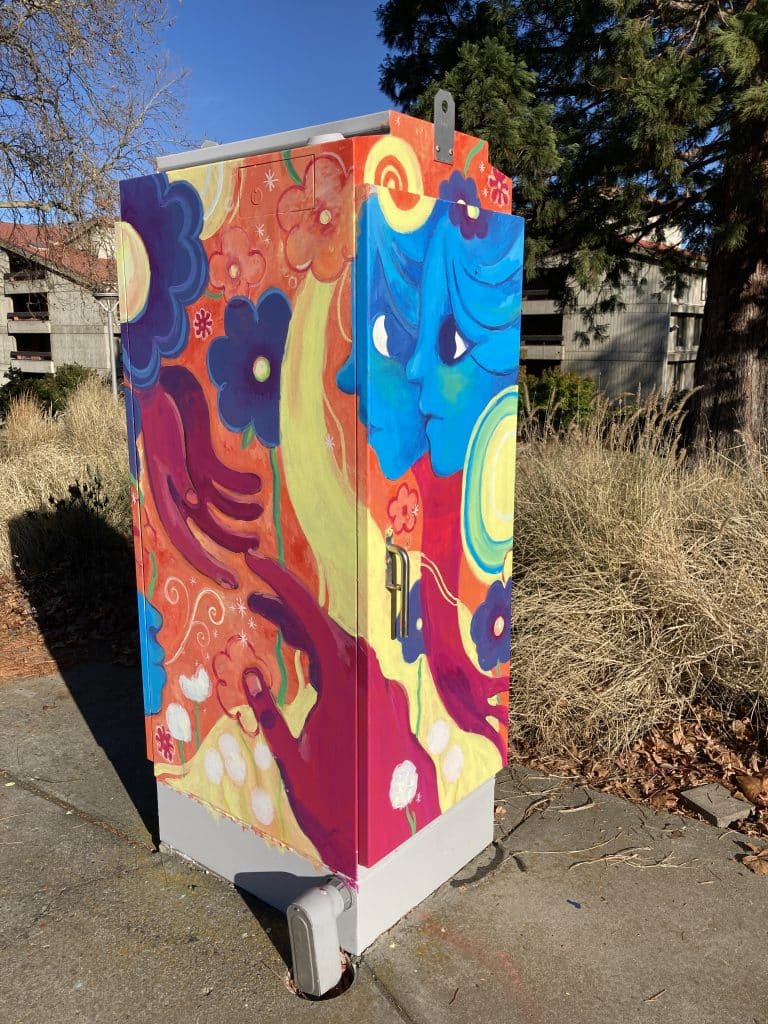
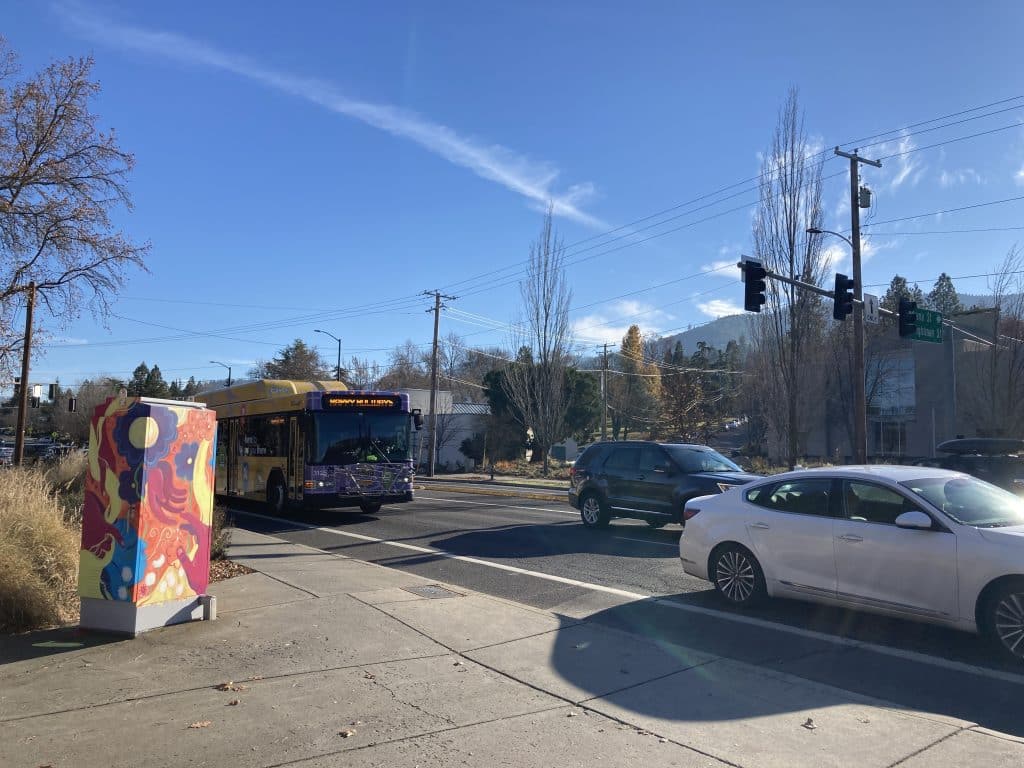
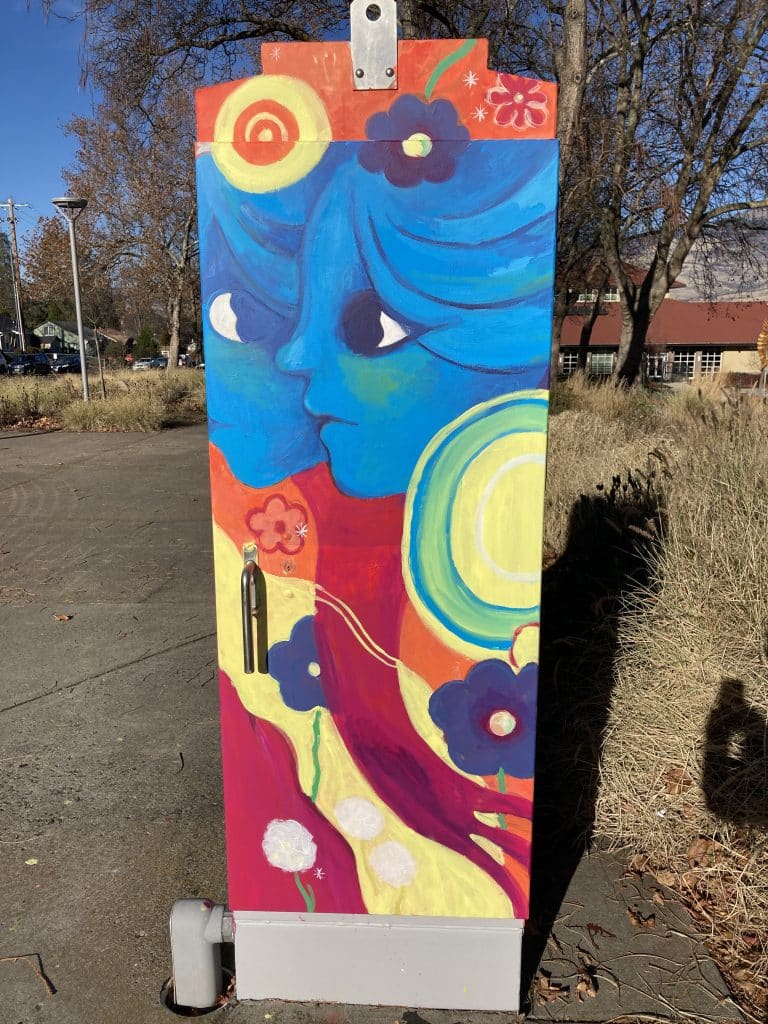
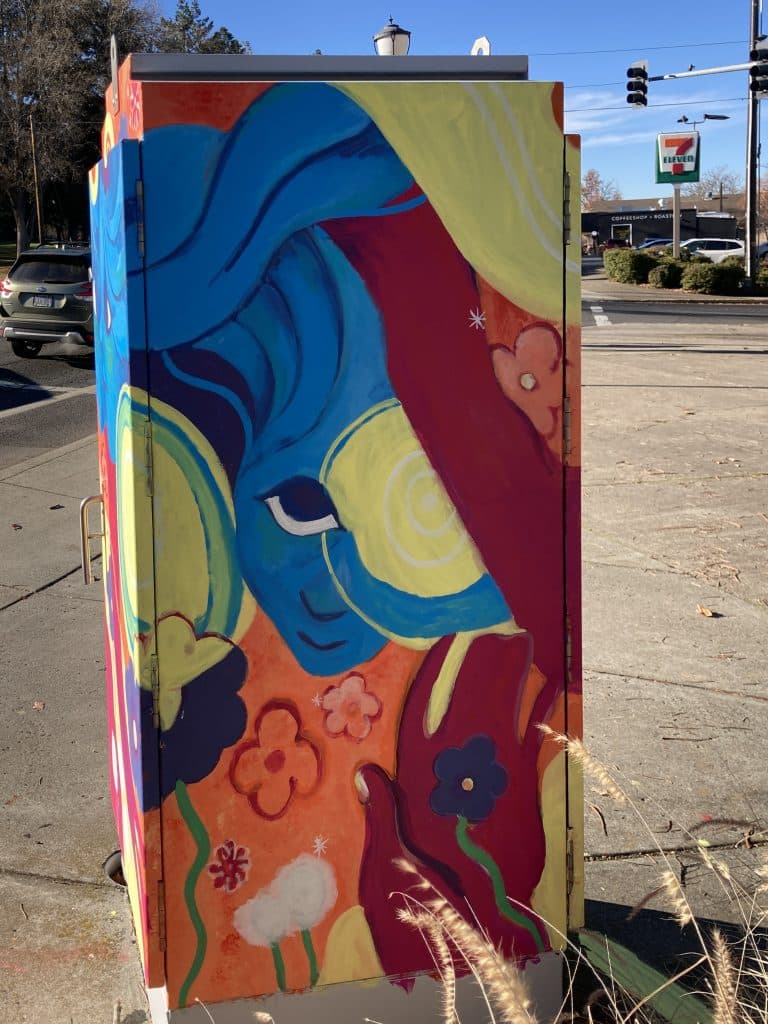
“Hands and Faces” – Artist Sidney Reha (the artwork that is no longer there)
Why the box artwork is no longer there
Sidney Reha’s beautiful design is no longer on the box at this corner. All we have left is my photos of it. In winter of 2024-2025, Oregon Department of Transportation informed the City of Ashland that they would be inspecting all traffic signal boxes in Southern Oregon, and replacing some of them. Sadly, the box Sidney painted is one that needed to be replaced, and it’s once again just a plain box at that corner.
Even though the artwork is no longer there, I will show you photos of it, and tell you stories about Sidney and the creation of the artwork.
When did you become an artist?
In response to my question, Sidney painted this word-picture from her pre-school years, a time when she was already drawing. “My mom once told me that when I was really little, I would say things like I was going to be “a veterinarian or a marine biologist.’ But the preschool teacher told my mom, ‘That kid’s going to be an artist.’ I guess it was apparent to everybody but me for a long time.”
Since those early years, she has learned that being an artist is an integral part of her identity. Growing up, she didn’t have access to very many art materials, so she did a lot with a little. Once into the Southern Oregon University art program, she blossomed with new opportunities and helpful teachers. Sidney Reha graduated from SOU in 2024 with a B.F.A. degree (Bachelor of Fine Arts). Now she is into the working world, newly learning how to balance passion for art with hours at paying jobs.
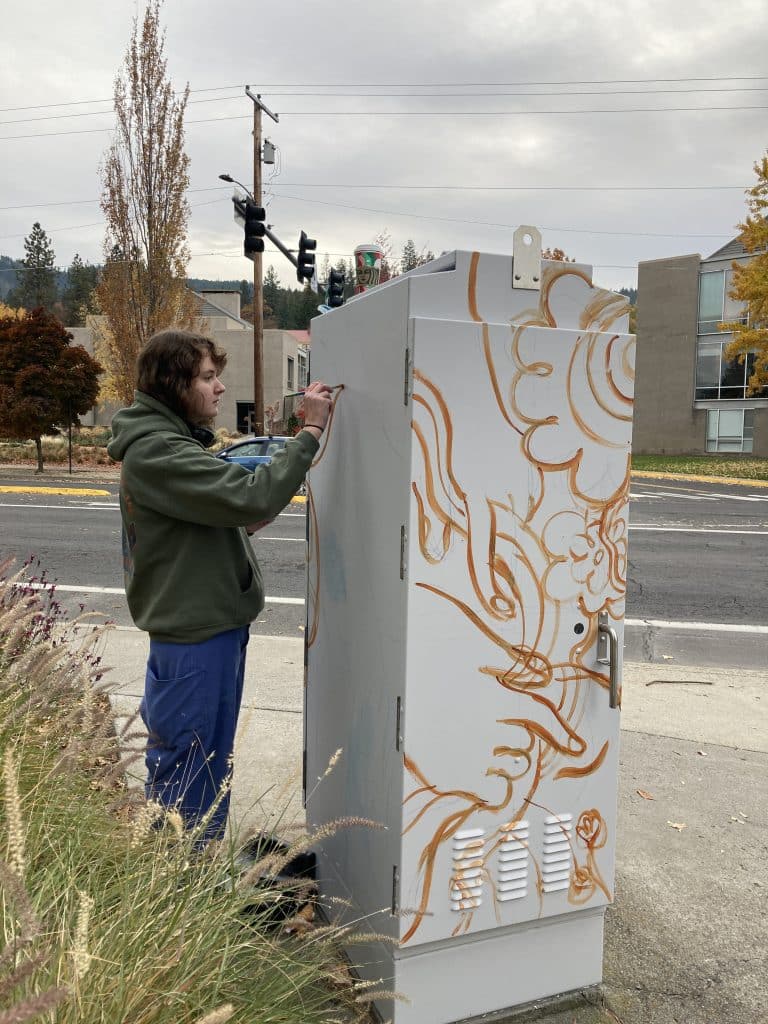
Painting the box: Sidney’s weather challenges
Sidney began sketching the design on November 10, a cool, cloudy Sunday with a high temperature of 59°. The first day turned out to be the warmest of her painting days. By December 1, the final day of painting, the high temperature was only 39°!
Cold weather wasn’t the only challenge of painting outside in November. Autumn rains came during the second half of November; it rained on nine of the days between November 10 and December 1. Lack of progress due to unpredictable starts and stops made it difficult to enter an artistic flow, even stimulated self-doubt. By the end, though, as all the pieces of the puzzle came together, she was happy with the outcome.
Sidney’s final thoughts on the process
Sidney reflected on the impact this project had on herself as a usually solitary and self-contained artist and personality. She painted at a very busy intersection, with a constant stream of students, staff and community members walking by. She described her encounters with passersby, including houseless folks who stopped to talk or paint with her, as especially meaningful.
“Because I was working on something out in the open, it was an invitation to discuss things. I had conversations about art and life with a lot of those people, really fulfilling and incredible.”
Sidney Reha
Community participation: Only about seven people helped artist Sidney Reha to create this artwork. The cold weather discouraged some planned collaborators from coming out. In addition, she had difficulty involving SOU art teachers and students. Her most faithful painting assistants were three SOU art student friends, especially Brenna Culbert.
Local business support: Thank you to Central Art Supply. Sidney purchased paints and supplies at Central Art Supply in Medford, which generously offered a significant discount to the Public Arts committee for this project.
Community-assisted public artworks: what have we learned so far?
In 2022, Public Arts committee members had multiple discussions about ways to increase community involvement in public art. Their concern was that although most people enjoy looking at public art (at least some of it), many lack an emotional connection with any of the public artworks. During these discussions, the belief and hope was that people who participate in creating an artwork develop an emotional connection with that artwork, which may then extend to a greater appreciation for public art in general.
The committee summarized the challenge in two questions:
How can we boost participation in public art?
How can we increase appreciation for public art?
The large traffic signal boxes at many Ashland intersections were identified as a potential “canvas” for “neighborhood” or “community” painting projects. Most of these boxes are about six feet tall, and about two feet by two and one-half feet on their sides. That adds up to a total paintable area of about 54 square feet – definitely a large “canvas” for a mural!
The Oregon Department of Transportation had previously given other Southern Oregon towns the ability to paint or wrap artworks on the traffic signal boxes in their communities. They gave the same approval to the City of Ashland in March 2023, with twenty traffic signal boxes on a list to be painted during the next seven to ten years.
Overview: Steep learning curve
The process was a steep learning curve for the artists, as well as for the Public Arts committee, city liaison and volunteer helpers. It took two and one-half years from the first discussions about painting these boxes to completing the first three artworks.
There was so much everyone learned or relearned: (1) learned how to navigate Oregon Department of Transportation rules; (2) relearned the many steps involved in choosing an artist for each artwork; (3) dealt with preparing the boxes for painting; (4) relearned how to work with local paint stores on a public art project; (5) began learning how to find and involve a small community of people to help paint each box; (6) and finally, we are still learning ways to inform Ashland residents about the meaning and joy embodied in each community-painted traffic signal box.
Wrap-up: Past history, vision for the future
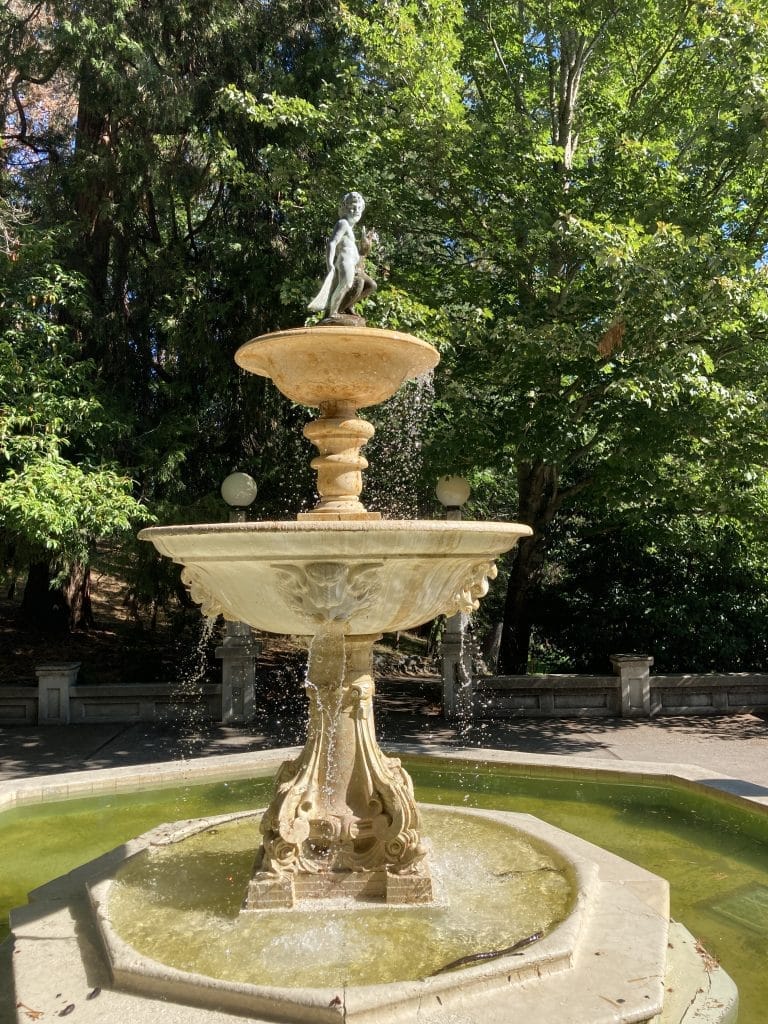
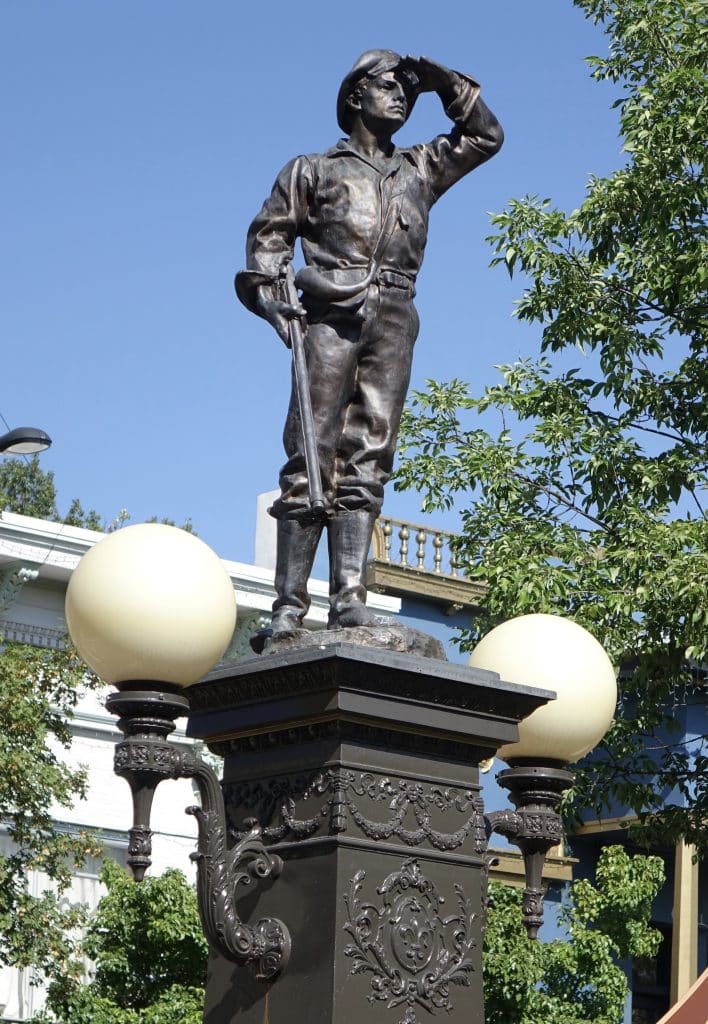
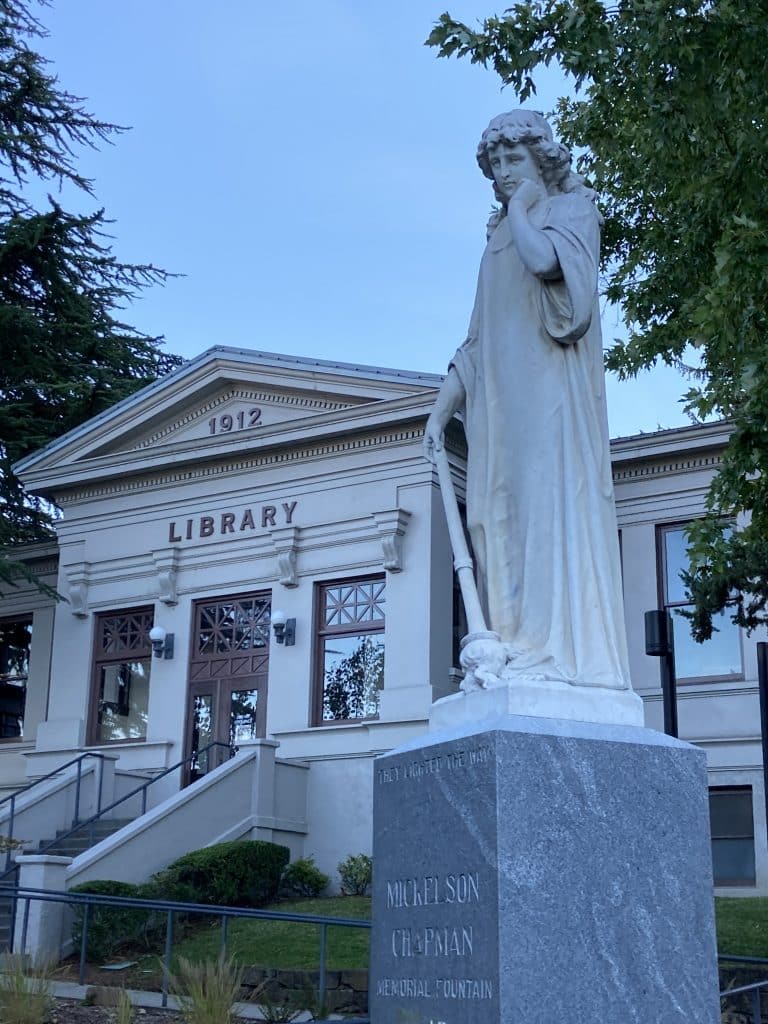
Our town has a long history of public art. You are probably familiar with three early 1900s public artworks: the Butler-Perozzi Fountain in Lithia Park, Pioneer Mike in the Plaza and the Mickelsen-Chapman Memorial Fountain in front of Ashland Library. Our city public art collection has grown considerably since the Public Arts committee was formed in 2003 by the City Council. Now, in 2026, many new public art projects are underway. This multi-year traffic signal boxes project is one of them
There are about thirteen more boxes to paint during the next five years or so. By the time they are all painted, hundreds of Ashland residents will have helped to create these public artworks. Counting just their families and friends, thousands of residents have the potential to be touched emotionally or intellectually by the painting process.
Being human, we tend to take for granted what we are familiar with. For example, we might travel to another country to see “famous” art, but we so easily take for granted lovely art we see regularly in our own town. If we stop for a moment to think about it, we know that art, whether we see it as a tourist in another city or here at home, has the ability to move us emotionally and spark us intellectually.
Ultimately, the success of this “community-assisted public artworks” project will be measured by how many people are inspired, even a little, to more deeply appreciate the wide variety of public art that surrounds us in our daily lives.
Stay tuned for more traffic signal boxes to be painted in 2027 and beyond!
Bonus for you:
Our locally produced “Power of Public Art” video is filled with powerful visuals
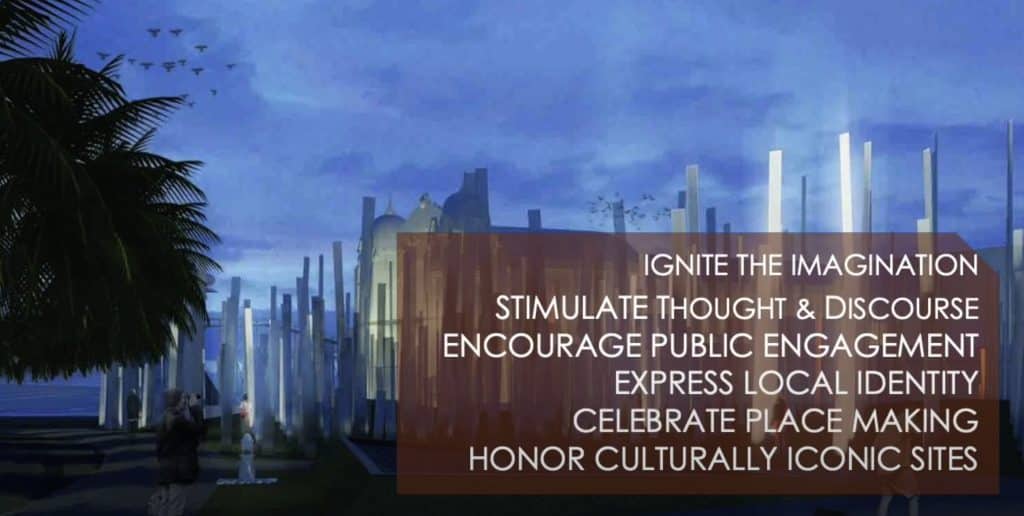
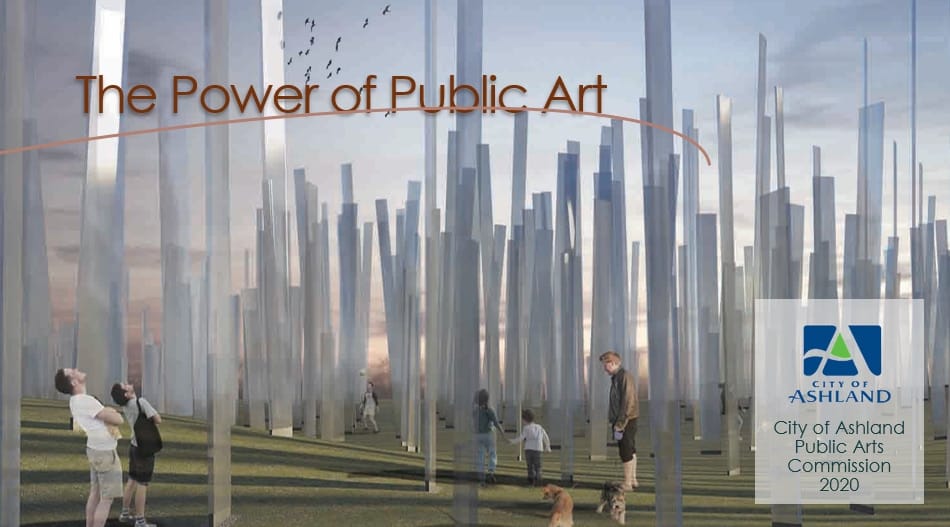
CLICK HERE for a beautiful video called “Power of Public Art,” prepared by Ashland’s Public Arts committee in 2021. It is filled with powerful visuals that show how public art helps to:
References:
Christopherson, Juniper “Junie.” Interview and personal communications, 2024.
Findleton, Jessica Lee. Interview and personal communications, 2026.
Fram, Dylan. Interview and personal communications, 2026.
Hiles, Adele. Interview and personal communications, 2024.
Reha, Sidney. Interview and personal communications, 2024.
No Comments